Table of Contents
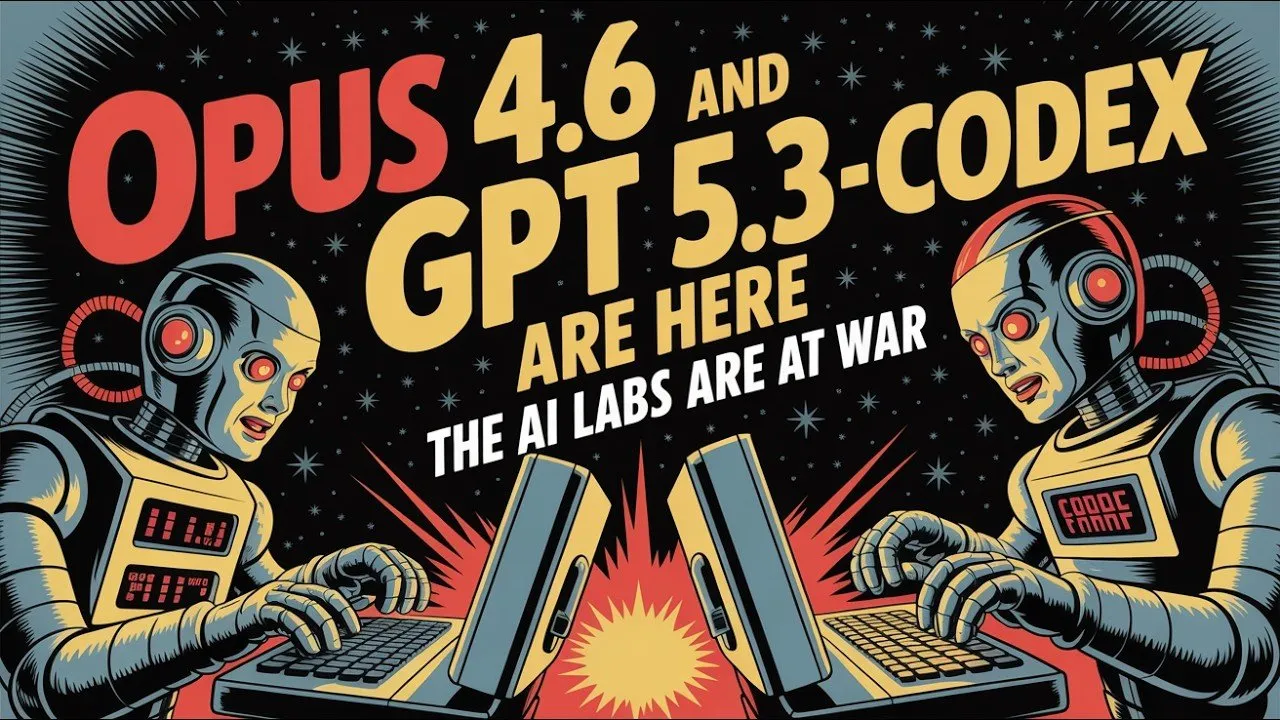
Anthropic and OpenAI escalated the artificial intelligence arms race this week by releasing their latest frontier models—Claude Opus 4.6 and GPT-5.3 Codex—within 20 minutes of one another. This simultaneous launch underscores a strategic pivot by the industry’s leading laboratories, positioning autonomous coding agents not just as developer tools, but as the foundational technology for broader enterprise knowledge work.
Key Points
- Simultaneous Launch: Anthropic’s Claude Opus 4.6 and OpenAI’s GPT-5.3 Codex were released minutes apart, signaling intense competition in the coding agent sector.
- Anthropic’s Focus: Opus 4.6 introduces a 1-million-token context window and "Agent Teams," a feature designed for complex, multi-agent coordination and parallel task exploration.
- OpenAI’s Strategy: GPT-5.3 Codex prioritizes speed and efficiency, boasting a 3x improvement in token usage and a claimed state-of-the-art score of 77.3% on Terminal Bench 2.0.
- Workflow Shift: Both companies are driving toward an "agent-first" development cycle, where humans orchestrate autonomous systems rather than writing individual lines of code.
The Battle for Coding Supremacy
The near-simultaneous release of these models highlights a developing narrative in the AI sector: coding capabilities are becoming the proxy for general functional intelligence. While previous model generations competed on general knowledge, the current "war" between Anthropic and OpenAI is being fought over which model can best function as an autonomous employee.
Industry observers noted the aggressive timing. Latent Space, a prominent tech publication, remarked on the intensity of the rivalry:
If you think the simultaneous release of Claude Opus 4.6 and GPT-5.3 Codex is sheer coincidence, you're not sufficiently appreciating the intensity of the competition between the leading two coding model labs in the world right now.
Anthropic’s Opus 4.6: Orchestration and Context
Anthropic’s release of Opus 4.6 doubles down on the model's reputation for high-level reasoning and "human-like" interaction. The standout feature is the expansion of the context window to 1 million tokens, addressing a critical bottleneck for enterprise users working with massive codebases or extensive documentation.
Alongside raw capacity, Anthropic introduced "Agent Teams." Moving away from the industry terminology of "swarms," this feature adds a coordination layer that allows multiple instances of Claude to collaborate. According to Anthropic, this is distinct from simple sub-agents; it enables parallel exploration where agents can share findings and challenge one another's logic.
In terms of performance, the model includes "adaptive thinking," allowing it to gauge context clues to determine the necessary reasoning effort for a specific task. Early testers report significant gains in complex workflows. Box and Levy reported that Opus 4.6 represented a 10% performance jump over its predecessor on their most difficult knowledge work tasks.
OpenAI’s GPT-5.3 Codex: Efficiency and Self-Improvement
OpenAI’s strategy diverged slightly by releasing the coding-tuned "Codex" variant of GPT-5.3 prior to the general model. This decision signals that OpenAI views coding capabilities as the core engine for future model development. The company revealed that GPT-5.3 Codex was instrumental in its own creation, used by the team to debug training and manage deployment.
Max Stober from the ChatGPT team highlighted the model's autonomy, noting that the recently announced support for MCP apps was built entirely by GPT-5.3 Codex:
Zero lines of code written by hand. Most times the Codex CLI worked autonomously for hours and implemented parts of this first try.
On the metrics front, OpenAI claims significant leads. The company reported a score of 77.3% on Terminal Bench 2.0, surpassing Opus 4.6’s 65.4%. Perhaps more critical for enterprise adoption is the model's efficiency; GPT-5.3 Codex is reportedly three times more token-efficient than previous iterations, significantly lowering the cost of continuous, autonomous operations.
Market Reaction and Developer Sentiment
Despite OpenAI’s lead in raw benchmarks, early developer sentiment appears to favor Anthropic’s user experience. In a poll conducted by developer Ryan Carson with over 700 respondents, 53.3% indicated they would code with Opus 4.6 for the week, compared to 24.9% for Codex 5.3.
However, the gap between the models is narrowing, leading to a convergence in utility. Dan Shipper of Every suggests that the distinction between a "coding agent" and a "general work agent" is vanishing. The traits that make a model good at software development—planning, tool use, and parallel execution—are identical to those required for high-level white-collar knowledge work.
Latent Space offered a split verdict on the current landscape: OpenAI currently holds the edge in raw coding speed and cost-efficiency, while Anthropic retains dominance in orchestration and long-context tasks.
Implications: The Move to Agent-First Development
The release of these models marks a definitive transition from AI as a "copilot" to AI as an autonomous agent. This shift is necessitating a restructuring of technical workflows. Greg Brockman, President of OpenAI, stated that the company is actively retooling its internal teams toward "agentic software development."
Brockman outlined an aggressive timeline for this transition:
By March 31st, we're aiming that for any technical task, the tool of first resort for humans is interacting with an agent rather than using an editor or terminal.
This "agent-first" philosophy suggests a future where human engineers focus on architecture, safety evaluation, and orchestration, while the actual generation and debugging of code are delegated entirely to models like Opus 4.6 and GPT-5.3. As these tools become capable of operating for hours without human intervention, businesses will likely need to rethink resource allocation and project management metrics to align with this new operational reality.