Table of Contents
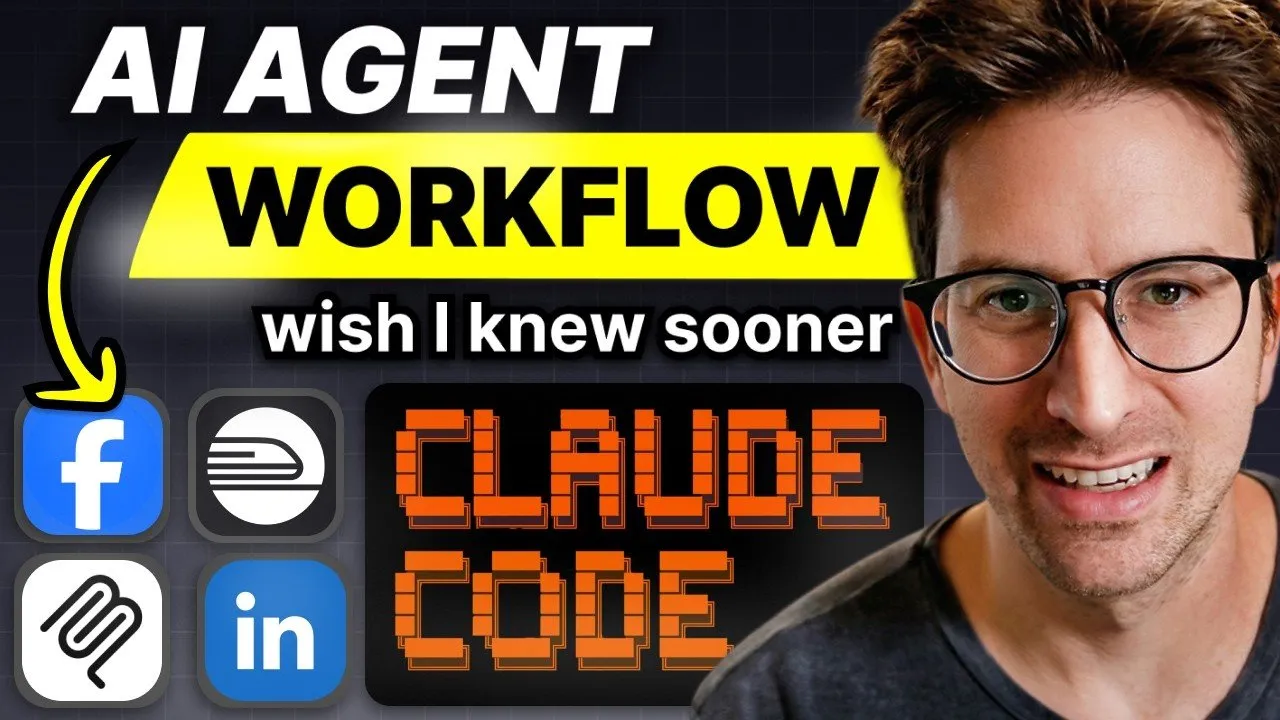
The marketing landscape is undergoing a fundamental shift from manual campaign management to what growth experts are calling GTM (Go-To-Market) Engineering. Instead of spending hours in Figma or manually uploading spreadsheets to ad managers, a new breed of marketers is using AI agents and the Model Context Protocol (MCP) to build autonomous machines that handle the "middle work." By leveraging tools like Claude Code and Railway, growth leaders are now orchestrating complex workflows that scrape data, generate creative assets, and optimize budgets in real-time, effectively replacing entire departments with high-performance code.
Key Takeaways
- Shift to GTM Engineering: Marketing is moving away from manual button-clicking toward building cascading workflows for data enrichment and outbound sales.
- API-First Strategy: Robust APIs are now more valuable than user interfaces; software selection should prioritize endpoint flexibility to allow agents to interact with the data.
- Autonomous Ad Management: AI agents can now handle the entire lifecycle of a Facebook ad campaign, from bulk creative generation to pausing low-performing ads based on real-time CPM data.
- The Agent Jockey Role: The future marketer acts as a "jockey," managing multiple agent instances simultaneously to accomplish tasks that previously took weeks in a matter of minutes.
The Evolution of GTM Engineering
The term GTM Engineering, originally coined by the team at Clay, has evolved beyond simple data enrichment. It now represents the practice of using agent harnesses like Claude Code to automate the manual labor historically performed by junior marketers. This approach treats marketing operations as a software engineering problem rather than a creative one.
From Manual Work to Polishing Outputs
In this new paradigm, the marketer's job is to have the idea, pass it to an agent harness, and then polish the end product. This allows for scale that was previously impossible. For example, rather than designing 50 ad variations in Figma, a marketer can use React components and agents to generate 1,000 variations based on real-world pain points scraped from social media.
The Importance of Technical Vocabulary
Domain knowledge remains the ultimate superpower. While the AI does the heavy lifting, the quality of the output depends on the user’s ability to describe the problem using specific industry lexicons. A marketer with 20 years of experience has the vocabulary to guide an agent toward high-converting creative in ways a novice cannot, even with the same AI tools.
Building the Modern Growth Stack
To build a $145K marketing machine, you must move beyond the browser and into the terminal. The foundational piece of this setup is a central repository—a folder that serves as the "brain" for your growth agents. This folder contains environment files with API keys for every tool in the stack, from CRM systems to ad platforms.
Core Tools for Agent Orchestration
- Claude Code: The primary agent harness used to build personal software and execute workflows.
- Railway: A cloud platform used to spin up on-demand databases (Postgres) and servers to run agents in perpetuity.
- Instantly.ai: Used for managing cold email campaigns at scale via API.
- Phantom Buster: Essential for scraping LinkedIn engagers and other social data.
- Graft MCP: A Model Context Protocol that connects AI agents directly to live data warehouses, bypassing the limitations of standard UIs.
"Everything that used to be the middle work that we would do, all of anything that I would do to touch the keyboard, I'm now passing it on to some type of agent harness."
Automating the Facebook Ads Lifecycle
One of the most powerful applications of this stack is the end-to-end automation of paid social media. By treating ad creative as code—specifically React components—marketers can generate "ugly" but high-converting ads that speak directly to customer pain points found on Reddit or Twitter.
Bulk Creative Generation
Using the Perplexity API, agents can scrape social platforms to identify exactly what potential customers are complaining about. These pain points are then fed into a bulk ad generator that creates thousands of image variations. Because these ads are built with code rather than design software, they cost almost nothing to produce and can be iterated upon instantly.
Real-Time Optimization via MCP
The real power lies in the feedback loop. By using an MCP to connect Claude Code to a Facebook Ads data warehouse, the agent can analyze live performance metrics. It can identify which ads have the highest CPMs and automatically pause them, while simultaneously bumping up the budget for winning creative. This creates a self-healing, autonomous marketing funnel that operates 24/7 without human intervention.
Scaling Outbound with Agent Swarms
Beyond advertising, AI agents are revolutionizing outbound sales and distribution. Cody Schneider describes a process of "agent jockeying," where he manages 10 to 15 windows of Claude Code simultaneously, each performing a different specialized task to build a larger "agent swarm."
The LinkedIn Engagement Funnel
A typical automated workflow involves a Slack command that triggers a series of agent actions. A team member drops a LinkedIn post URL into Slack; an agent then uses Phantom Buster to scrape every person who engaged with that post, enriches their data via the Apollo API, verifies their email through MillionVerifier, and adds them to a custom cold email sequence in Instantly—all within seconds.
On-the-Fly Software and Databases
The future of work involves "on-the-fly" infrastructure. If a marketer needs to analyze a massive dataset, they can have an agent spin up a Postgres database on Railway, push the data in, perform the analysis, and then spin the database back down. This removes the need for traditional, clunky SaaS interfaces and allows for hyper-efficient, custom-built solutions for one-off problems.
"The epiphany I had was like on-the-fly UIs, on-the-fly databases, like on-the-fly software is going to become the standard for these people that are working at the forefront of this."
The Strategic Shift: APIs Over UIs
As marketing becomes more automated, the criteria for choosing software are changing. In the past, marketers looked for the best user interface. Today, the most important feature is the robustness of the API. If a feature exists in the UI but cannot be accessed via an endpoint, it becomes a bottleneck for the AI agent and, consequently, for the business.
The Rise of Autonomous Marketing
Sam Altman has noted that every company will eventually become an API company. For marketers, this means that the "nice-to-have" is no longer the pretty dashboard—it is the ability for an agent to sit in a terminal and execute tasks 24/7. This shifts the focus from managing people to managing systems. Small teams and solo entrepreneurs who master these "agent swarms" can now compete with large agencies by operating with significantly lower overhead and much higher speed.
Conclusion
The transition to agent-led marketing is not just a technological upgrade; it is a total reimagining of the marketing role. While the displacement of traditional "middle work" roles is inevitable, the opportunity for those who can orchestrate these systems is immense. By moving from being a practitioner to an "agent jockey," you can build a marketing machine that is faster, cheaper, and more precise than any human-led department. The barrier to entry is no longer the size of your team, but the sophistication of your technical vocabulary and your ability to leverage the power of the API.