
Table of Contents
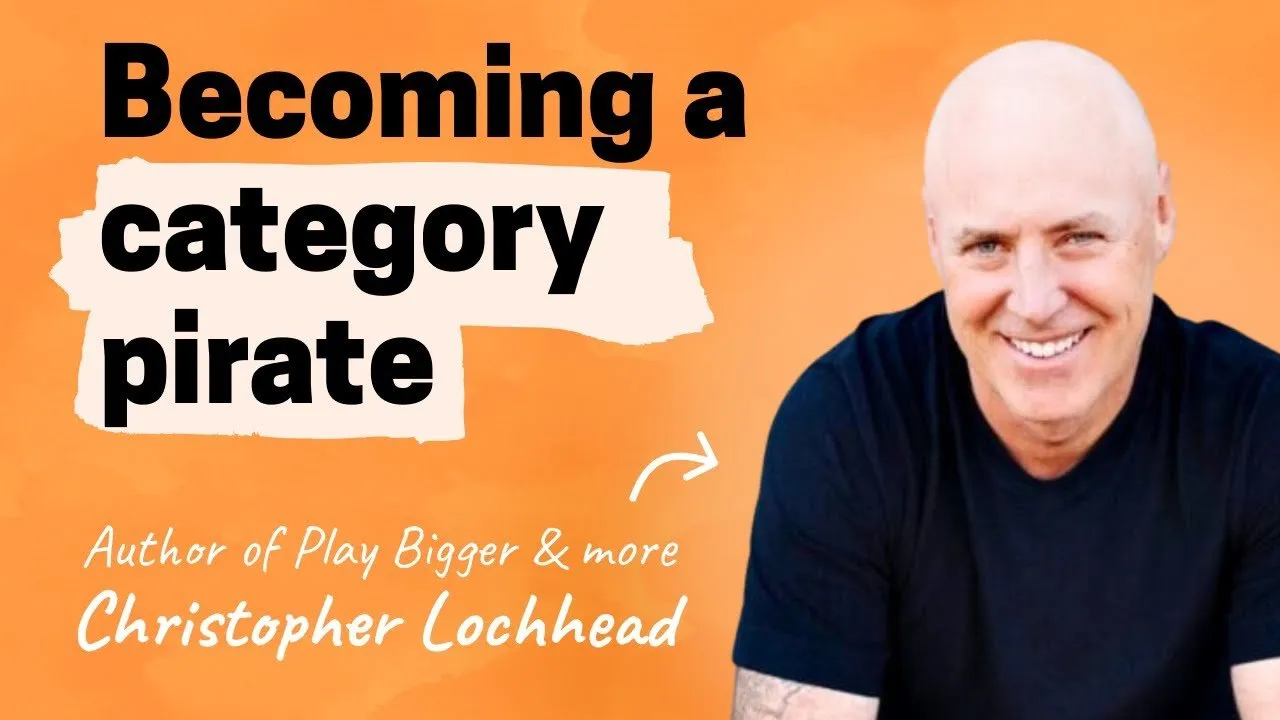
Most entrepreneurs, marketers, and creators operate under a dangerous assumption: if they build a better product, the market will beat a path to their door. They scrutinize competitors, add incremental features, and fight tooth and nail for market share. According to Christopher Lochhead, a three-time public company CMO and the "Godfather of Category Design," this is a losing strategy. The most legendary companies in history—from Apple to Picasso—did not compete. They designed entirely new categories.
Key Takeaways
- The "Better" Trap: Competing on features or price (the "better" product) fights for only 24% of the market value, while category creators capture 76%.
- Category Design Dynamics: The category makes the brand, not the other way around. You must solve a new problem or reframe an old one, rather than just selling a solution.
- Languaging: Strategic use of new language changes thinking. You cannot explain a new future using old terminology.
- Backcasting vs. Forecasting: True innovators do not forecast from the present; they stand in the future and determine what must happen to get there.
- The Fallacy of Product-Market Fit: "Fitting" into a market implies the market already exists. Legendary companies design the market to fit their product.
The Economics of Category Design vs. Competition
There is a distinct difference between capturing demand and creating it. When companies make the unquestioned decision to compete in an existing market, they are unwittingly fighting for scraps. Data analysis of venture-backed tech companies from 2000 to 2015 reveals a stark reality: category kings—the companies that define their space—capture approximately 76% of the total market capitalization of that category. Everyone else fights for the remaining 24%.
This economic disparity exists because most businesses fall into the "Better Trap." They attempt to attack an incumbent with a product that is marginally faster, cheaper, or feature-rich. However, history suggests that the best product does not necessarily win; the company that best defines the problem wins.
The Failure of the "Twitter Killer"
A recent example of the Better Trap is the launch of Threads by Meta. Despite having arguably the greatest distribution advantage in software history—leveraging billions of Instagram users—and a highly functional product, Threads struggled to displace Twitter (X). Meta attacked a known problem with a known solution, simply claiming it was "better."
"You can't take an existing problem with an existing solution, launch exactly the same thing, tell the world it's better, and have the world embrace it because the problem makes the solution, not the other way around."
To displace an incumbent, you cannot simply be better. You must be different. You must reframe the problem so that the old solution becomes obsolete, rather than just inferior.
The Framework: Frame, Name, and Claim
Category design is not about slogans or logos; it is a business strategy that sits alongside product design and company culture. The core mechanism of this strategy is to Frame, Name, and Claim a new space. This requires shifting focus from the solution (the product) to the problem.
Framing the Problem
Legendary innovators obsess over the problem. Gojo Industries did not invent Purell because they wanted to sell alcohol gel; they invented it because washing hands with soap and water was not always accessible. They reframed the problem from "how to wash hands" to "how to sanitize hands in the absence of water." This distinction created the hand sanitizer category.
The Power of Languaging
Language is the primary tool for changing how a market thinks. If you use old language to describe a new innovation, customers will tether your product to the past. This concept, known as "languaging," involves creating new distinctions that alter perceived value.
Consider the elevator. Before Elisha Otis, elevators were dangerous contraptions that frequently crashed. When Otis invented the braking mechanism, he didn't market a "better elevator." He marketed a "vertical railway." By changing the language, he bridged the gap between a known concept (railways move people safely) and a new reality, enabling the category of skyscrapers.
Similarly, Starbucks changed the pricing anchor for coffee. By introducing terms like "Grande" and "Vente," they dissociated their product from the 50-cent cup of diner coffee, allowing them to charge significantly more for what is essentially a milkshake.
Strategic Thinking: Backcasting and Rejecting the Premise
To design a category, entrepreneurs must change how they think about time and progress. Most businesses engage in forecasting: standing in the present, looking at the past, and projecting an incremental improvement forward. This method works for hiking trips but fails for exponential innovation.
Category designers engage in backcasting.
- Reject the Premise: Abandon the constraints of how things work today.
- Stand in the Future: Envision a future 5 to 10 years out where the problem is solved and the world is different.
- Look Back: From that future vantage point, determine what steps were taken to arrive there.
"The greatest entrepreneurs are visitors from the future telling us how it's going to be."
This approach prevents innovators from being dragged down by the "status quo" gravity. Instead of trying to "disrupt" an industry (which uses the industry as a reference point), backcasting allows for the creation of a net-new future.
Why Product-Market Fit is Dangerous
One of the most pervasive concepts in Silicon Valley is "Product-Market Fit." The implication of this phrase is that entrepreneurs should find a market hole and mold their product to fill it. This effectively creates a "product bigot" mentality, where founders believe that if the product is good enough, the market will naturally adopt it.
The alternative view is that products do not fit into markets; categories make products. You design the market to fit the product you created. Threads achieved "product-market fit" faster than any app in history, yet engagement cratered because there was no new category design. Conversely, the iPad was initially ridiculed as a "big iPhone," yet Apple designed the tablet category around it, eventually dominating personal computing.
Execution: Lightning Strikes and Super Consumers
Once a category is defined, it must be marketed. The traditional "peanut butter" approach—spreading a marketing budget evenly across the year—is ineffective in a world where consumers are bombarded by thousands of messages daily.
The Lightning Strike Strategy
Instead of continuous, low-level noise, companies should emulate Hollywood movie launches. A "Lightning Strike" is a concentrated burst of marketing focused on a specific window of time to force the market to pay attention. The goal is to be unavoidable for a week rather than irrelevant for a year.
Leveraging Super Consumers
Category design relies heavily on Word of Mouth (WOM). This is generated not by the average user, but by "Super Consumers." Data suggests that roughly 8% to 10% of buyers drive the vast majority of profit and evangelism. These are the people who care deeply about the problem you are solving.
Marketing efforts should target these supers specifically. By equipping them with the right "languaging" and a compelling Point of View (POV), companies can turn their best customers into a marketing army. The goal is to educate these consumers on the "From-To" journey: moving them from the current unsatisfactory status quo to the new category solution.
Conclusion
We are currently living in the greatest era for creators and entrepreneurs. The tools to build are more accessible than ever, but the noise is louder than ever. To build a legendary career or company, one must refuse to compete for incremental improvements.
The world does not need another "better" mousetrap. It needs new solutions to ignored problems. By shifting focus from product features to category design, entrepreneurs can stop fighting for market share and start creating the future. As Lochhead emphasizes, the future needs you—but only if you are willing to abandon the safety of the known for the potential of the exponential.


)