Table of Contents
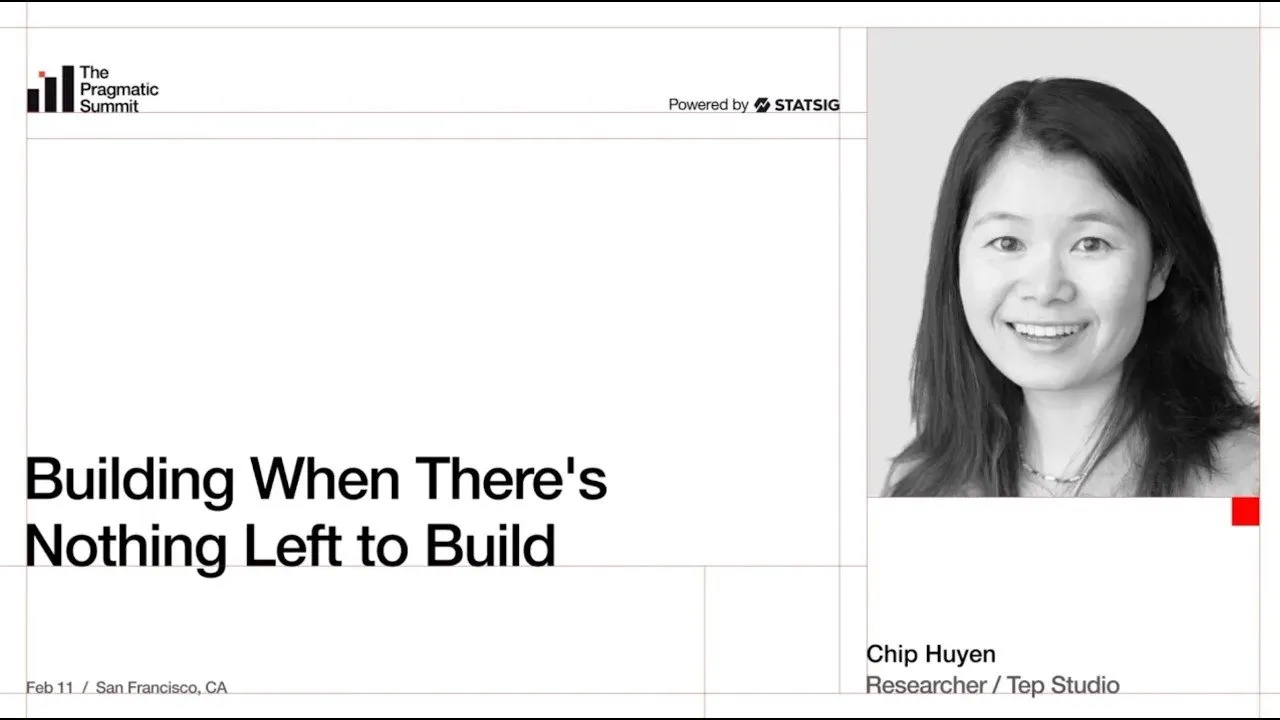
We are currently living through a period where the barrier to entry for software development has effectively vanished. With AI capable of replicating existing tools, websites, and applications in a fraction of the time it once took, many developers are experiencing a crisis of purpose. If any product you build can be cloned by a sophisticated model, does your work still hold value? As Chip Huyen suggests, the answer lies not in what is being built, but in the shift from being a manual laborer to becoming a creative architect.
Key Takeaways
- The Replication Reality: Anything that exists can now be replicated by AI, rendering traditional "software moats" less effective.
- Long-Tail Problem Solving: While AI dominates top-tier, common problems, a vast ecosystem of niche, culturally specific, and edge-case problems remains open for human creators.
- Human-Centric Nuance: Cultural preferences, such as communication styles and interaction habits, provide a critical advantage for developers who deeply understand their local demographics.
- Collaboration Evolution: Traditional workflows, such as line-by-line code reviews, are becoming obsolete; the new focus must shift to mentoring others on how to better instruct AI.
- The Joy of Craft: Building software should be reclaimed as an act of personal expression and craftsmanship, akin to artisanal work in a post-industrial world.
The End of Traditional Moats
The speed at which AI can recreate complex software has fundamentally altered the competitive landscape. Previously, companies relied on proprietary codebases or vast amounts of data as "moats"—defensible positions that competitors couldn't easily cross. Today, if you can describe the software, an AI can build it.
This reality forces a difficult question: What is the incentive to innovate when your output can be commoditized overnight? Critics argue that this leads to a "death of imagination," where developers simply ask AI to replicate existing solutions rather than dreaming up new ones. However, this is only a limitation if your vision is restricted to the status quo.
"I feel like now I can build anything I want but at the same time anyone can build anything I want. So what is the incentive structure for me to do anything?"
Solving for the Long Tail
AI models are inherently trained on the most common patterns, making them exceptionally good at solving "top of the tail" problems—the issues everyone experiences. Consequently, these areas are becoming increasingly saturated.
Finding the Sweet Spot
The greatest opportunities for human developers lie in the "long tail" of problems. These are the specific, often messy, edge cases that are not large enough to attract massive corporate interest but are deeply important to specific communities or demographics. Just as in a prediction market, there is a "sweet spot" for developers: a market large enough to be meaningful, but too niche or nuanced for "sharks" like large AI labs to prioritize.
The Cultural Variable
Understanding human preference remains a uniquely human challenge. Technology is not one-size-fits-all; it is deeply dependent on culture, geography, and age. For instance, while Western tech stacks favor text-based chatbots, regions like Vietnam—where users are constantly mobile—have found higher success with voice-first interfaces. These cultural nuances are not just "bugs" to be fixed; they are design requirements that require local human empathy to resolve.
Reimagining Human Collaboration
AI is fundamentally changing how we work together. The traditional software development lifecycle, centered around pull requests and line-by-line code review, is increasingly disconnected from the way code is actually being produced.
Currently, many senior developers still review AI-generated code line-by-line. This is inefficient. The value of a senior engineer is no longer to catch syntax errors—the AI does that—but to mentor their team on how to provide better instructions to the AI. We are moving toward a world where the manager is an editor of logic and intent, rather than a proofreader of syntax.
"I don't think the senior member instead of like giving feedback on the code they should be giving feedback on like how you give instruction to AI to produce better."
The Danger of Irreversible Actions
As we grant AI more agency, we must address the shift from digital environments to the physical world. In coding, if an AI wipes your local database, you can revert a commit. In the real world, actions are often irreversible. If an AI agent commits an error in a legal form, a financial transaction, or physical space, the stakes rise exponentially.
We are currently operating in a "human-centric" design era where we force AI to mimic human limitations, such as slow search patterns or rate-limiting. As we move toward a truly "AI-centric" architecture, we need to design environments that are "agent-ready," allowing systems to interact with data and reality without the bottlenecks imposed by legacy systems.
Building for the Joy of Craft
Ultimately, the most sustainable reason to build is the process itself. Industrialization brought us mass-produced clothing, yet artisanal goods remained valuable because of the intent and craft behind them. Software is beginning to mirror this transition.
The barrier to building is now so low that developers can create for the pure joy of it. Whether it is a small app for a friend’s birthday or a niche tool for a specific problem, the act of creation remains a fundamental expression of humanity. AI should not be viewed as the end of the builder, but as the tool that allows the builder to focus on the things that actually matter: empathy, nuance, and purpose.
"I do think that we can normalize building things for fun because before I found out that I spend a lot of energy in doing things just like just to get to the part of building."
The future of development belongs to those who embrace the power of AI to clear the mundane, allowing us to spend our energy on the complex, the cultural, and the deeply personal problems that AI is not yet designed to solve.
![Warning TRUMP: This Is Very Dangerous [It’s Starting]](/content/images/size/w1304/format/webp/2026/04/trump-middle-east-market-volatility-oil-prices.jpg)