Table of Contents
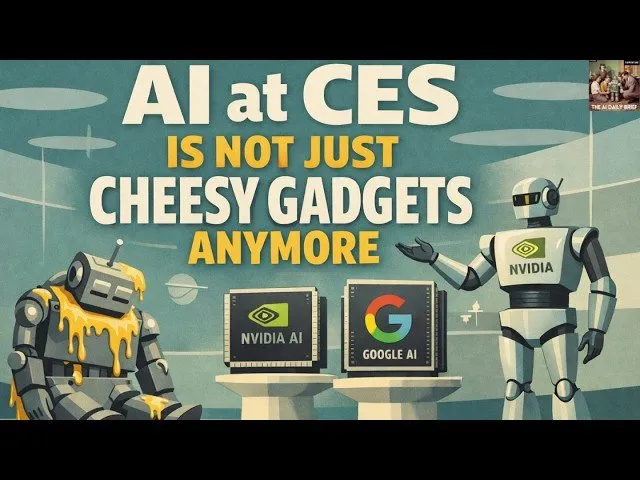
CES 2026 has shed its reputation for gimmicky AI integration, pivoting instead toward foundational infrastructure and mass-market deployment from the technology sector’s largest incumbents. Nvidia, AMD, and Amazon dominated the Las Vegas floor this week, unveiling next-generation silicon and ecosystem strategies designed to power the next decade of artificial intelligence, marking a distinct shift from the experimental startup culture of previous years.
Key Developments at CES 2026
- Nvidia's Vera Rubin Architecture: Jensen Huang announced the new chip architecture is already in full production, offering 3.5x faster training and 5x faster inference compared to the Blackwell series.
- AMD's Counterstrike: CEO Lisa Su unveiled the MI455 GPU with a claimed 10x performance boost, supported by OpenAI’s Greg Brockman who emphasized the need for billions of GPUs.
- Amazon's Strategic Pivot: The retail giant launched a web-based interface for Alexa and updated its "Bee" wearable, aiming to activate its network of 600 million existing devices.
- Samsung's Mobile Scale: The company plans to expand Gemini-powered Galaxy AI to 800 million devices by 2026, solidifying Google's stronghold on mobile AI utility.
From Novelty to Infrastructure
The tone of CES has undergone a significant correction. While previous years featured an abundance of AI-enabled household appliances with questionable utility, this year’s event focused on category-defining products from industry leaders. The saturation of "AI for everything" has forced a market maturation where utility and infrastructure take precedence over novelty.
According to Wired, the industry has reached a point where products offering generic chatbots and sensors are evening out, making differentiation difficult. Consequently, the spotlight has shifted to the "five-layer stack" of computing that Nvidia and its peers are actively reinventing. This shift indicates that product iteration cycles are accelerating, compelling major players to treat conferences as essential roadshow events to maintain narrative dominance.
Nvidia and AMD Escalate the Silicon Arms Race
Nvidia continues to set the pace for the industry with the unveiling of its Vera Rubin chips. Despite the ongoing rollout of the Blackwell architecture, CEO Jensen Huang confirmed that Vera Rubin is already in full production. The system splits duties between the "Vera" CPU and the "Rubin" GPU.
The claimed performance metrics represent a generational leap: a 3.5x increase in speed for model training and a 5x increase for inference tasks compared to Blackwell. Perhaps most critical for data centers facing power constraints, the new chips reportedly produce eight times as much inference compute per watt. Nvidia projects these efficiencies will result in a 90% decrease in token costs.
"You no longer program the software, you train the software. You don't run it on CPUs, you run it on GPUs... Computing has been fundamentally reshaped as a result of accelerated computing." — Jensen Huang, CEO of Nvidia
Simultaneously, Nvidia is positioning itself as the "Android of embodied AI." The company introduced the Nvidia Osmo ecosystem and a suite of "Cosmos" models designed to train robots in simulated environments before real-world deployment. By partnering with Hugging Face, Nvidia aims to become the default hardware and software vendor for the rapidly growing robotics sector.
AMD's 10x Performance Claim
Refusing to cede the data center market, AMD presented its new flagship MI455 GPU. CEO Lisa Su claimed the chip delivers a 10x performance boost over the previous generation. The presentation featured OpenAI President Greg Brockman, who underscored the sheer scale required for future AI agents.
"The AI build-out isn't going to be about choosing one chip over the other... the idea of everyone on the planet using AI agents will require billions of GPUs. No one has a plan to build that scale." — Greg Brockman, President of OpenAI
AMD also outlined a roadmap promising a 1,000x performance jump by 2027 compared to their 2023 metrics, alongside new Ryzen CPUs designed to bring AI capabilities to consumer PCs.
Amazon and Samsung Target the Consumer Home
While chipmakers battle for the data center, consumer electronics giants are fighting for the home interface. Amazon made headlines with a revamped strategy for Alexa, launching a dedicated web app (Alexa.com) to make the assistant device-agnostic. This move allows Amazon to compete directly with ChatGPT and Gemini interfaces while leveraging its massive hardware footprint.
Connor Grennan of NYU Stern noted the strategic significance of this move, highlighting that Amazon is not merely launching a chatbot but activating a dormant network. With 600 million Alexa devices sold and 200 million Prime members, Amazon is attempting to transition users from simple voice commands to complex, context-aware AI interactions involving calendar management and family coordination.
Amazon also reintroduced its AI wearable, Bee, with features designed to act as a "life coach," analyzing user patterns and offering insights on time management and relationships.
Meanwhile, Samsung is doubling down on its partnership with Google. Co-CEO TM Rowe announced plans to install Gemini-powered Galaxy AI on 800 million handsets by 2026. This massive distribution channel, combined with Apple's integration of Google technology, suggests that Google is securing a dominant position in mobile AI utility, potentially outpacing competitors who lack direct access to smartphone operating systems.
Looking Ahead: The 2026 Landscape
The aggressive roadmap updates from Nvidia and AMD, combined with the consumer deployment strategies of Amazon and Samsung, suggest 2026 will be defined by the integration of AI into physical reality—whether through robotics, advanced wearables, or ubiquitous smart home ecosystems. As the infrastructure matures, the competition is moving away from who can generate the most hype to who can deliver the most efficient compute and the most seamless user utility.
![CAUTION: This Bitcoin TRAP Is Almost Set! [How I’m Playing It]](/content/images/size/w1304/format/webp/2026/03/bitcoin-price-trap-warning-market-analysis.jpg)