Table of Contents
While the broader crypto ecosystem often fixates on speculative cycles, memecoin launchpads, and yield farming, a quiet revolution is happening in the world of peer-to-peer (P2P) payments. Celo, an ecosystem historically proximate to Ethereum and now formally transitioning into an Ethereum Layer 2 (L2), has been relentlessly focused on a singular goal for eight years: building a global payment network that works for everyone, everywhere.
In a recent conversation with Bankless, Marek Olszewski, CEO of cLabs, pulled back the curtain on Celo’s impressive—and largely undertold—traction. From overtaking major competitors in active user counts to solving the "last mile" problem in emerging markets through strategic partnerships, Celo is positioning itself not as a casino, but as the "Global Venmo" of the blockchain world. The network's evolution from a standalone Layer 1 to a mobile-first L2 offers a compelling case study on how utility can drive mass adoption.
Key Takeaways
- Dominating Daily Activity: Celo reports approximately 700,000 daily active addresses, frequently surpassing Base, Polygon, and Ethereum Mainnet, driven largely by real-world payment usage.
- The "Mini Pay" Catalyst: A partnership with Opera has integrated the Mini Pay wallet into the browser of millions of users in Africa, creating a seamless UX that leverages phone numbers rather than complex crypto addresses.
- Solved the Last Mile: Through integrations with local payment rails (like M-Pesa in Kenya) and virtual bank accounts, Celo allows freelancers and families to move between fiat and crypto instantly.
- Identity Layer Innovation: The new "Self" protocol uses Zero-Knowledge (ZK) proofs to verify identity using existing biometric passports, offering Sybil resistance without the need for specialized hardware like Worldcoin.
- Strategic Pivot to L2: Celo is transitioning from an EVM-compatible Layer 1 to an Ethereum Layer 2 to tap into Ethereum's liquidity and security while maintaining low fees and fast finality.
The Origins of a "Global Venmo"
Celo’s journey began nearly eight years ago, arguably sparked by a chance meeting between Olszewski and Coinbase CEO Brian Armstrong at a music festival. While the initial inspiration was to bring financial inclusion to the world, the execution required a significant deviation from the status quo of 2017.
The team quickly realized that building a "normie-friendly" mobile wallet on Ethereum at that time was impossible due to scalability constraints. To achieve a user experience comparable to Web2 fintech apps, they needed a chain that supported mobile-first features natively. This led to distinct architectural choices: allowing transaction fees to be paid in stablecoins and replacing hexadecimal wallet addresses with phone numbers.
We realized that address-based identifiers are just too complicated for most normies. And so that took us down the path of developing a protocol that allowed you to use phone numbers as your identifier... It makes it just so much easier for people to effectively bootstrap the biggest social network in the world, which is the amalgamation of everyone's contact lists.
This focus on the P2P use case has remained constant. While other chains pivoted to capture NFT mania or DeFi summer, Celo continued to refine the infrastructure required for seamless global payments.
Real-World Adoption: Metrics Over Hype
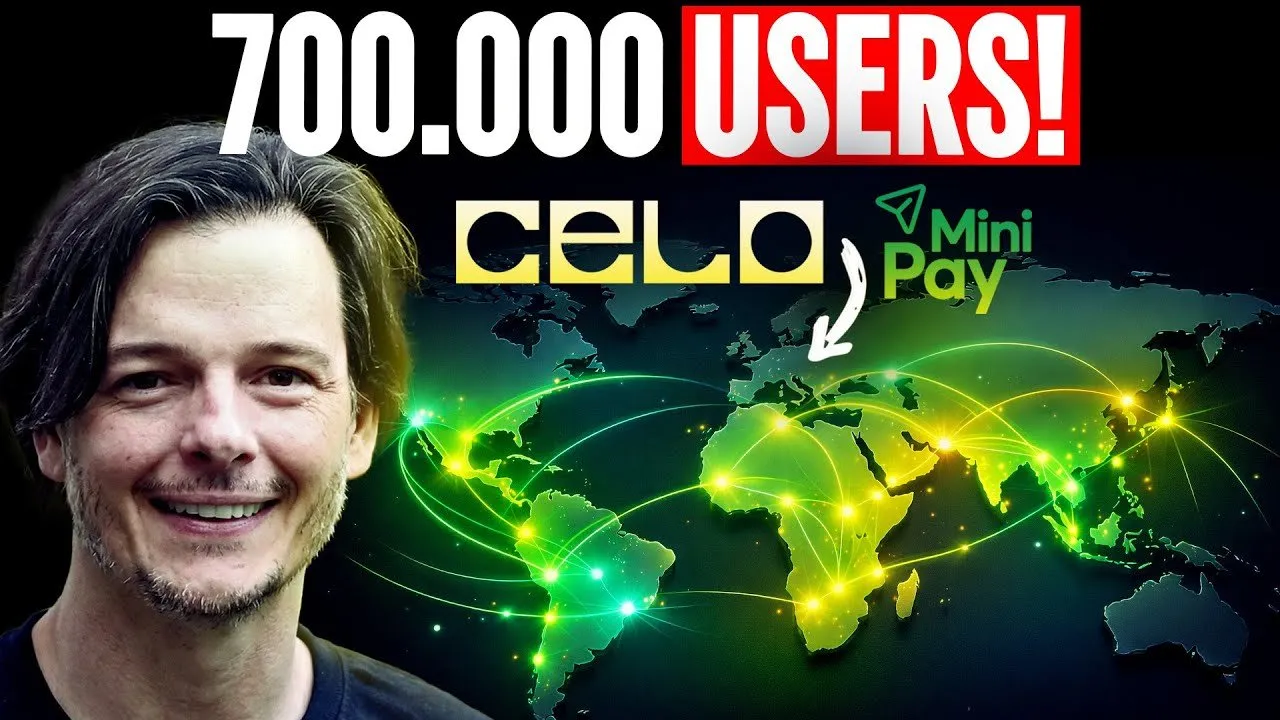
The most surprising aspect of Celo’s current state is the sheer volume of its user base. According to Olszewski, the network sees roughly 700,000 daily active addresses. Unlike chains where activity is driven by bots or airdrop farming, Celo’s volume is heavily anchored in verified human usage due to the phone number verification required by its primary wallet interfaces.
When comparing these metrics to the broader industry, the results are striking. On platforms like GrowThePie, Celo frequently ranks as the number one L2 by active addresses, overtaking industry darlings like Base and Polygon. Perhaps most notably, Celo is now challenging Tron, the long-standing king of stablecoin payments.
If you go to Tether's stats page, you actually can see that when it comes to weekly active users, Celo is actually ahead of Tron now... Celo is like Ethereum's answer to Tron 100%.
This traffic is not generated by whales moving millions of dollars, but by ordinary users in emerging markets engaged in three primary activities: P2P payments, on-chain foreign exchange (FX), and decentralized identity verification.
The Power of Mini Pay and the "Last Mile"
The primary engine behind Celo’s recent surge is Mini Pay, a wallet integrated directly into the Opera Mini browser. Opera has a massive footprint in Africa and other emerging markets, with over 100 million monthly active users on its data-saving browser. By embedding a crypto wallet directly into this ecosystem, Celo bypassed the friction of app store downloads and complex onboarding.
However, the true innovation lies in solving the "last mile" problem—the difficulty of converting crypto back into usable local fiat currency. Mini Pay has integrated with local payment rails, such as M-Pesa in Kenya and various banking systems in Nigeria, enabling users to "cash out" instantly.
Empowering the Global Workforce
Olszewski shared the story of a yoga instructor in Malawi who pivoted to online classes during the pandemic. Initially using MoneyGram to receive payments from European clients, the instructor lost a significant percentage of earnings to fees and exchange rates. switching to Mini Pay allowed him to receive stablecoins instantly, keep the funds in USD to hedge against local inflation, and cash out to local currency only when necessary.
Furthermore, Mini Pay has introduced virtual bank accounts for users in emerging markets. A freelancer in Nigeria can now generate a US or European bank account number within the app. Clients pay into that account via standard bank transfer, and the funds arrive in the freelancer’s wallet as stablecoins.
On-Chain FX: The Quadrillion-Dollar Opportunity
Beyond simple transfers, Celo is aggressively targeting the foreign exchange (FX) market. The traditional FX market processes over $3 quadrillion annually but remains inefficient, slow, and expensive for the average person. Through the Mento protocol, Celo supports 15 different local currency stablecoins, allowing for decentralized FX trading.
This capability is crucial for users who need to hedge currency risk. Rather than holding volatile crypto assets or inflating local currencies, users can swap between assets like cUSD, cEUR, and cREAL (Brazilian Real) instantly. This utility transforms the blockchain from a speculative casino into a practical tool for economic stability.
Identity Verification via "Self"
As the network grows, differentiating between humans and bots becomes critical, especially for distributing incentives (airdrops) or Universal Basic Income. While projects like Worldcoin attempt to solve this via hardware (scanning irises), Celo’s approach with Self.xyz is purely software-based.
Self utilizes the biometric data already embedded in modern passports and national IDs. Using NFC technology present in most smartphones, the protocol can read the signed data from a government ID and generate a Zero-Knowledge proof on-chain.
You can verify the authenticity of this data in your knowledge and then you can prove statements about yourself in zero knowledge without having to reveal your personal information.
This allows users to prove they are unique humans, prove they are over 18, or prove they are not on a sanctions list, all without revealing their actual identity to the blockchain or a third party.
The Strategic Pivot to Layer 2
Technically, Celo is undergoing a massive transformation by migrating from a standalone Layer 1 blockchain to an Ethereum Layer 2. This move is designed to unify liquidity and leverage Ethereum’s security, while maintaining the low costs Celo users expect.
Olszewski describes this transition as a "no-brainer." While other projects like Stripe (via Tempo) or Monad are launching new L1s, cLabs believes that Ethereum will inevitably become the settlement layer for the internet. By becoming an L2, Celo gains access to Ethereum's deep liquidity and interoperability while using ZK technology to ensure fast finality—a non-negotiable requirement for payments.
Conclusion
Celo’s traction challenges the prevailing narrative that crypto adoption is years away. By focusing on mobile-first infrastructure, stablecoin utility, and seamless on/off ramps in emerging markets, Celo has built a thriving economy that operates largely outside the view of Western crypto speculators. As it transitions to an Ethereum Layer 2, Celo is bridging the gap between the decentralized ideals of Web3 and the practical necessities of the real world, proving that the killer app for crypto might just be money itself.