
Table of Contents
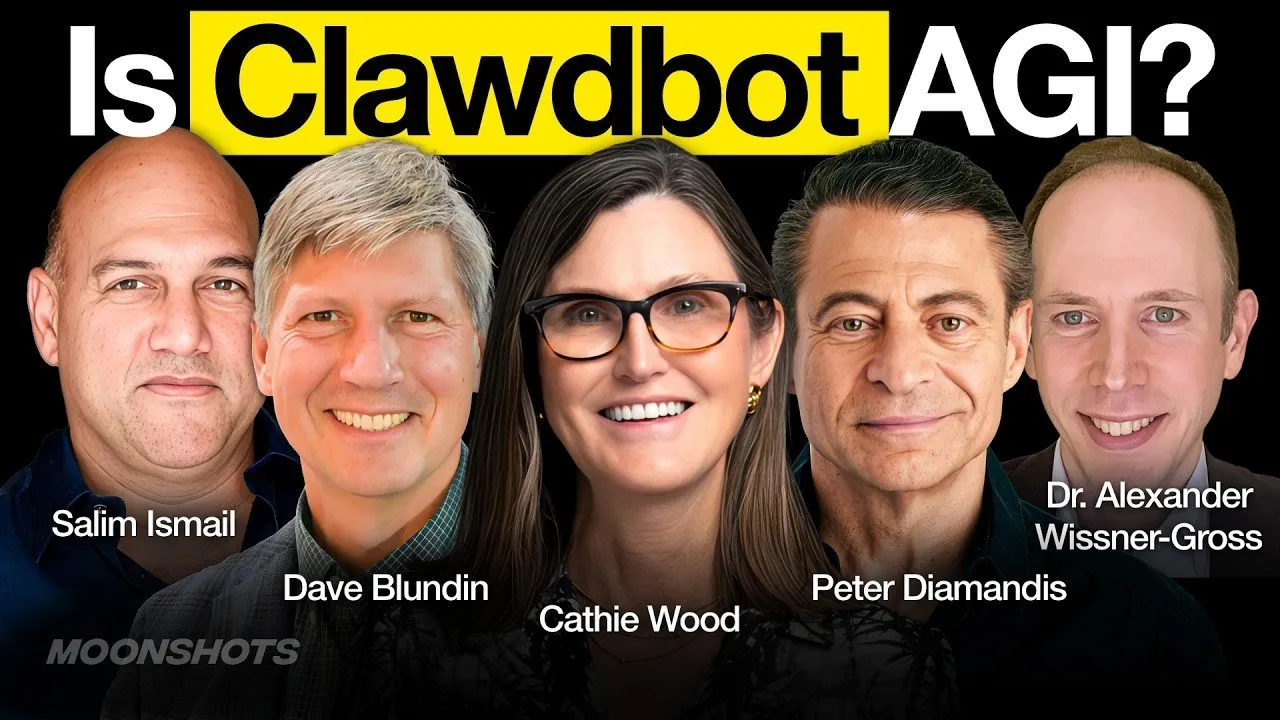
The pace of technological change is no longer linear; it is exponential. In the latest examination of the future, ARK Invest’s CEO Cathie Wood joined Peter Diamandis to unpack the "Big Ideas 2026" report. The consensus? Humanity is approaching a singularity event where economic growth, artificial intelligence, and physical automation converge to reshape the global landscape.
While traditional economists often predict a return to mean growth rates of 2-3%, the data emerging from the convergence of robotics, energy storage, AI, blockchain, and multiomics suggests a radically different future. We are standing on the precipice of a global economic reset that promises both deflationary prices and explosive productivity.
Key Takeaways
- Global GDP Growth Surge: ARK forecasts a jump to 7%+ real global GDP growth, driven by a convergence of five major technology platforms.
- The Commoditization of Intelligence: As inference costs collapse, AI agents (like the open-source "Moltbot") will dominate workflows, creating infinite demand for compute.
- Bitcoin’s Trajectory: Despite market volatility, the bull case for Bitcoin remains at $1.5 million by 2030, driven by its role as "digital gold" and insurance against fiat instability.
- Autonomous Mobility: Tesla’s vertical integration places it ahead of legacy auto and Waymo, with the potential to lower autonomous transport costs to $0.20 per mile.
- Energy is the Key: The AI and robotics revolution relies heavily on expanding energy infrastructure, particularly through nuclear and solar convergence with orbital data centers.
The Great Economic Acceleration: 7% Global GDP
For the past 125 years, the world has grown accustomed to a specific economic rhythm. Following the introduction of the internal combustion engine, electricity, and the telephone, global real GDP growth stepped up from roughly 0.6% to 3%. This 3% benchmark has become the accepted ceiling for economic expansion in the eyes of most financial institutions.
However, historical data suggests that every major technology revolution is accompanied by a step-function increase in growth. The convergence of today's five critical innovation platforms suggests we are about to witness another leap.
"AI is moving faster than we expected. I think the 7% plus is conservative... Every technology revolution has been accompanied by a step function increase in GDP growth. And so here we are."
Critics often argue that despite technological advancements, growth inevitably settles back to 3%. This view, often echoed at gatherings like Davos, relies on sector-based analysis. Traditional analysis silos industries—viewing automotive, healthcare, and energy as separate entities. However, innovation today blurs these lines. When AI permeates healthcare, or when robotics redefine manufacturing, the cumulative effect on productivity is far greater than the sum of its parts.
The Rise of AI Agents and the "Moltbot" Phenomenon
One of the most startling metrics in the 2026 outlook is the collapse of inference costs. The cost to run AI models is dropping at a rate that effectively commoditizes cognition. As costs plummet towards zero, the barrier to entry for intelligent agents vanishes.
Open Source vs. Closed Models
A significant driver of this acceleration is the open-source community. While major labs like OpenAI and Google dominate the headlines with closed models, the open-source ecosystem is iterating at a pace that rivals funded giants. The conversation highlighted the emergence of "Moltbot" (formerly referred to as Claudebot), an open-source agent capable of organizing digital lives and executing complex tasks autonomously.
This democratization of intelligence presents a paradox. While the cost of individual inference drops, the demand for "smart" transactions is effectively infinite. This is Jevons Paradox in action: as technology increases the efficiency with which a resource is used, the total consumption of that resource increases rather than decreases.
The Geopolitical AI Race
The acceleration of open-source AI has geopolitical implications, particularly regarding China. Due to restrictions on US software exports, China was forced to galvanize its open-source community. The result is a thriving ecosystem of models that are competing globally. This competition is net-positive for innovation, forcing US companies to iterate faster, although it raises questions about regulation and safety standards.
Bitcoin, Digital Gold, and the $1.5 Million Target
Despite recent market fluctuations, the long-term thesis for Bitcoin remains robust. ARK’s research maintains a bull case of $1.5 million per coin by 2030. This projection is underpinned by a shift in how the asset is perceived globally.
Historically, gold has led Bitcoin in market cycles. Recently, gold has hit all-time highs while Bitcoin has seen volatility, suggesting the digital asset is coiling for a significant run. The core utility of Bitcoin is evolving into two distinct lanes:
- Insurance Policy: In emerging markets and unstable regimes (such as Iran), Bitcoin is used as a hedge against currency debasement and wealth confiscation.
- Digital Gold: As intergenerational wealth transfer occurs, younger demographics are far more likely to choose digital stores of value over physical bullion.
"If you look at what's happened historically, certainly the last two cycles, gold has led Bitcoin. So, we think Bitcoin is getting ready for another big run."
While stablecoins have absorbed some of the demand for transactional utility in emerging markets, Bitcoin’s role as a counterparty-free store of value remains unchallenged, particularly in a world facing potential sovereign debt crises.
The Disruption of Mobility: Tesla vs. Waymo
The era of the robotaxi is no longer theoretical; it is operational. However, the market is bifurcating into two distinct approaches: the sensor-heavy, geofenced approach of Waymo, and the vision-based, general-purpose approach of Tesla.
The Vertical Integration Advantage
The automotive industry is facing an extinction-level event for companies that cannot pivot to software and robotics. Legacy automakers are collections of third-party suppliers, making it nearly impossible to innovate at the speed required for autonomy. If a single supplier delays a component, the entire chain halts.
Tesla, by contrast, operates with extreme vertical integration. By manufacturing the "machine that makes the machine," Tesla can drive costs down aggressively. The forecast suggests Tesla could offer autonomous transport at roughly $0.20 per mile, undercutting not just Waymo, but traditional public transport and personal car ownership costs.
Energy and Grid Convergence
These vehicles are not just transportation; they are mobile energy storage units and inference engines. A distributed fleet of millions of robotaxis represents a massive, stabilized energy grid that can smooth out demand peaks, further integrating the energy and transportation sectors.
Energy: The Constraint and The Opportunity
None of these advancements—from AI data centers to electric robotaxis—are possible without a massive expansion in energy production. The correlation between energy usage and human flourishing is undeniable. To support the 7% GDP growth forecast, global power investment must scale to the trillions.
While the US has lagged in nuclear infrastructure due to regulatory hurdles in the 1970s, the sentiment is shifting. Small Modular Reactors (SMRs) and a renewed interest in nuclear physics are essential to meet the baseload power requirements of the AI age. Furthermore, innovations like orbital data centers powered by high-efficiency solar arrays in space could bypass terrestrial constraints entirely.
Conclusion
The "Big Ideas 2026" report paints a picture of a world in flux. We are moving from an economy defined by labor and capital to one defined by intelligence and energy. The convergence of these technologies means that linear extrapolations of the past will fail to predict the future.
While the transition may be volatile, the long-term trend points toward massive wealth creation and a fundamental restructuring of how humanity lives, moves, and transacts. As the cost of intelligence approaches zero and the cost of energy declines, the ceiling on global economic growth is about to be shattered.



%20Takeover%2C%20AI%20Demand%20Spikes%2C%20and%207%25%20GPD%20growth%20%7C%20EP%20226)