
Table of Contents
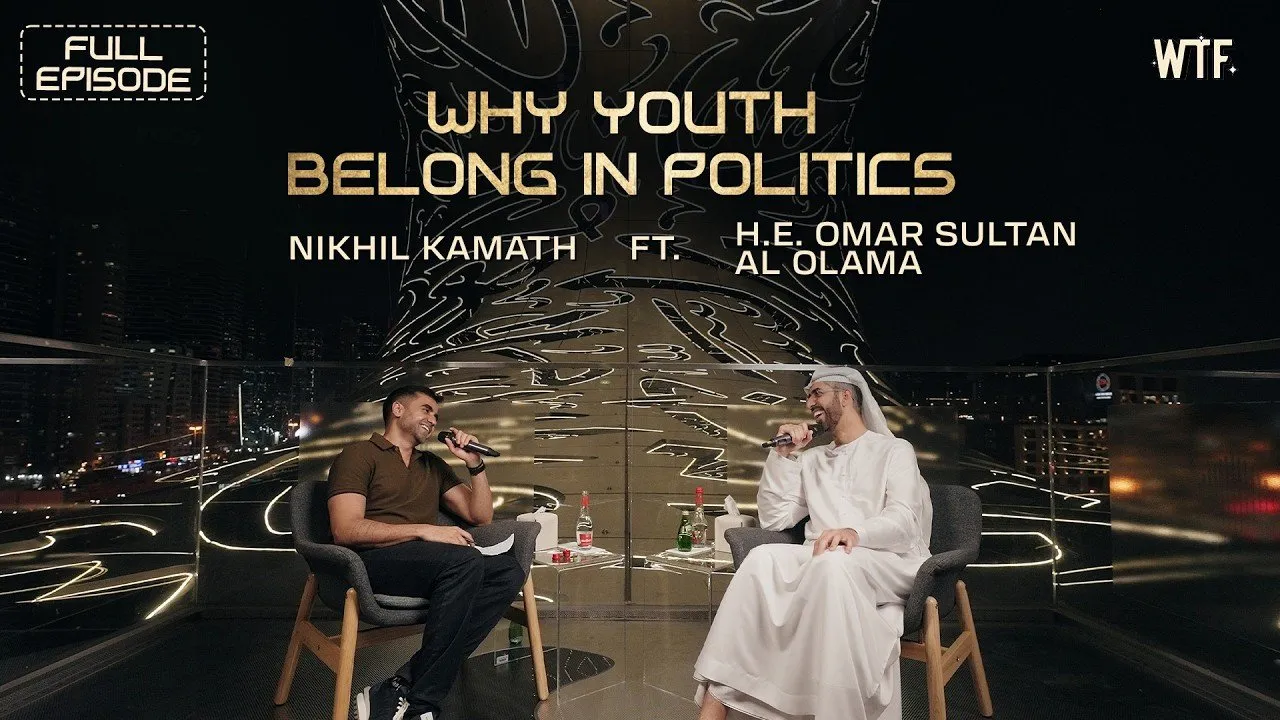
In a rapidly evolving global landscape, the intersection of youth leadership, artificial intelligence, and governance models defines the trajectory of nations. His Excellency Omar Sultan Al Olama, the UAE’s Minister of State for Artificial Intelligence, Digital Economy, and Remote Work Applications, represents a new archetype of politician. As one of the world’s youngest ministers, appointed at age 27, Al Olama brings a unique perspective that blends the agility of a startup founder with the long-term vision of traditional statesmanship.
In a wide-ranging dialogue with Nikhil Kamath, Al Olama dissects the future of work, the mechanics of the UAE’s governance model, and the philosophical underpinnings of leadership in the 21st century. His insights offer a blueprint for how smaller nations can leverage technology to compete on the global stage and how governments can transition from bureaucratic entities to service-oriented enablers of human potential.
Key Takeaways
- The Generalist Advantage: In the age of AI, hyper-specialization carries risk; possessing a "breadth of intelligence" and being a "jack of all trades" provides resilience against automation.
- Government as a Service: The UAE approaches governance with a customer-centric mindset, prioritizing invisible, seamless services (like smart gates) over heavy-handed bureaucracy.
- AI as an Equalizer: Artificial Intelligence allows nations with smaller populations to "punch above their weight" by dramatically increasing productivity and output.
- Meritocracy over Lineage: Al Olama’s rise from the banking sector to the cabinet highlights a system where results and grit outweigh age or background.
- Geopolitical Neutrality: The UAE maintains its historical role as a trade hub by acting as a bridge between East and West, prioritizing global cooperation over polarization.
The Strategic Advantage of Generalists in an AI World
A prevailing narrative in career development has long been the pursuit of hyper-specialization. However, Al Olama challenges this orthodoxy, suggesting that the impending ubiquity of AI flips the script on what constitutes valuable human capital. When machines can process specific data sets and perform specialized tasks better than humans, the human advantage shifts to synthesis and broad understanding.
Revisiting the "Jack of All Trades"
The cultural dismissal of the generalist is often based on an incomplete reading of a famous adage. Al Olama argues that the comprehensive version of the saying perfectly encapsulates the future workforce strategy.
"Everyone uses the verse from Shakespeare's poem 'a jack of all trades is a master of none.' But no one actually continues that verse because the second verse after it says, 'But most times better than a master of one.'"
The logic is rooted in adaptability. A master accountant or a specialized coder faces a higher risk of displacement by AI models trained specifically for those verticals. In contrast, an individual with a "breadth of intelligence"—someone who understands technology, humanities, business, and nature—can connect dots that AI currently cannot. This multidisciplinary approach allows for greater agility in a market where the "easiest jobs" (often the most repetitive or rules-based) are replaced first.
Small Nations and the Productivity Multiplier
For a country like the UAE, with a population of approximately 10 million, competing with demographic giants like India or China on manpower alone is physically impossible. AI serves as the great leveler. By integrating AI into the national infrastructure, a small population can achieve the output of a nation ten times its size.
Al Olama frames this not as a choice but as a necessity for survival and relevance. The divide of the future will not necessarily be between the rich and poor, but between those who embrace AI to amplify their productivity and those who are bogged down by red tape and technological hesitation.
Governance as a Service: The UAE Model
One of the most distinct aspects of the discussion is the reframing of government not as a ruler, but as a service provider. The metric for success in the UAE is not the visibility of the government, but the quality of life afforded to its residents.
Invisible Infrastructure vs. Intimidation
Al Olama illustrates this philosophy through the experience of airport immigration. In many nations, entering the country involves confronting an armed officer behind bulletproof glass—an intimidating, high-friction interaction. In contrast, Dubai implemented smart gates where residents pass through without human intervention or even producing a passport.
"Government is here for one purpose. It's here to ensure that your quality of life is better tomorrow than it is today. And we don't need to point out that we are the government and we are here to do this job. It needs to happen by complete autonomy if possible."
This "invisible government" approach extends to business licensing, infrastructure, and taxation. The goal is to remove friction so that the ecosystem attracts high-net-worth individuals and global talent, not just through tax incentives, but through superior service delivery.
Combating Bureaucracy and Corruption
To maintain this efficiency, the UAE employs rigorous mechanisms to prevent the stagnation that plagues many bureaucracies:
- Zero Bureaucracy Initiative: A government mandate to reduce bureaucracy by 50% year-on-year, forcing agencies to constantly streamline processes.
- Secret Shoppers: High-level officials and designated civilians act as customers to test government services. Their reports go directly to the highest levels of leadership, ensuring that the reality on the ground matches the policy in the boardroom.
- The Majlis System: A traditional, yet radically democratic practice where rulers hold weekly open houses. Citizens and residents can petition leaders directly, bypassing layers of middle management and ensuring leaders remain grounded in the people's needs.
A Meritocratic Rise: Defining Impact
Al Olama’s personal journey serves as a case study in the UAE’s meritocratic structure. Contrary to the assumption that high office is reserved for royalty or political dynasties, Al Olama’s path was carved through performance, particularly during high-pressure situations.
From Crisis to Cabinet
His early career was forged in the fires of the 2008 financial crisis, working in banking during a merger. This experience instilled a resilience and a realization that financial wealth is fragile. A pivotal conversation on a flight to the Vatican with Mohammed Al Gergawi (Minister of Cabinet Affairs) shifted his focus from accumulating wealth to creating impact.
The realization was that while money is a tool, the government offers a unique network and platform to enact change at a scale impossible in the private sector. This drive led him to the Prime Minister’s Office, where a culture of "working 10 times harder" prevailed.
The "Minister at 27" Phenomenon
Al Olama’s appointment wasn't a ceremonial nod to youth; it was a result of executing complex projects, such as the World Government Summit and the World Drone Prix. His critique of an initial, Western-centric AI strategy caught the attention of leadership. He argued against unrealistic timelines for self-driving cars and pushed for a focus on local talent development.
"His Highness doesn't believe that it's about your age. He believes that it's about your ability, your grit, your perseverance... Put in your heart. Make the best out of this and let's see what you can do."
This ethos suggests that for governments to remain relevant, they must empower youth not just with titles, but with actual decision-making power regarding the technologies that will define their future.
Geopolitics and the Philosophy of Neutrality
In a polarized world characterized by trade wars and binary alliances, the UAE maintains a steadfast commitment to neutrality. Al Olama grounds this in historical context: archaeological findings confirm the region has been a trade nexus connecting civilizations like Egypt and India for over 4,000 years.
The Bridge Between East and West
The UAE’s foreign policy is driven by the necessity of trade and the value of open borders. By maintaining strong relationships with the US, China, Russia, India, and European nations simultaneously, the UAE positions itself as a global sanctuary for dialogue.
- Economic Pragmatism: Traders from the UAE have historically looked outward, engaging globally rather than isolating.
- Safe Harbor: In times of conflict, capital and talent flock to stability. By refusing to pick sides, the UAE attracts diversity in business and residency.
- Global Collaboration on Tech: Al Olama argues that technologies like AI and biotech are too dangerous to manage in silos. The world needs "patrons of dialogue" to facilitate cooperation on safety guardrails, much like the nuclear non-proliferation talks during the Cold War.
Leadership, Wisdom, and the Dunning-Kruger Effect
The conversation touches deeply on the psychology of leadership. Al Olama notes that the younger generation often suffers most acutely from the Dunning-Kruger effect—possessing high confidence but low competence due to a lack of experience. He suggests that the "best generation" might be those currently between 40 and 60, who bridge the analog and digital worlds.
Restraint vs. Impulse
A critical attribute for modern politicians is the balance between action and restraint. While youth is often associated with impulse and the desire to "move fast and break things," governance requires the wisdom to know when to absorb pressure and when to act.
Ultimately, Al Olama believes that the effectiveness of a political system should be judged by its results. Whether a system is a democracy or a monarchy matters less than whether the population feels safe, represented, and optimistic about the future. In the UAE, the social contract is built on the promise that tomorrow will be better than today—a promise kept through agile, technology-driven governance.
Conclusion
HE Omar Sultan Al Olama’s perspective offers a refreshing deviation from standard political rhetoric. It prioritizes competence over tenure, generalist adaptability over rigid specialization, and human-centric outcomes over bureaucratic process. As the world stands on the precipice of the AI revolution, the UAE’s model of treating government as a high-performance service provider—while empowering youth to steer the ship—presents a compelling case study for nations striving to remain competitive in the 21st century.



)