
Table of Contents
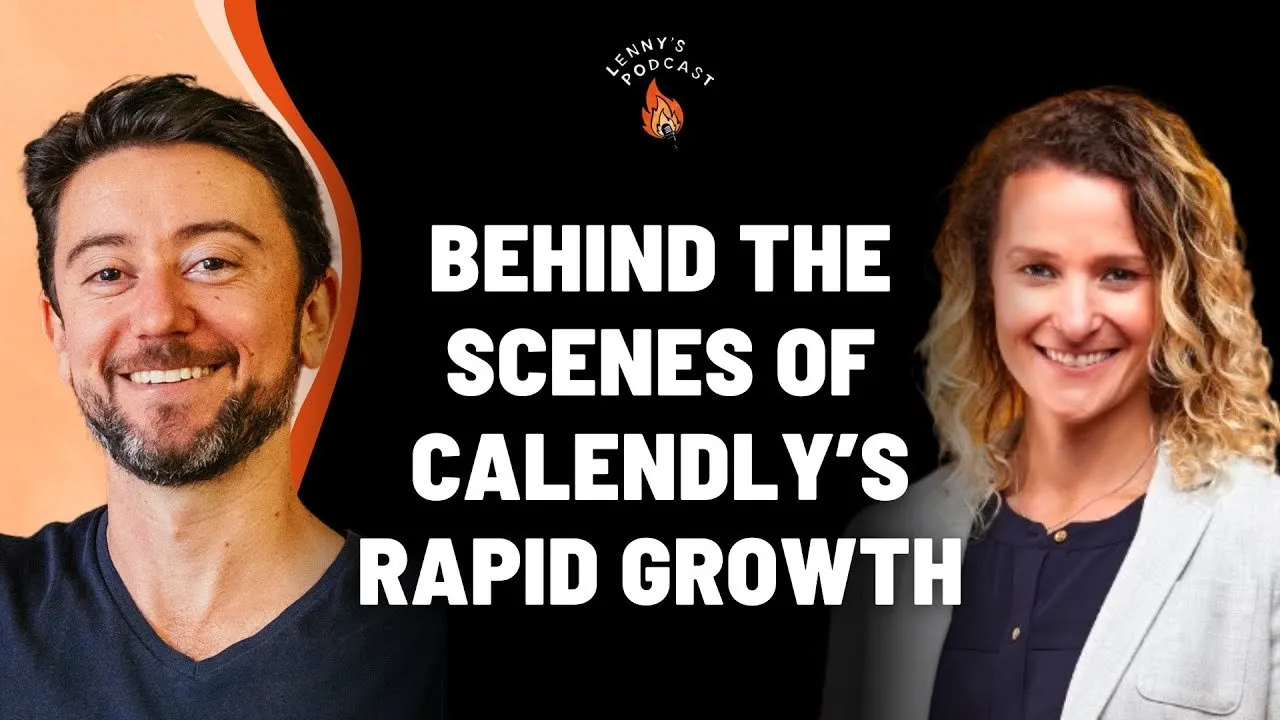
Calendly has become ubiquitous in the modern professional workflow, fundamentally changing how we schedule time. But behind the simplicity of sharing a link lies a complex, evolving product strategy that balances massive horizontal adoption with targeted enterprise growth. Annie Pearl, Chief Product Officer at Calendly, offers a rare look under the hood of how the company scales its product organization, transitions from pure product-led growth (PLG) to sales-led motions, and maintains rigorous strategic focus.
From the counter-intuitive story of Calendly’s first 1,000 users to specific frameworks for prioritizing features, Pearl details the operational realities of managing a product used by millions. Whether you are navigating a transition into product management or scaling a late-stage growth company, these insights provide a blueprint for building high-impact product teams.
Key Takeaways
- The origin of the viral loop: Calendly’s first users weren’t acquired through traditional marketing; they were the customer success agents at the Ukrainian development firm hired to build the product, sparking a viral chain reaction in the education sector.
- Strategic prioritization frameworks: Effective strategy isn't just a plan; it is an integrated set of choices about where to play and how to win, requiring the discipline to say "no" to features (like Venmo integration) that don't serve the core persona.
- Transitioning from PLG to Sales-Led: Adding a sales motion to a PLG company requires a massive cultural shift, moving from siloed self-service optimization to integrated account expansion targeting department heads rather than end-users.
- Pathways into Product Management: There are four distinct paths to breaking into PM roles: formal APM programs, internal transfers from adjacent roles, becoming a subject matter expert (SME), or joining an early-stage startup.
- Rituals for rigor: Calendly utilizes "OPPA" meetings for peer-to-peer debate on product bets and "Competitive Wargaming" to deeply understand market rivals without distracting the entire team daily.
Breaking into Product Management
The transition into product management is notoriously difficult due to the scarcity of roles relative to other functions like engineering. However, for those attempting to make the leap without a technical background, there are four proven pathways to secure a seat at the table.
1. Formal APM Programs
The most direct route is applying to Associate Product Manager (APM) programs. While giants like Google and Meta established this model, mid-sized growth companies often create similar programs to build their bench of talent. These programs provide structured mentorship and rotation, though they are highly competitive.
2. Internal Transfers via the "Side Door"
Perhaps the most common successful path is transferring internally. This involves excelling in a product-adjacent role—such as customer support, implementation, or sales engineering—and leveraging that proximity to offer help to the product team. The key here is demonstrating curiosity and a willingness to do the "grunt work" before officially holding the title.
3. Subject Matter Expert (SME) Programs
Some organizations formalize the internal transfer process through SME programs. A Customer Success Manager (CSM), for example, might be embedded within a product squad to provide deep domain expertise. This allows the individual to partner closely with designers and PMs, effectively auditing the role before fully transitioning.
4. The Early-Stage Startup Route
At an early-stage company, roles are fluid. Joining a founding team often requires everyone to wear multiple hats. In this environment, you can simply start doing the work of a product manager because it needs to be done. This builds the portfolio and experience necessary to land a senior role later.
Structuring a Scaling Product Organization
As Calendly grew from 150 to over 600 employees, the product organization had to evolve to maintain velocity. A critical component of this structure is the consolidation of leadership.
Unifying Product and Design
At the leadership level, Calendly organizes Product, Design, and Research under a single CPO. While keeping these functions separate is common in earlier stages, consolidating them ensures a holistic focus on the end-to-end user experience. When product managers (prioritizing problems) and designers (crafting solutions) roll up to the same leader, it forces tighter integration and reduces friction in the development lifecycle.
Team Topography
To prevent silos, the product teams are divided by the problems they solve and the personas they serve:
- Core Team: Focuses on the end-to-end experience for the primary personas (sales, recruiting, customer success). They handle both feature development and PLG funnel optimization (acquisition, activation, retention).
- Enterprise Team: Targets the IT admin and departmental leaders. Their focus is security, reporting, and management at scale—essential features for moving up-market.
- Platform Team: Manages integrations, APIs, and embedding Calendly into existing business processes.
Strategy, Prioritization, and the Art of Saying No
One of the hardest challenges for a horizontal product like Calendly—which serves everyone from yoga instructors to enterprise sales teams—is focus. Without a rigorous strategy, the backlog becomes a wishlist of disconnected features.
strategy is really just an integrated set of choices that outline how you're going to win in whatever Marketplace you choose... a good product strategy is going to answer questions like what's your sort of winning aspiration but maybe more importantly where are you going to play.
The "Playing to Win" Framework
Calendly utilizes a strategy framework that forces clarity on "where to play" and "how to win." This clarity empowers teams to reject requests that don't align with the winning aspiration. For example, despite high demand from freelancers for a Venmo integration, the team deprioritized it. Why? Because the strategic focus is on professional teams (Sales, Recruiting, CS) within organizations, not the solopreneur market.
Horizon Planning
To balance immediate execution with long-term vision, resource allocation is split across three horizons:
- Horizon 1: Core business improvements and immediate extensions.
- Horizon 2: Emerging opportunities and next-generation growth engines.
- Horizon 3: Long-term bets and future innovations.
The allocation shifts dynamically. In year one of a new strategy, the split might be 70% Horizon 1 and 30% Horizon 2. As the company matures into that strategy, the investment in Horizon 1 scales back to fund Horizon 2 and initiate Horizon 3 work. This disciplined fluidity ensures the company doesn't stagnate while optimizing the present.
The Evolution from Viral Loop to Sales-Led Growth
Calendly’s growth story is a textbook example of product-led growth (PLG) fueling a sales-led motion. Surprisingly, the initial spark wasn't a calculated marketing campaign.
The Accidental Viral Origin
Founder Tope Awotona bootstrapped Calendly, using his savings to hire a Ukrainian development firm. The first 10 users were actually Customer Success agents at another company that used the same dev shop. They used the tool to schedule meetings with parents in the K-12 education sector. Those parents saw the utility, adopted it for parent-teacher conferences, and the viral loop began. Today, 70% of signups still come through this viral loop of receiving a link and signing up.
Layering Sales on Top of PLG
While the viral loop captures individual users, monetizing large organizations requires a sales team. Transitioning from 99% PLG revenue to a model where sales-led growth (SLG) drives significant expansion (now 20% of ARR) requires a cultural overhaul.
The sales motion in this environment is unique. It is not about "hunting" cold leads; it is about harvesting demand. Sales reps look for Product Qualified Leads (PQLs)—domains with high usage volume—and reach out to consolidate those individual users into an enterprise account. This requires a specific type of salesperson: one who understands the inbound dynamic and can sell to department heads rather than just CIOs.
Cultural Rituals for Product Rigor
Maintaining high decision quality in a remote, fast-growing team requires intentional rituals. Calendly employs specific meeting formats to foster debate and market awareness.
The OPPA Meeting
The "Opportunity/Problem Assessment" (OPPA) is a safe space for Product Managers to spar. Crucially, leadership often opts out of these meetings. It serves as a peer-review forum where PMs debate the validity of a problem space or the viability of a solution before it moves forward. This prevents "groupthink" and ensures ideas are stress-tested by peers rather than just approved by executives.
Competitive Wargaming
To avoid the distraction of constantly watching competitors, the team concentrates this energy into "Competitive Wargaming." Teams are assigned a specific competitor to study deeply over a quarter—performing SWOT analyses and immersing themselves in the rival product. This culminates in a presentation day with prizes. This approach centralizes competitive intelligence, allowing the team to stay informed without losing focus on their own users during the rest of the year.
Conclusion
The journey from a single-user scheduling tool to an enterprise platform requires a deliberate shift in how product is built, sold, and managed. For Annie Pearl, the through-line is "focusing wisely." Whether it is narrowing the Ideal Customer Profile (ICP) to say no to distracting features, or implementing strict frameworks for horizon planning, the ability to exclude good ideas to make room for great ones is the hallmark of a maturing product organization.
As companies scale, the "happy accidents" of early viral growth must eventually be replaced by the engineered predictability of enterprise sales and strategic portfolio management. By bridging the gap between user-centric design and revenue-centric strategy, product leaders can navigate the complex transition from startup to scale-up.


)