Table of Contents
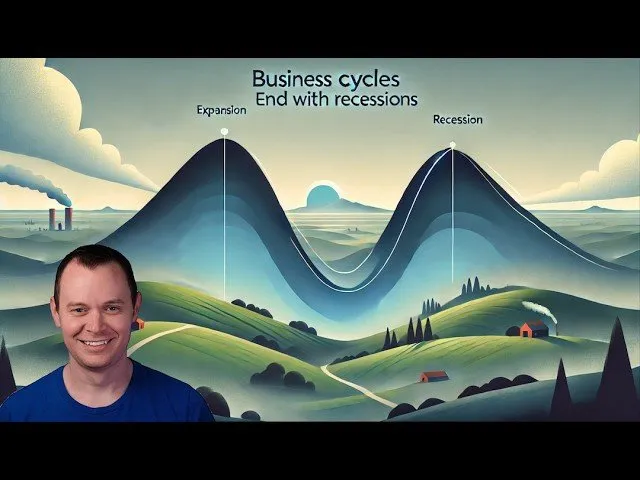
Understanding the current state of the global economy requires looking beyond surface-level headlines. While many investors focus on day-to-day price action, the underlying business cycle provides a much more reliable roadmap for long-term trends. History shows that business cycles inevitably end with recessions, and identifying where we stand in that progression—whether in the early, mid, or late stage—is essential for capital preservation. By analyzing the relationship between the stock market, unemployment, and liquidity, we can better visualize the transition from expansion to contraction.
Key Takeaways
- Late-Cycle Indicators: Current macro metrics, when normalized by the money supply, suggest we are firmly in a late business cycle environment.
- The Negative Feedback Loop: Recessions are characterized by a self-reinforcing cycle where layoffs lead to reduced demand, which in turn triggers more layoffs.
- Market Front-Running: On average, the S&P 500 bottoms roughly 15 days before a recession is officially announced, meaning waiting for "certainty" is often a losing strategy.
- Risk Curve Cascade: Capital typically exits the riskiest assets (altcoins and Bitcoin) before the stock market and defensive sectors like energy begin to correct.
Quantifying the Late Business Cycle
To determine our current position in the business cycle, we must look at a composite of factors that influence the Federal Reserve’s decision-making. A useful metric for this involves evaluating the S&P 500 against the unemployment rate, inflation, and interest rates. By squaring the unemployment rate in this formula, we can effectively "punish" the metric whenever the labor market shows signs of softening, as rising unemployment is a primary driver of cycle endings.
Normalizing for Liquidity
While this metric provides a baseline, it becomes even more revealing when normalized by the M2 money supply. Since the 2020 pandemic, the money supply has expanded at an unprecedented rate, which can distort traditional valuations. When we adjust for this liquidity, the current chart shows peaks similar to those seen in 2000 and 2007. Notably, these peaks do not always coincide perfectly with a stock market top, but they consistently signal that the era of "easy money" and rapid expansion is drawing to a close.
The Return to the Lows
Historically, this macro metric eventually returns to its baseline "lows." The mechanism that facilitates this return is almost always a recession. While the economy has shown resilience since 2022, staying elevated off these lows does not mean the danger has passed; rather, it suggests that the eventual correction may still be ahead of us. "We are at the end of a business cycle, and sometime at the end of the business cycle, we get a recession in the United States," which serves as a necessary reset for the next phase of growth.
The Anatomy of a Negative Feedback Loop
A recession is not a singular event but a process driven by a negative feedback loop. Currently, real GDP remains positive and layoffs are historically low, which is why a recession has not yet been declared. However, the labor market is showing early signs of "cooling" that often precede a more significant break. Hiring data is becoming abysmal, and job openings continue to collapse from their 2022 highs.
The feedback loop begins when companies start laying off workers to preserve margins. In a healthy market, these workers find new roles quickly. In a late-cycle environment, job openings are scarce, and those laid off struggle to find employment. This leads to reduced consumer spending, lower corporate earnings, and a second, more aggressive round of layoffs. We are not yet in the nonlinear phase of this loop, but once it begins, the transition happens with startling speed.
Timing the Market Bottom vs. Economic Data
One of the most common mistakes investors make is waiting for a recession to be "official" before adjusting their portfolios. By the time a recession is confirmed by negative GDP prints or mass layoffs, the market has often already priced in the worst of the damage. Data shows that the stock market frequently bottoms out just before the formal announcement of an economic contraction.
"On average the stock market bottoms a little more than two weeks before a recession is announced."
If you wait for the headlines to turn bearish, you are likely selling at the bottom. The current weakness in risk assets, particularly in the cryptocurrency space, may already be the market "pricing in" the eventual end of the business cycle. This forward-looking nature of the markets is why narratives often feel disconnected from reality until it is too late to act.
The Risk Curve: Where Capital Flees First
Liquidity does not exit all markets simultaneously. Instead, it works its way down the risk curve. Historically, the highest-risk assets are the first to bleed out. This includes speculative altcoins, which have been struggling since late 2021. Once the "fringes" of the market are exhausted, the selling pressure moves into more established assets like Bitcoin.
The Stock Market and Defensive Sectors
After crypto has been sufficiently de-risked, the stock market typically follows suit. Within the S&P 500, certain sectors act as the "last stand" for bulls. Energy (XLE) and precious metals are often the final sectors to hold up. Even in 2008, the energy sector continued to put in new highs months after the broader market had already topped. Monitoring these defensive pockets can provide clues as to how close we are to the final phase of the cycle.
The Midterm Window of Weakness
Timing-wise, midterm years often present a specific "window of weakness" for equities, typically stretching from March through October. If the stock market experiences a standard midterm correction during this window, the risk is that it could trigger the aforementioned negative feedback loop in the labor market. If initial claims for unemployment stay below 300,000, the cycle may extend; however, a spike in these claims would signal the definitive end of the current expansion.
Conclusion
We are currently navigating a late-business cycle environment that requires a higher degree of selectivity than the euphoric years following the pandemic. While it is impossible to predict the exact month a recession will begin, the macro indicators suggest we are closer to the end than the beginning. Bear markets make fools of both bulls and bears, largely because the timing rarely aligns with popular narratives. By recognizing the cascade of risk and the lag in economic data, investors can position themselves in defensive sectors or cash, ensuring they enter the next business cycle from a position of strength rather than desperation.