Table of Contents
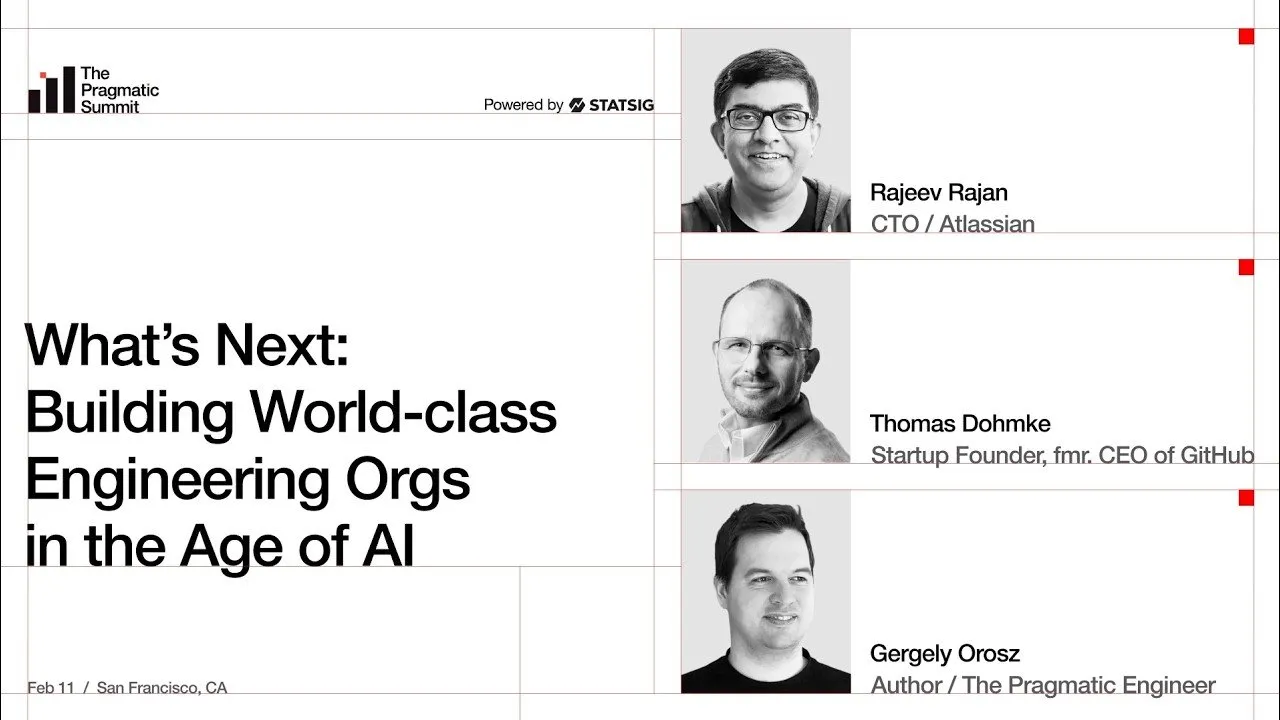
The landscape of software development is undergoing its most significant shift since the advent of cloud computing. At the recent Pragmatic Summit, industry veterans Rajie Singh (CTO of Atlassian) and Thomas Dohmke (former CEO of GitHub) sat down to discuss what it truly means to build engineering teams in an era where AI agents are no longer just assistants, but active collaborators. The conversation moved beyond the typical hype, focusing instead on the practical realities of productivity, team structure, and the rekindled joy of building software.
Key Takeaways
- Mindset Over Toolset: Being "AI native" is defined by an orchestration mindset where engineers act as masters of agents rather than just writers of syntax.
- Role Convergence: The boundaries between product management, design, and engineering are blurring as non-technical roles use AI to build functional prototypes.
- Management Evolution: Engineering leaders are returning to their technical roots, with management spans of control increasing as AI handles administrative drudgery.
- Productivity Paradigm Shift: Success is no longer measured by lines of code but by the speed of verification and the ability to unleash creative intent.
- The Return of Joy: By automating the "boring" parts of development—like unit tests and build errors—AI is making the profession of coding feel fun and experimental again.
Beyond Code: What It Means to Be AI-Native
In the early 2010s, "cloud-native" defined a generation of companies that rebuilt their infrastructure for the distributed age. Today, we are seeing the rise of the AI-native team. For Rajie Singh, this shift begins with a fundamental change in how software is birthed. At Atlassian, some teams are already operating in a mode where they write zero lines of manual code, focusing instead on the orchestration of agents to achieve their goals.
Orchestrating vs. Authoring
The AI-native developer prioritizes intent over implementation. Thomas Dohmke notes that the next generation of developers—those currently growing up with tools like Adobe Firefly and ChatGPT—will view "traditional" search or manual coding as archaic. In this environment, the bottleneck shifts from how fast one can type to how well one can reason and prompt. The goal is to look at as little code as possible, forcing the reasoning process to happen at a higher level of abstraction.
The Context Advantage
The effectiveness of an AI-native team depends heavily on context. Atlassian’s internal coding agent, RoboDev, succeeds not just because of its underlying model, but because of its integration with the "teamwork graph." This graph provides the agent with deep context regarding who is working on which Jira issue or Pull Request, allowing it to produce more relevant and accurate outputs than a generic model could.
"Agents are only as smart as the context you give them."
The Collapse of Traditional Engineering Roles
One of the most profound organizational changes discussed was the "role collapse" occurring between product, design, and engineering. Historically, these functions operated in a linear chain: product specs, design mocks, and then engineering implementation. AI is turning this chain into a circle.
The Rise of the Product Engineer
Product managers are now expected to use coding agents to build functional prototypes rather than just writing documents. This reduces the "distance" between an idea and its execution. When a designer or PM can hand over a functional artifact created with a tool like Replit or Lovable, the conversation with engineering becomes more vigorous and creative. We are seeing the emergence of "Design Engineers" and "Product Engineers" who share a much larger overlapping Venn diagram of skills.
Verification Over Inspection
As agents generate more of the codebase, the role of the human engineer shifts toward accountability and verification. Instead of line-by-line inspection, the focus is moving toward defining the "left of code" (planning and spec-ing) and the "right of code" (CI/CD, deployment, and incident resolution). The engineer becomes a guardian of the system’s inputs and outputs, ensuring the AI-generated code meets security, reliability, and performance bars.
The Evolution of Engineering Leadership
The traditional career path—moving from junior to senior to manager—is being disrupted. Rajie Singh notes that engineering managers might become rarer, but their roles will become more technical and hands-on. Leaders are no longer distanced from the codebase by layers of bureaucracy; AI allows them to dive back into the technical weeds without sacrificing their strategic responsibilities.
Increasing Spans of Control
Historically, an engineering manager might oversee 7 to 8 direct reports. In an AI-empowered organization, that number can increase significantly. Some leaders are already experimenting with spans of control reaching 30 to 50 people. This is possible because AI agents can handle the administrative "middle-ware" of management—summarizing performance data, drafting job descriptions, and even assisting with the first pass of code reviews.
"Managers and leaders... those who want to stick to the old career paths might have to find something else."
Hands-on Leadership
Thomas Dohmke points out that even CTOs of large banks are returning to coding. With agents handling the setup of environments and package management, the barrier to entry for a busy executive to build a prototype has vanished. This "dirty hands" approach allows leaders to better understand the technological shifts they are directing, leading to more informed decision-making across the organization.
Operational Realities and the Token Economy
While productivity metrics are soaring—Atlassian reports an 89% increase in PRs per engineer and a 42% decrease in cycle time—these gains come with new operational challenges. The shift from fixed salary costs to flexible "token costs" is a new reality for financial planning.
The Inversion of Cost
In a traditional setup, higher productivity doesn't necessarily increase immediate operating expenses. In the AI era, the more productive a developer is, the more they burn in API costs. This creates a potential inversion where a company might feel pressured to slow down developers to manage "token burn." Smart organizations, however, are leaning into this, realizing that the human cost of a developer is still far higher than the cost of the compute they use to be 10x more effective.
Remote Work and the "Sparring Partner"
For distributed teams, AI agents are solving the "loneliness" problem. In a remote environment, you can’t always tap a colleague on the shoulder for a quick brainstorm. Agents now serve as 24/7 "sparring partners" for research, code review, and architectural decision records (ADRs). This allows remote teams to maintain high-velocity engagement across time zones, effectively evening out the competitive advantage once held by co-located teams.
Conclusion: The Return of the Joy of Creation
Ultimately, the move toward AI-native engineering is about more than just efficiency; it is about recapturing the joy of the craft. By automating the drudgery—writing unit tests, debugging obscure build errors, and managing boilerplate—AI is allowing engineers to focus on the problems that drew them to the profession in the first place.
As Thomas Dohmke eloquently put it, coding is fun again. Whether it is building a native Mac app in minutes without looking at the underlying Swift code or resolving complex security vulnerabilities automatically, the friction between intent and reality is disappearing. The future of engineering belongs to those who embrace these agents not as a threat, but as the key to unleashing a new level of human creativity.