Table of Contents
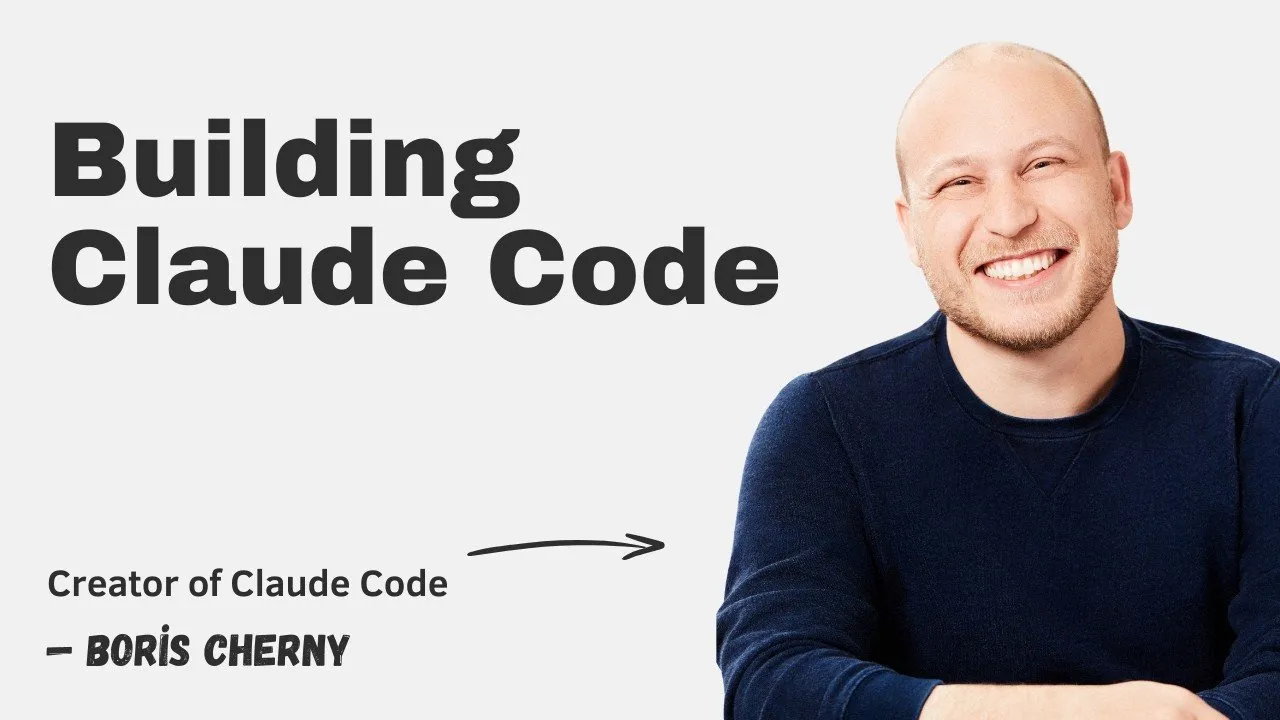
The role of the software engineer is undergoing a shift as radical as the invention of the printing press. For centuries, scribes held a monopoly on written communication; today, developers are experiencing a similar transition as AI tools like Claude Code fundamentally alter the nature of coding. Boris Cherny, the creator and engineering lead behind Claude Code at Anthropic, describes this not as the end of engineering, but as a massive expansion of the "literacy" of building software.
Key Takeaways
- The Printing Press Analogy: Just as the printing press democratized literature and replaced the need for elite scribes with a new class of authors, AI is transforming coders from manual laborers into architects of agentic systems.
- The Shift to Generalism: Modern software development increasingly rewards generalists who can navigate product, design, and infrastructure, as AI lowers the barrier to entry for technical tasks.
- The End of Manual Coding: At leading AI labs, the workflow has evolved to include shipping dozens of pull requests daily, with AI handling the implementation while humans shift their focus to verification, strategy, and high-level architectural oversight.
- Iterative Prototyping: The cost of building has collapsed, shifting the focus from rigid, pre-planned specifications (PRDs) to rapid, hypothesis-driven prototyping.
The Evolution of the Software Engineer
Boris Cherny’s career, spanning from early startup experiments to leading code quality across Meta, reflects the broader industry movement toward pragmatic generalism. At Meta, Cherny led initiatives like "Better Engineering," which mandated that 20% of an engineer's time be spent addressing technical debt—a clear recognition that long-term system health is the foundation of productivity.
Today, that philosophy has evolved. At Anthropic, the team avoids traditional silos. "Member of Technical Staff" is the standard title, signaling that everyone—from finance to product—is empowered to use tools like Claude Code to build solutions. This shift implies that the "hard skills" of the past, such as memorizing specific syntax or manual debugging, are becoming less relevant than the ability to orchestrate AI agents and maintain the system's safety and quality.
"The way to think about it is the model is its own thing. You give it tools. You give it programs that it can run. You let it run programs. You let it write programs, but you don't make it a component of this larger system in this way."
The Workflow: Shipping at Scale
The modern developer workflow, as demonstrated by the Claude Code team, is no longer about typing out individual lines of code. Instead, it is about parallelism and oversight. Cherny often manages multiple terminal tabs simultaneously, each running an agent in "plan mode."
Verification in an AI-Native World
When an AI generates 80% to 100% of a codebase, the bottleneck shifts from writing to verifying. Cherny highlights that verification is now a multi-layered process:
- Local Testing: Agents are encouraged to write and run their own unit tests before committing.
- Self-Correction: Models are increasingly capable of launching sub-processes to verify their own logic or run linting checks.
- Automated Review: CI pipelines now feature AI-driven code reviews that catch the vast majority of common bugs, leaving humans to handle only the most complex architectural concerns.
The Death of the PRD
Perhaps the most significant change in culture is the move away from rigid, written specifications. In the old world, the high cost of development meant engineers had to "aim carefully" with detailed product requirements documents (PRDs). Today, the cost of building is so low that teams prefer to show, not tell. Cherny explains that the team often creates dozens of interactive prototypes to see how a feature "feels" before committing to a final version.
"We don't really write stuff. We just show. It's a little hard to reflect back on the time before... because prototyping everything is so baked into the way that we build."
Embracing the Shift
Cherny acknowledges the sense of grief that many engineers feel as their hard-earned skills become automated. However, he remains optimistic. By offloading the "tedium of the syntax," engineers are liberated to focus on higher-level problem solving. The goal is to move beyond language wars and framework debates, focusing instead on the types and the outcomes of the systems being built.
The future, according to Cherny, belongs to those who maintain intellectual humility. Because models improve so quickly, ideas that failed six months ago might be the perfect solution today. The ability to adapt, to constantly test new hypotheses, and to bridge the gap between business needs and technical implementation will be the defining trait of the next generation of builders.
"I just think back to the printing press... none of the things around us would exist today without this. None of these things would exist. And I just kind of think about back then if people had to predict what would happen when the printing press came out, no one would have predicted that the microphone would become a thing."
Conclusion
The transition toward agentic software development is not a threat to the profession, but a signal of its maturation. By adopting a "beginner's mindset" and treating the model as a collaborator rather than a component, developers can maintain their edge in a rapidly changing landscape. As we move from being "scribes" of code to architects of autonomous systems, the potential for innovation—and the scale of what we can build—is truly limitless.