
Table of Contents
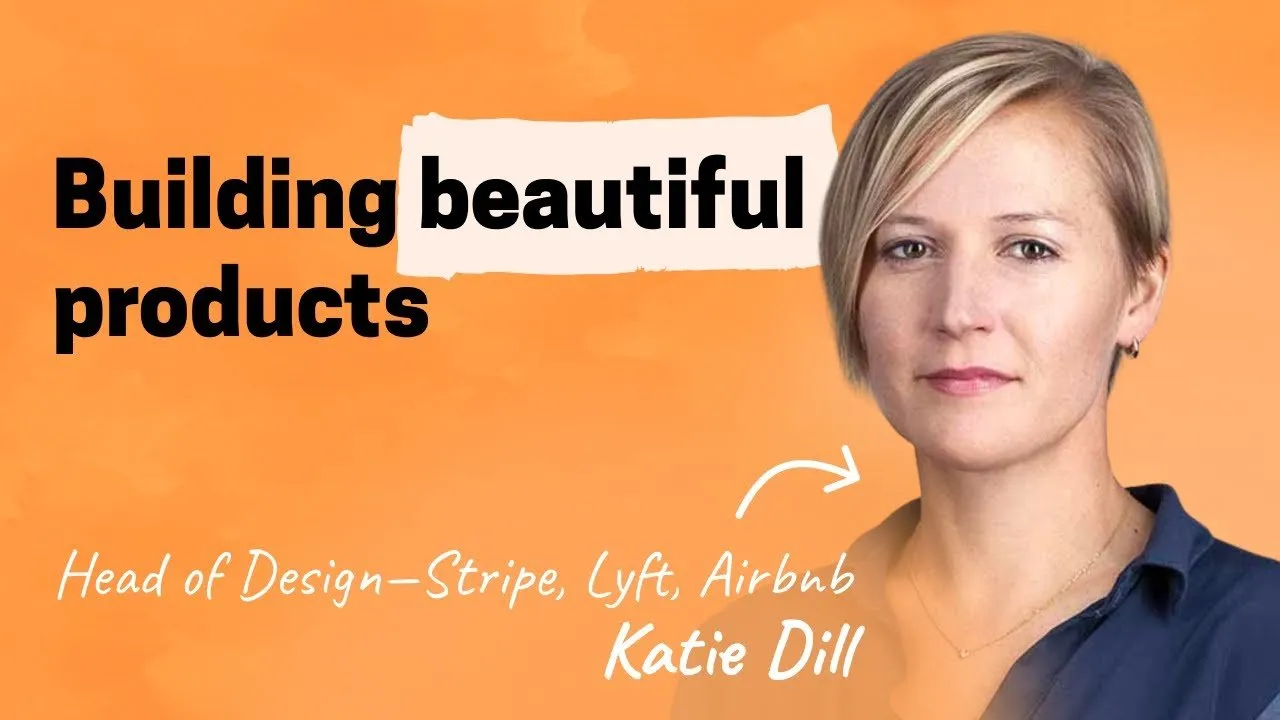
In the world of hypergrowth tech companies, design is often misunderstood as merely "making things pretty" after the engineering work is done. However, for Katie Dill, Head of Design at Stripe, design is the rigorous architecture of intention. Having led design teams at three of the world’s most design-forward companies—Airbnb, Lyft, and now Stripe—Dill has operationalized a philosophy where beauty and functionality are not opposing forces, but symbiotic drivers of business growth.
Stripe is renowned for its meticulous attention to detail, from its API documentation to its landing pages. This reputation isn't an accident; it is the result of specific, repeatable processes that prioritize quality at scale. Dill reveals how Stripe maintains its high bar, the mathematical formula she uses for team performance, and why beauty is a quantifiable business asset.
Key Takeaways
- Quality drives growth: Improvements to the design quality of checkout flows led to a 10.5% increase in revenue for businesses using Stripe, proving that beauty and usability are direct revenue drivers.
- The "Walk the Store" method: Stripe operationalizes quality by having cross-functional leaders audit 15 critical user journeys quarterly, grading them on friction and emotional experience rather than just uptime.
- Performance equation: Dill manages teams using the formula Performance = Potential - Interference. A leader’s job is to maximize talent while aggressively removing the bureaucratic weight that slows them down.
- Visibility solves redundancy: A simple, low-tech "visual scroll" deck shared monthly allows the entire organization to see work-in-progress, preventing silos and colliding roadmaps.
- Hiring for taste: While tools can be taught, taste and character cannot. The most effective way to gauge this is by asking candidates to deconstruct the work they are most proud of.
The ROI of Beauty: Why Craft is a Business Metric
There is a pervasive belief in product management that functionality is king, and beauty is a "nice-to-have" layer applied at the end. Dill argues that this view is obsolete. Functionality and beauty are not on opposite ends of a spectrum; rather, beauty enhances functionality by building trust and reducing cognitive load. When a product feels crafted, users implicitly trust that the backend engineering is equally robust—a critical factor for a financial infrastructure company like Stripe.
Functionality is important and actually beauty enhances functionality because it does make things easier to use, more approachable, and more compelling to use.
The business impact of this philosophy is measurable. Dill points to Stripe’s relentless optimization of their checkout experience. By analyzing the top e-commerce sites, Stripe found that 99% had errors in their checkout flows that hindered conversion. By redesigning these flows with a focus on high-quality interaction design and removing friction, they achieved significant results.
- Trust increases conversion: High-quality design signals competence. In financial transactions, if the interface looks neglected, users worry about the security of their money.
- The 10.5% lift: Through rigorous design improvements in the checkout suite, Stripe saw a 10.5% revenue increase for businesses moving from older integrations to the newer, optimized checkout forms.
- Beauty begets beauty: When a platform sets a high visual standard, it elevates the work of everyone interacting with it, from internal employees to external partners.
Operationalizing Quality: The "Walk the Store" Methodology
As companies scale, the gravitational pull is always toward mediocrity. Maintaining excellence requires specific rituals. At Stripe, they utilize a process called "Walking the Store" to ensure that the user experience doesn't degrade as new features are shipped by siloed teams.
The 15 Critical Journeys
Stripe identified 15 essential user journeys—such as onboarding, running a payout, or checking an invoice. They appointed cross-functional leaders (Engineering, Product, and Design) to own the quality of each journey. These owners are not just responsible for shipping code, but for the holistic experience of that pathway.
Friction Logging and Calibration
The process involves leaders physically going through the product flows as a user would, documenting the experience in a "friction log."
- Quarterly Audits: Leaders walk through their designated journeys at least once a quarter.
- Holistic View: The audit starts from a Google search or a documentation page, not just inside the logged-in dashboard, to capture the full user context.
- Qualitative Scoring: Teams grade their journeys using a color-coded system (Green, Yellow, Red) based on usability, utility, and desirability.
- PQR Meetings: In "Product Quality Reviews," teams present their scores to executive leadership. This acts as a calibration mechanism, ensuring that one team’s "Green" isn't another team’s "Yellow."
This system forces leaders to rely on their own product judgment rather than hiding behind data. While user research is vital, internal leaders must have the taste and empathy to recognize a bad experience without needing a study to prove it.
The Leadership Formula: Removing Interference
Leading design at hypergrowth companies like Airbnb and Lyft taught Dill that scaling a team isn't just about hiring more bodies; it is about environment management. She utilizes a specific mental model to diagnose team issues.
Performance equals potential minus interference.
Maximizing Potential
This side of the equation involves hiring the best talent and developing their skills. However, Dill notes that many leaders over-index on potential while ignoring the second half of the equation.
Minimizing Interference
Interference is the organizational "lead weight" that suppresses talent. It manifests as misalignment, bureaucracy, or poor physical and digital structures.
- Breaking the "Creative" Silo: At Lyft, the design team originally sat in a separate, locked room filled with creative inspiration. While it fostered design culture, it created a disconnect with engineering. Dill literally and figuratively broke down the walls, embedding designers with their cross-functional partners while maintaining shared spaces for critiques.
- The Intervention: Early in her tenure at Airbnb, Dill faced a mutiny where her team presented her with a list of grievances. The core issue was not her strategy, but a lack of trust. She learned that you cannot inflict change on a team until you have earned their trust through listening. Interference often comes from leadership moving faster than the team's trust levels allow.
Creating Visibility with the "Visual Scroll"
In large organizations, redundancy is a silent killer. Two teams might solve the same problem in two different ways, or a feature might conflict with a marketing narrative. To solve this, Dill implemented a low-friction visibility habit known as the "Visual Scroll."
- The Format: A simple Google Slide deck where designers drop screenshots or prototypes of what they are working on.
- The Frequency: Originally bi-weekly, now monthly.
- The Audience: The deck is circulated not just to designers, but to product managers, engineers, and executive leadership.
- The Goal: It is not a status check or a critique session. It is an awareness mechanism. It allows anyone in the company to spot patterns, redundancies, or opportunities for collaboration without scheduling a meeting.
This practice reinforces the idea that work-in-progress should be shared. Waiting for "pixel perfection" before sharing creates silos; sharing early drafts creates alignment.
Hiring for Taste and Character
When building a team that cares about "meticulous craft"—one of Stripe's operating principles—Dill looks for attributes that cannot be easily trained. While you can teach a designer how to use Figma or how to follow a specific agile process, you cannot easily teach them how to care.
It's easier to teach tools and process than it is taste and character.
The "Pride" Interview Question
To assess these intangibles, Dill asks candidates: "Tell me what work you are most proud of."
- Assessing Taste: What a candidate considers "great work" reveals their internal quality bar. If they are proud of mediocre work, their ceiling is likely low.
- Assessing Motivation: This question reveals what drives them. Do they care about the visual polish? The user impact? The complexity of the problem?
Humility and Hustle
Dill emphasizes the combination of humility and "hutzpah." Design is an act of creation that requires the courage to present something new to the world, but it requires the humility to listen when users (or data) say it isn't working. A designer who lacks humility will defend bad work; a designer who lacks hustle will never ship good work.
Conclusion: Design is Intention
Ultimately, Dill views design not as a department, but as a behavior. Design is simply intention applied to execution. whether you are designing an API, an org chart, or a door handle, you are making decisions about how a human will interact with that object.
Stripe’s success suggests that when companies stop viewing design as a cosmetic layer and start treating it as a core business lever—operationalized through rigorous reviews, intentional friction logging, and a culture of high craft—they don't just build prettier products. They build more profitable ones.



)