
Table of Contents
Waking up late in your career and feeling trapped is a terrible outcome. You have a certain lifestyle and expectations from others, forcing you into a job that leaves you unhappy when you look in the mirror. This is a trap we should all try to avoid. Navigating your career path is about finding what's most optimal for you—a mix of success, meaningfulness, and alignment between your work and your personal values. With the right frameworks, you can intentionally build a career that is not just successful, but genuinely joyful.
Key Takeaways
- Use Curiosity Loops for Better Decisions: Instead of asking vague questions, create a structured process to gather contextual advice. Ask a specific question to a curated group of people, make it lightweight to respond to, and process the diverse feedback to inform your final decision.
- Define Your Inner Scorecard: Move beyond external metrics like status and salary. A values exercise helps you identify your core principles, creating an internal scorecard to gauge whether opportunities truly align with what matters most to you.
- Frame Your Career with "Explore and Exploit": In your early career, focus on exploration—testing hypotheses about what you enjoy and where you excel. Once you find a rich area, switch to exploitation mode to deepen your expertise and maximize your learning.
- Seek and Internalize Hard Feedback: Success often depends on understanding unwritten rules. Proactively seek honest feedback, even on sensitive topics, to uncover blind spots that might be holding you back.
- Be Strategic About Coaching: An executive coach isn't for everyone. They are most valuable during periods of hyper-growth or when navigating sensitive, complex challenges. For most other situations, alternatives like mentorship, courses, or community support can be more effective.
Make Better Decisions with Curiosity Loops
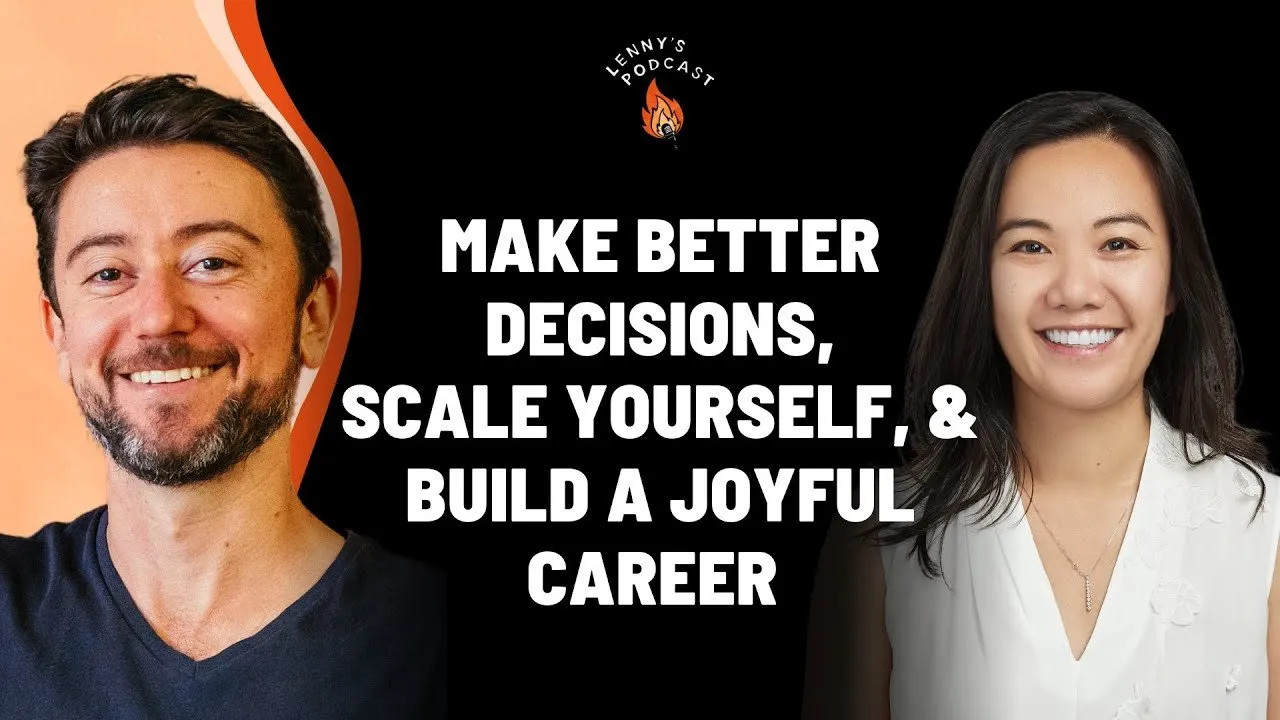
We often turn to friends for advice, but the process can be haphazard and the feedback unhelpful. Ada Chen Rekhi, co-founder of Notejoy and an executive coach, champions a structured method called "Curiosity Loops." It’s a way to gather high-quality, contextual advice that fights the noise of well-intentioned but often generic guidance.
It really fights the fact that there's a lot of bad advice out there...it's bad because it's not contextual.
A Curiosity Loop isn't just asking, "What should I do?" It's a deliberate process of user research for your life decisions. By treating your choices with the same rigor you'd apply to a product, you can uncover blind spots and make more confident moves. The key is to remember that you are still the final decision-maker; the loop provides inputs, not instructions.
How to Structure a Curiosity Loop
You can run a heavyweight loop with a formal email and document, or a lightweight one by weaving a consistent question into your daily conversations. Either way, the structure follows four key steps.
- Ask a Good Question: Start with a specific, unbiased question that solicits rationale. A bad question is, "What should I do with my career?" It's vague and puts a high cognitive load on others. A better question is, "I'm a marketer considering a web dev boot camp to switch careers. What are your thoughts on this plan?" This gives people a concrete scenario to react to.
- Curate Who You Ask: Your panel should include two types of people. First, subject matter experts who understand the domain (e.g., a web developer). Second, and just as important, people who know you well. They can provide insight into whether a path is a good fit for your personality and skills. Aim for a group large enough to yield at least three or four responses.
- Make it Lightweight: Respect people's time. Don't ask them to write an essay. Frame the ask so it’s easy to answer, like, "Here are nine topics, which two resonate most and why?" A simple, low-friction request increases your response rate and the quality of feedback from busy individuals.
- Process and Give Thanks: The goal isn't to follow the advice blindly but to look for patterns, surprises, and strong disagreements. This is about checking the integrity of your own thinking. Afterwards, close the loop by thanking your participants and sharing how their input was helpful. It feels good to help someone, and acknowledging their impact strengthens your relationships.
Define Your "Why" with a Values Scorecard
The external world constantly pressures us with its own scorecard: titles, salary, status, and prestige. It's easy to get caught chasing achievements that look good on a resume but leave you feeling empty. The antidote is to develop and live by your own internal scorecard, and that starts with defining your values.
I think you know it's a terrible outcome to wake up one day and be sort of late career and feel trapped.
Ada uses a simple values exercise with her coaching clients. It involves reviewing a long list of potential values, selecting those that resonate, and then stack-ranking them to identify the top three to five. This process creates a personal compass for decision-making. When faced with a choice, you can ask, "Does this align with my values?" instead of "Will this look good to others?" This internal alignment is the foundation of a fulfilling and sustainable career.
Inner Scorecard vs. Outer Scorecard
The concept, popularized by Warren Buffett, distinguishes between living for external validation versus internal principles. The outer scorecard is how the world evaluates you. The inner scorecard is how you evaluate yourself—based on your character, your actions, and your alignment with what you truly believe matters.
Ada shared how this framework helped her turn down a high-profile job that, while impressive on paper, would have categorically failed her top three values. The role demanded grueling travel and wasn't in a space she was passionate about. It would have been a win on the outer scorecard but a loss on the inner one. Prioritizing relationships, autonomy, and personal growth led her down a different path—one that was ultimately more rewarding.
A Framework for Your Early Career: Explore and Exploit
Your career isn't a linear ladder; it’s a journey of discovery. Ada recommends viewing your early career through the lens of "explore and exploit," a concept borrowed from growth strategy. This framework helps you be intentional about when to broaden your experiences and when to double down.
The Exploration Phase
Early in your career, your primary goal should be exploration. You have a lot of unknowns, so you should be testing hypotheses about what kind of work energizes you, what environments you thrive in, and what skills you want to build. Ada’s own path is a perfect example. She moved from a large corporation (Microsoft) to a startup (Mochi Media) to founding her own company (Connected). Each step was a deliberate experiment to learn more about what she wanted, refining her thesis from "corporate life is too slow" to "I love marketing and small teams" to "I want to be a founder."
The Exploitation Phase
Once you've found something rich and deep, you can switch to exploitation mode. This is where you focus on getting more out of a proven area. After her startup was acquired by LinkedIn, Ada was intentional about her goals. Instead of chasing titles, she told her manager, "I'm here to learn to be a better founder." She strategically moved into roles in growth and subscriptions to fill the gaps in her knowledge, exploiting the opportunity to learn at scale. This unique combination of experiences is what made her the ideal candidate for her next role as SVP of Marketing at SurveyMonkey.
Don't Be the Boiling Frog
A common pitfall is staying in a situation that is slowly becoming untenable. This is the "boiling frog" analogy: a frog thrown into boiling water will jump out, but one placed in cool water that is slowly heated won't notice the gradual change until it's too late.
It's really easy for all of us to be the frog where there are little things that make us uncomfortable and you know we kind of sit with them.
It’s easy to become a victim of inertia, telling yourself things will get better after the next promotion or with a new manager. To avoid this, constantly ask yourself: "What am I learning? Am I still growing?" If the answer is no, it's time to be an agent in your own career. This doesn't always mean quitting. It could mean having a proactive conversation with your manager about new projects or, if that fails, using your extra time at an optimized job to build new skills or relationships on your own.
Thriving in Your Career: Unwritten Rules and Hard Feedback
Advancing in any field, especially a competitive one like Silicon Valley, is like playing a game where nobody tells you all the rules. Success often hinges on understanding subtle cues and navigating unwritten expectations. This is particularly challenging for underrepresented groups, who may not receive the direct feedback needed to grow.
Ada shared a powerful story of coaching a brilliant female founder. While the founder's competence was undeniable over Zoom, her casual in-person appearance could have created a hurdle with investors unfamiliar with her work. No one had ever connected the dots for her between her presentation and the potential biases it might trigger. Giving this feedback was incredibly difficult, but it was also a gift. It empowered the founder to control her narrative and ensure her first impression matched her operational excellence. This highlights a critical lesson: we are not powerless. We can study the game, help each other learn the rules, and proactively seek the hard feedback others are often afraid to give.
Eat Your Vegetables: The Power of Deliberate Practice
How do you distinguish between genuine dislike for something and the simple discomfort of being a beginner? Ada calls this concept "eating your vegetables." Researchers say it takes 10 to 12 exposures for a child to develop an appreciation for a new vegetable. The same principle applies to skills. The first time you do something hard, you probably won’t be good at it, and you probably won’t like it.
Early in her career, Ada was awkward at networking. She forced herself to go to one event a week with a clear rule: hand out 10 business cards and touch the back wall of the venue before leaving. It was horrible at first, but it got better. She began seeing familiar faces and grew more confident in introducing herself. This deliberate, if uncomfortable, practice built the foundation of her professional network. Identify the skills you need but aren't good at, and create an intentional plan to practice them until they become second nature.
The Role of an Executive Coach in Your Growth
With the rise of coaching, it's tempting to think everyone needs one. However, Ada offers a "hot take": for the vast majority of people, a coach is likely not the best solution. Before hiring one, it's crucial to define your goals and explore alternatives.
If you're seeking mentorship, a Curiosity Loop with several experts is better than relying on one person's opinion. If you want to learn a specific skill like growth, a structured course might offer more comprehensive knowledge. And if you need emotional support, building a trusted community of peers will last you a lifetime. A coach can be a powerful resource, but they shouldn't be the default option.
When Is a Coach the Right Choice?
Coaching is most impactful in specific, high-stakes situations. Ada identifies two key scenarios:
- Hyper-Growth and Accelerated Learning: Founders, for example, are in a unique state of chaos. They face fully justified imposter syndrome and must learn incredibly quickly. A coach can act as a shortcut, providing frameworks and guidance when time is of the essence.
- Navigating Sensitive Topics: Issues like interpersonal conflicts or deep-seated people problems require a safe, confidential space. A coach can provide rational, objective guidance to help you work through complex challenges without judgment.
If you decide to pursue coaching, talk to two or three different coaches. Research shows that half of people go with the first coach they talk to, but "vibe" and personal connection are more important than a perfect on-paper resume. Find someone who understands you and whose style matches how you learn best.
Conclusion
Building a career that brings you both success and joy requires intention. It means shifting your focus from the external scorecard of what the world expects to the internal scorecard of what you value. By using frameworks like Curiosity Loops to make better decisions, "Explore and Exploit" to guide your career path, and proactively "eating your vegetables" to build necessary skills, you move from being a passenger to being the pilot of your own professional life. The journey isn't always easy, but it’s far better than waking up one day in a trap of your own making.

)