Table of Contents
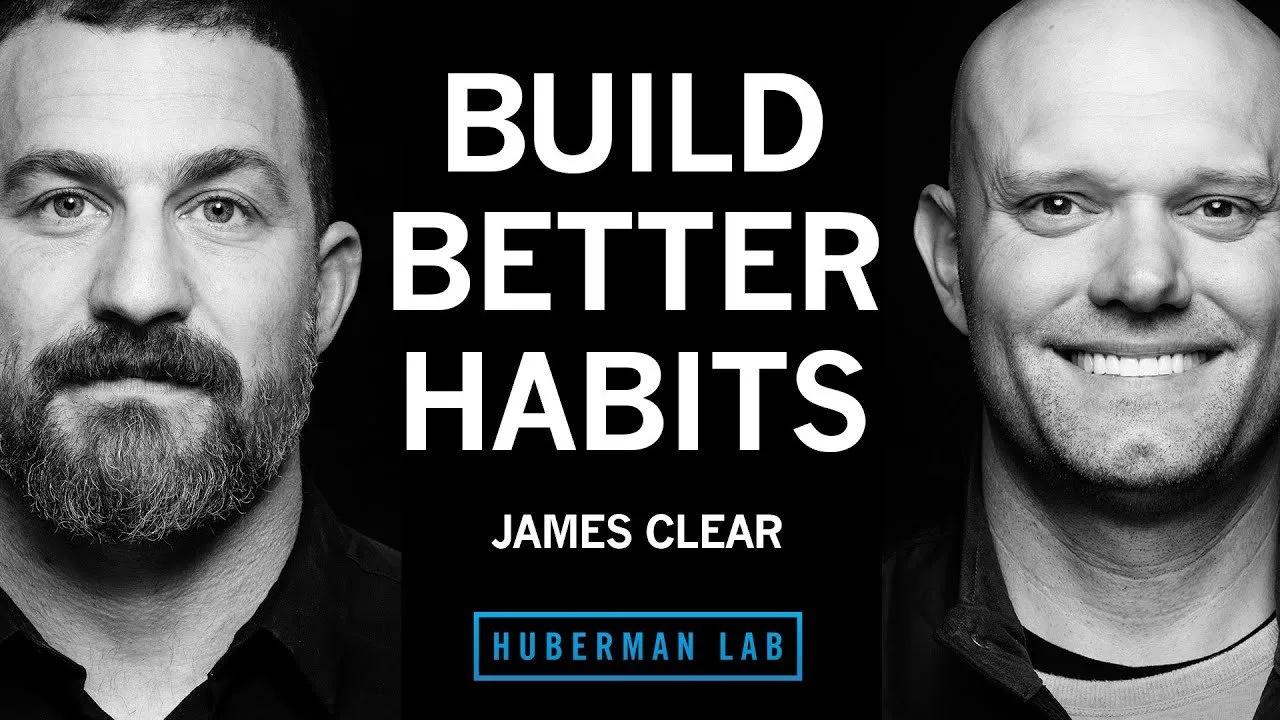
Habits are essentially automated solutions to recurring problems in our environment. When you finish a long, exhausting day at work, your brain seeks a resolution to that stress. One person might solve it by going for a 30-minute run, while another solves it by smoking a cigarette. Both are attempting to resolve the same core friction, but the long-term trajectories of those lives will differ vastly. Often, the habits we rely on are simply inherited from parents or modeled by friends, rather than chosen optimally. Once you realize your current solutions may not be the best ones, it becomes your responsibility to design better systems. In this deep dive based on a conversation between neurobiologist Andrew Huberman and author James Clear, we explore the science of building rock-solid habits and breaking detrimental ones.
Key Takeaways
- The Art of Showing Up: Consistency beats intensity. The habit of simply getting to the gym is more important than the workout itself during the early stages of behavior change.
- The Four Laws of Behavior Change: To build a habit, make it obvious, attractive, easy, and satisfying. To break one, invert these laws.
- Identity Drivers: True behavioral change happens when you shift your focus from what you want to achieve to who you want to become.
- Environment Design: Your environment acts like gravity, gently pulling you toward certain behaviors. Altering your physical and digital space is more effective than relying on willpower.
- The "Never Miss Twice" Rule: Perfection is impossible. Success is defined by how quickly you rebound after a slip-up, preventing a mistake from becoming a new habit.
Mastering the Entry Point: The Art of Getting Started
The single biggest hurdle in habit formation is friction. Most people assume that to achieve a big goal, they need a big, ambitious plan. However, the data suggests that those who succeed are the ones who master the art of the start. If you can optimize the first two minutes of a behavior, the rest often follows naturally. This concept relies on scaling the habit down until it requires almost no effort to begin.
James Clear highlights the story of a reader who built a workout habit by adhering to a strict rule: he was not allowed to stay at the gym for longer than five minutes. For six weeks, he drove to the gym, did half an exercise, and left. Psychologically, this seems counterintuitive, but he was mastering the art of showing up. He became the type of person who went to the gym four days a week. Once that identity was established, increasing the duration was easy.
The heaviest weight at the gym is the front door.
To implement this, consider the following strategies:
- Reduce Friction: If you want to run in the morning, sleep in your running clothes or place your shoes directly in front of your bedroom door.
- Optimize the Environment: Walk through your home and ask what behaviors the space encourages. If the couch faces the TV, it encourages consumption. If a guitar is hidden in a closet, it discourages practice.
- The Two-Minute Rule: Scale any new habit down to a version that takes two minutes or less. Read one page, not one chapter. Write one sentence, not one article.
- Standardize Before You Optimize: You cannot improve a habit that does not exist. Establish the consistency of showing up before worrying about the quality of the performance.
- Mental Toughness as Adaptability: Refrain from viewing consistency as rigid perfection. True mental toughness is adaptability—finding a way to do the "easy version" on bad days rather than doing nothing at all.
- Identify the Wedge: Find the "thin edge of the wedge"—the smallest action that initiates the momentum for the larger task.
The Four Laws of Behavior Change
While there is no single way to build better habits, there is a comprehensive framework that covers the psychological requirements for recurring behavior. Clear outlines the "Four Laws of Behavior Change," which describe the stages a habit goes through: cue, craving, response, and reward.
How to Build a Good Habit
- Make it Obvious (The Cue): Design your environment so the cues for good habits are visible. Place healthy food on the counter, not in the drawer. Schedule your workouts in your calendar so the time is undeniable.
- Make it Attractive (The Craving): Pair the habit with something you enjoy (temptation bundling). Or, join a social group where your desired behavior is the normal behavior, leveraging the human desire to belong.
- Make it Easy (The Response): Reduce the number of steps between you and the good behavior. Use technology to automate savings or set reminders. The less friction, the more likely the action.
- Make it Satisfying (The Reward): Give yourself an immediate reward for completing the habit. This is crucial because the long-term rewards (health, wealth) are delayed. You need an immediate signal that the behavior paid off.
How to Break a Bad Habit
To eliminate a bad habit, you simply invert the four laws:
- Make it Invisible: Remove the cue. If you check your phone too much, leave it in another room. If you eat junk food, do not buy it.
- Make it Unattractive: Reframe your mindset to highlight the benefits of avoiding the bad habit. Visualize the negative identity associated with the behavior.
- Make it Difficult: Increase friction. Unplug the TV after every use. Delete social media apps so you have to re-download them to log in.
- Make it Unsatisfying: Create an immediate cost. Use a habit contract where you owe a friend money if you engage in the bad behavior.
Identity-Based Habits: Who Do You Wish to Become?
True behavioral change is identity change. Many people focus on outcome-based habits: "I want to lose 20 pounds" or "I want to write a book." A more effective approach is to focus on identity-based habits: "I want to be a runner" or "I want to be a writer."
Every action you take is a vote for the type of person you wish to become. No single instance transforms your beliefs, but as the votes build up, so does the evidence of your new identity. This shifts the internal narrative from "I am trying to run" to "I am a runner." When you take pride in an aspect of your identity, you are more motivated to maintain the habits associated with it.
Every action you take is like a vote for the type of person you wish to become.
Considerations for Identity Shift:
- The Double-Edged Sword: While adopting an identity helps build habits (e.g., "I am a soldier"), clinging to it too tightly can hinder growth when life circumstances change (e.g., retirement or injury).
- Flexible Identity: Learn to redefine yourself by your characteristics rather than your titles. Instead of "I am the CEO," think "I am the type of person who builds solutions."
- The "Season" of Life: Acknowledge that habits serve specific seasons. A workout routine that worked in your 20s may not fit your 40s. Adapting your habits does not mean you are failing; it means you are evolving.
- Consistency Enlarges Ability: By consistently reinforcing an identity—even in small ways—you raise your baseline capacity, making you capable of handling harder challenges later.
- Internal vs. External Validation: Relying on external accolades to define your identity is dangerous. Focus on the internal satisfaction of "playing the game" rather than just winning it.
- Reinventing Yourself: Be willing to edit your identity. Life is dynamic, and your habits and self-conception should be retouched continuously like a painting.
Environment Design: The Invisible Hand
We often attribute our failures to a lack of willpower, but frequently, the culprit is a poorly designed environment. Your environment acts as a form of gravity, constantly nudging you toward the path of least resistance. If you are fighting your environment, you are fighting a losing battle.
Physical Environment
Walk into any room in your house and ask: "What is this space designed to encourage?" If your desk is cluttered with distractions, it encourages procrastination. If your phone is the first thing you see in the morning, it encourages scrolling.
James Clear utilizes a "phone in another room" policy. By leaving his phone in a separate room until lunch, he eliminates the constant, low-level friction of checking notifications. Interestingly, he notes that while he would check his phone every three minutes if it were in his pocket, he never wants to check it badly enough to walk 30 seconds to the other room. This proves that a small amount of friction is often enough to break a bad habit.
Social Environment
The people around us influence our behavior significantly. We are driven by a deep desire to belong. If your desired habits go against the grain of your social group (e.g., refusing alcohol when everyone is drinking), maintaining them requires high friction and willpower.
- Join the Right Tribe: The most effective way to build a habit is to join a group where your desired behavior is the normal behavior. When you see others doing it, it becomes the standard expectation.
- Create the Group: If a group doesn't exist, build it. Clear cold-emailed authors and created retreats to normalize the habits of writing and entrepreneurship in his own life.
- Social Norms Override Willpower: Most people would rather be wrong with the crowd than right by themselves. Leverage this by placing yourself in crowds that are "right" regarding the habits you want to build.
- Digital Environment: Curate your digital feeds. Your thoughts are downstream of what you consume. If you follow accounts that make you feel inadequate or distracted, your habits will reflect that.
- The "Clean Slate": It is easier to change habits in a new environment. If you go to a new place (like a coffee shop or a park), you break the association with your old cues, allowing you to form new patterns.
- Context Association: Dedicate specific devices or chairs to specific tasks. If you only journal in one specific chair, eventually, sitting in that chair will prime your brain to journal.
The "Never Miss Twice" Rule
Perfection is a trap. In any long-term pursuit, you will inevitably have a bad day, miss a workout, or break your diet. The difference between top performers and everyone else is not that they never fail; it is that they rebound quickly.
The "Never Miss Twice" rule is a philosophy for resilience. If you miss one day, your priority becomes not missing the second. The first mistake is a mistake; the second mistake is the beginning of a habit. By reclaiming the habit immediately, you prevent the slip-up from compounding.
The people who make it easy to get started and who master the art of getting started tend to stick with it and succeed.
- Avoid the "All-or-Nothing" Mentality: Do not let a bad morning ruin the whole day. You can compartmentalize your day into quarters—if you lose the first quarter, play hard to win the remaining three.
- The Bad Days Matter Most: It is easy to work out when you feel motivated. It is the days when you don't feel like it—but do it anyway—that build the most mental fortitude and maintain the compound interest of your habits.
- Scale Down, Don't Stop: On a bad day, reduce the scope. If you can't run 5 miles, run 5 minutes. Keeping the habit alive is more important than the intensity of the session.
- Consistency is Adaptability: The person who can adjust their habit to fit a chaotic day is more likely to succeed than the person who requires perfect conditions.
- Speed of Retrieval: Focus on the recovery time. How fast can you get back on track? That metric matters more than your streak.
- Compassion over Criticism: Beating yourself up typically leads to shame, which rarely fuels positive behavioral change. Acknowledging the slip and immediately correcting it is a pragmatic, non-judgmental approach.
Curating Inputs to Drive Outputs
Your creative output is directly tied to the quality of your intellectual inputs. As the saying goes, "garbage in, garbage out." Clear views his reading habit as the fuel for his writing engine. If he stops reading, the writing suffers because the reservoir of ideas dries up.
This concept extends to the "T-shaped" model of expertise. The vertical bar of the "T" represents deep focus on a specific project or craft. The horizontal bar represents wandering curiosity and broad inputs. You need the focus (the project) to give your wandering direction. When you are deeply focused on a project, your brain acts like a filter, scanning the world for relevant information.
- Read Before You Write: Prime your brain with high-quality ideas before attempting to produce your own.
- Wander to Learn, Focus to Achieve: Balance periods of broad exploration with periods of intense execution.
- Select Your Sources: Be ruthless about who you follow and what you read. These inputs will form the basis of your future thoughts.
- The Antenna Effect: Having a clear mission or project activates your reticular activating system, helping you spot connections you would otherwise miss.
- Synthesis is Creativity: Creativity is often just connecting two previously unrelated ideas. To do this, you need a diverse diet of inputs.
- Environment as Input: Even your physical posture and the spaces you inhabit are "inputs" that shape your state of mind.
Conclusion
Building better habits is not about possessing superhuman willpower; it is about designing a life where good decisions are the path of least resistance. By mastering the art of showing up, optimizing your environment, and anchoring your habits to a desired identity, you move from fighting against yourself to flowing with your natural psychology. Remember, the goal is not to be perfect, but to be consistent. If you fall off the wagon, simply apply the rule: never miss twice.