Table of Contents
Bryan Cantrill is a figure who has seen the absolute best and worst of Silicon Valley. With a career spanning over 30 years—including a legendary tenure as a Distinguished Engineer at Sun Microsystems and a leadership role at Joyant—he has transitioned from the "nuclear winter" of the dot-com bust to founding Oxide Computer Company. In a wide-ranging conversation, Cantrill reflects on the technical failures of early Microsoft, the predatory brilliance of Jeff Bezos, and why he believes the traditional corporate hierarchy is fundamentally broken. His journey serves as a masterclass in staying technically grounded while navigating the volatile shifts of the technology industry.
Key Takeaways
- Stack ranking is "organizational cancer": The practice of grading employees against each other creates perverse incentives and turns teams into adversaries.
- Jeff Bezos is an "apex predator" of capitalism: Amazon’s early dominance in cloud computing was driven by relentless execution and strategic price cuts that discouraged competition.
- Meaning beats financial independence: Chasing a "number" often leads to a mid-life crisis; true career longevity comes from finding work with intrinsic meaning.
- Failures are load-bearing: Even catastrophic mistakes, like the "worst hire in human history," are essential for building the rigor required to succeed later.
- Hardware-software co-design is the new frontier: Oxide was founded to build the "rack-scale" computers the enterprise market lacks, moving away from the mediocrity of generic server providers.
The Corrosive Nature of Corporate Hierarchy
Throughout his career, Cantrill has maintained a healthy skepticism of corporate titles and formalized performance reviews. At Sun Microsystems, he observed that the process of being promoted to "Distinguished Engineer" was often more political than technical. He argues that ranks are frequently corrosive, failing to get the best work out of people and instead encouraging performative behavior.
The Failure of Stack Ranking
One of Cantrill’s most pointed critiques is directed at stack ranking, a system famously used by companies like Intel and Microsoft. By forcing managers to identify a bottom percentage of performers to "yank," the system incentivizes leaders to keep "dead weight" on their teams simply to have someone to sacrifice during review cycles.
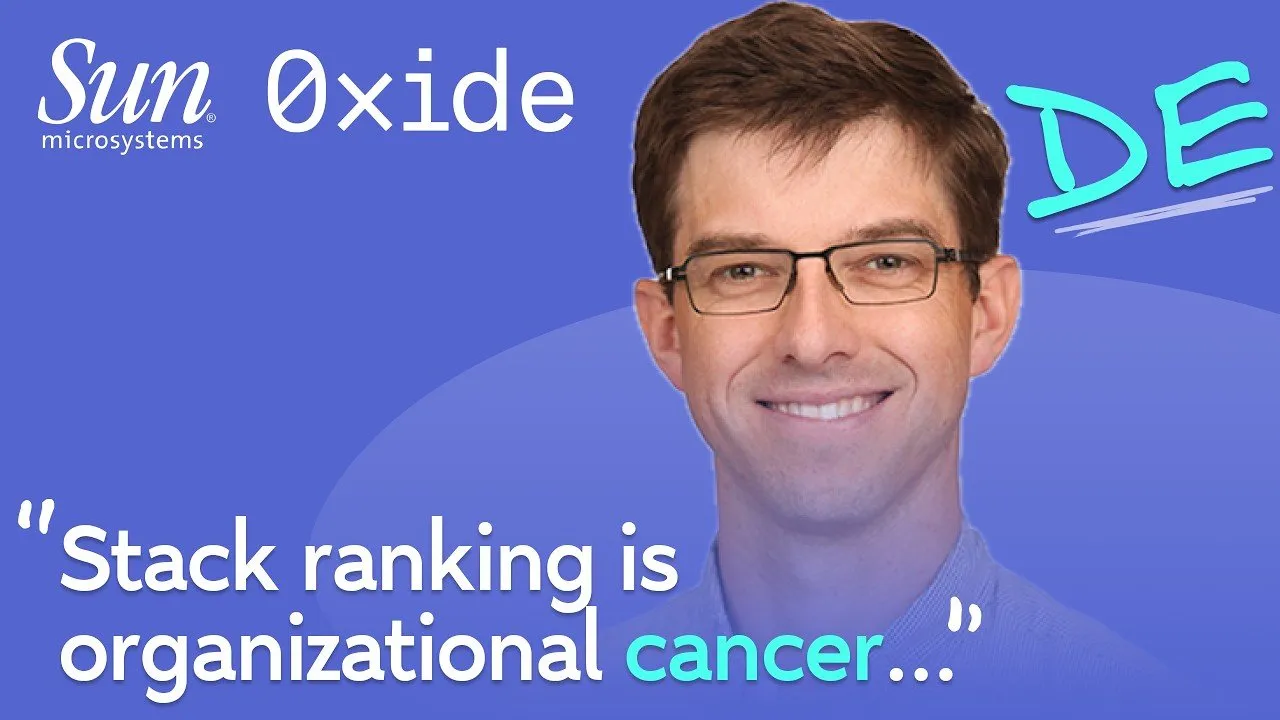
"Stack ranking is organizational cancer. It teaches you that your team are adversaries, and that is just not the way I want to operate."
Cantrill asserts that teams, not individuals, do extraordinary things. When the system rewards individual survival over collective success, the internal culture begins to rot. This is why his current venture, Oxide, avoids traditional ranks entirely, focusing instead on shared goals and technical excellence.
Lessons from the "Apex Predator" of Capitalism
During his time at Joyant, Cantrill competed directly with Amazon Web Services (AWS). This vantage point gave him a unique perspective on Jeff Bezos and the strategic brilliance that allowed Amazon to monopolize the cloud market before competitors even realized it was a viable business.
The AWS Strategy of Relentless Execution
Critics often mistake Amazon’s success for luck, but Cantrill argues it was the result of being an "apex predator." By relentlessly cutting prices at every re:Invent conference between 2010 and 2015, Bezos signaled to the market that the cloud was a low-margin, "terrible" business. This discouraged potential competitors from entering the space while Amazon quietly built a massive, highly profitable infrastructure.
"He is not merely a predator. He is an apex predator in capitalism. This is what makes him so good. He presses his advantage to make it so no one can compete."
This period of innovation was essential for cloud-born companies, but it also created a landscape where Amazon’s execution was so extraordinary that competing required finding very specific, narrow lanes. Cantrill notes that while Amazon is still profitable, it has transitioned away from that era of "must-have" new services and relentless price reductions.
The Foundational Shift: From Sun to Oxide
The acquisition of Sun Microsystems by Oracle remains a controversial chapter in tech history. Cantrill describes the transition as moving from a company that endeavored to do the right thing for its customers to one focused solely on "asphyxiating competition and raising the rent." This cultural misalignment led to a massive exodus of top-level engineering talent.
The "Suicide Mission" of Hardware
Starting a computer company in 2019 was widely considered a "suicide mission" by venture capitalists. The prevailing wisdom favored Software-as-a-Service (SaaS) models over the capital-intensive world of hardware. However, Cantrill and his co-founder Steve Tuck felt that the enterprise market was being served "junk" by companies like Dell and HP.
They envisioned a rack-scale machine—a computer where the hardware and software were co-designed from the ground up. Despite early rejections from VCs who had "big zeros" in their portfolio from previous hardware failures, Oxide successfully launched by leaning into the contrarian nature of their thesis. They focused on general-purpose CPU compute, avoiding the "gory" and proprietary landscape of GPUs dominated by Nvidia.
Finding Meaning in "Postpartum Engineering"
A recurring theme in Cantrill’s philosophy is the search for intrinsic meaning over extrinsic rewards. He warns young engineers against the "Financial Independence, Retire Early" (FIRE) movement, suggesting that achieving wealth without a purpose is a recipe for misery. He points to the .com bust as a helpful corrective that forced many in Silicon Valley to remember why they entered tech in the first place.
The High of the Heist
Cantrill compares the ideal organizational model to a "heist movie." He finds the most happiness when working on a team where everyone brings a unique, specialized skill—the "safe cracker," the "getaway driver"—to pull off a task that seems impossible. This collective triumph is what he calls the "fuel in the furnace" of a long career.
He also acknowledges the phenomenon of "postpartum engineering," the hollow feeling that often follows the shipping of a major project. To combat this, he emphasizes building a culture where the work itself, and the team performing it, provides the fulfillment, rather than just the final product or the paycheck.
Reflections on a "Lucky" Career
When asked about his regrets, Cantrill points to a few public outbursts and a notoriously bad hire at Joyant—a man who turned out to be a violent felon on parole. Yet, even these "catastrophes" were load-bearing. The bad hire led to a total redesign of his hiring process, moving toward a writing-intensive, values-based approach that now defines Oxide’s elite team.
Ultimately, Cantrill views his 30 years in the industry as a series of fortunate mistakes and gut-driven decisions. His advice to his younger self is simple: stay the course and don't over-correct. By trusting his instincts during "nuclear winters" and ignoring those who claimed operating systems were a dead field, he managed to build a career defined by longevity and technical integrity.
Conclusion
Bryan Cantrill’s career serves as a reminder that in the fast-paced world of technology, some principles remain timeless. Whether it is the necessity of memory protection in an OS or the importance of trust between a company and its customers, the "boring" fundamentals often dictate long-term success. By rejecting the "cancer" of stack ranking and focusing on the "heist" of team-based engineering, Cantrill has not only survived the booms and busts of Silicon Valley but has also carved out a space where technical boldness is still rewarded. His story encourages the next generation of engineers to ignore the "hot spaces" and instead focus on the "dent they want to kick in the universe."