Table of Contents
The defining characteristic of being a founder CEO is the sudden realization that safety nets no longer exist. Your parents cannot rescue you, your professors are gone, and even your VCs cannot solve your deepest operational crises. This reality hits hardest during the first major stumble, marking the transition from a visionary with an idea to a chief executive responsible for a durable organization.
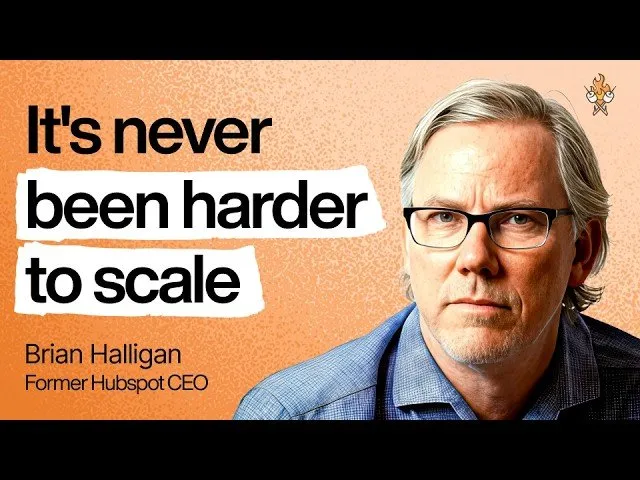
Brian Halligan, co-founder and longtime CEO of HubSpot, has spent decades mastering this transition. After scaling HubSpot from a startup to a publicly traded giant, Halligan moved to Sequoia Capital, where he now coaches the next generation of high-growth CEOs. In a recent conversation, Halligan unpacked the specific traits that define modern leadership, the changing landscape of AI-driven scaling, and the "Halliganisms" that guided his management philosophy.
Key Takeaways
- The "Kids Table" vs. "Adults Table": When companies cross the 100-employee mark, the CEO’s role shifts entirely from "doing" to organizational design and recruiting.
- The LOCK Algorithm: Successful founders often share four traits: Lovable, Obsessed, Chip on the shoulder, and Knowledgeable (with a bonus "S" for Student).
- Scaling is harder than starting: While AI has made launching a company easier than ever, the resulting noise makes scaling into a durable brand significantly more difficult.
- Don't nibble the sandwich: When facing bad news or necessary pivots, rip the band-aid off immediately rather than dragging out the pain.
- The DRI Principle: "If you want to kill a plant, have two people water it." Shared responsibility leads to failure; assign one Directly Responsible Individual.
From the Kids Table to the Adults Table
Halligan distinguishes between two distinct phases of a startup's life: the "Kids Table" (under 100 employees) and the "Adults Table" (scaling beyond 100). The primary friction point for founders occurs during the graduation from one to the other.
At the Kids Table, the founder is often the primary rainmaker, product visionary, and problem solver. However, at the Adults Table, the CEO’s schedule changes drastically. Successful scaling CEOs spend approximately half their time on recruiting, specifically focusing on the executive team and the layer directly beneath them.
Starting a company has never been easier. Scaling one into a durable, high impact organization has never been harder.
The Art of Executive Hiring
Most founders dramatically overrate their ability to interview. Halligan argues that traditional interviews—walking through a resume—are largely performative. To counter this, he suggests a few tactical adjustments:
- The Blind Reference: Do not rely on provided references. Seek out mutual connections who can answer the question: "On a scale of 1 to 10, how likely would you be to enthusiastically rehire this person?"
- The Working Session: Instead of a Q&A, engage the candidate in a whiteboard session to solve a real problem.
- The NDA Hack: Have the candidate sign an NDA, review the latest board deck, and discuss it. If they are purely complimentary, it is a red flag. You want someone who challenges the strategy, not a "yes person."
The 2004 Red Sox Strategy
A common mistake scaling companies make is over-indexing on external "shiny" hires from big tech firms like Salesforce or Google. Halligan advocates for a team composition similar to the 2004 Boston Red Sox: a core of homegrown talent supplemented by a few strategic "free agents."
Internal employees often have a higher success rate because they understand the culture and the product deeply. External hires from massive corporations often experience an "impedance mismatch"—they expect the infrastructure of a giant company and struggle in the chaotic environment of a scale-up.
The LOCK Algorithm for Founder Potential
When evaluating founders for investment or coaching, Halligan utilizes a framework he calls "LOCK." This heuristic helps identify individuals capable of navigating the lonely journey of company building.
- L (Lovable): Can they inspire followership? Would talented engineers and executives crawl across broken glass to work for them?
- O (Obsessed): Are they deeply fixated on the problem? Halligan is skeptical of founders who "found a market" six months ago. He prefers deep founder-market fit where the obsession has existed for years.
- C (Chip on Shoulder): Many top performers are driven by a psychological need to prove something, often stemming from a past grievance or disadvantage.
- K (Knowledgeable): They must possess deep domain expertise.
He adds a final modifier: S for Student. The best CEOs are learning machines, constantly absorbing history, strategy, and management theory to upgrade their internal operating systems.
Management Heuristics: "Halliganisms"
Over 15 years at HubSpot, Halligan developed short, memorable maxims to communicate complex management philosophies to a growing team. These "Halliganisms" served as cultural guardrails.
"When you have to eat a sandwich, don't nibble"
This advice, originally attributed to Ruth Porat (CFO of Google/Alphabet), addresses how to handle bad news, layoffs, or strategic pivots. The instinct for many empathetic leaders is to minimize the blow by taking small actions—a small layoff now, hoping growth catches up later. This destroys trust.
The better approach is to "rip the band-aid off." If a correction is needed, go deep enough that you only have to do it once. Treat employees like adults, deliver the hard news clearly, and then move forward.
"If you want to kill a plant, have two people water it"
As companies scale, cross-functional collaboration becomes necessary, but shared accountability is often fatal. When two people are responsible for a metric or a project, it usually results in the project being neglected (under-watered) or smothered by conflicting efforts (over-watered).
Halligan insists on the concept of the DRI (Directly Responsible Individual). Regardless of how many departments are involved, one single person must have their "ass on the line" for the outcome. Committees do not build great products; individuals do.
EV > TV > MV
Priorities in a scaling organization must be hierarchically structured to prevent silos. The formula is:
- CV (Customer Value): The customer always comes first.
- EV (Enterprise Value): The company's health comes second.
- TV (Team Value): The department or specific team comes third.
- MV (Me Value): The individual's personal gain comes last.
When VPs start solving for "Team Value" over "Enterprise Value"—for example, a sales leader pushing for bookings that churn quickly, hurting the support team—the culture rots. Leaders must be vigilant in identifying and correcting leaders who optimize for their specific silo at the expense of the company.
AI and the Future of Go-To-Market
Halligan notes that while AI is revolutionizing software development and support, it has yet to fully disrupt enterprise sales. Trust-based selling between "carbon-based lifeforms" remains resilient. However, the top of the funnel is undergoing a radical transformation.
Historically, marketing funnels were built around search engines (SEO). Users searched Google, found a blue link, visited a website, and navigated a site map. In the near future, this discovery phase will shift to AI agents.
Your website is a lot less important... I think sites will change where you're going to have a really high quality avatar that knows everything about your products, knows everything about your company... and you can have a high quality conversation with that person.
Companies must prepare for a world where their "homepage" is an interactive, all-knowing avatar that guides a prospect through the entire discovery phase before handing them off to a human sales rep for the final trust-building exercise.
Conclusion: The "Next Play" Mentality
Halligan references Duke basketball coach Mike Krzyzewski, who would yell "Next Play" after a player made a mistake. The tendency for high-performers is to dwell on an error, which leads to "compounding the mistake"—missing a shot, then fouling out of frustration on defense.
In the high-stakes environment of a scaling company, mistakes are inevitable. The defining trait of a successful CEO is not the avoidance of error, but the speed of recovery. Whether it is a product outage or a hiring failure, the ability to acknowledge the crisis, correct it aggressively, and immediately focus on the "next play" is what separates durable companies from those that fade away.
Ultimately, Halligan’s journey from a 20-year grind at HubSpot to a near-death snowmobile accident has left him with a singular perspective: life is short, and leadership requires intention. Whether you are at the kids table or the adults table, the goal is to build something that lasts, without losing yourself in the process.