Table of Contents
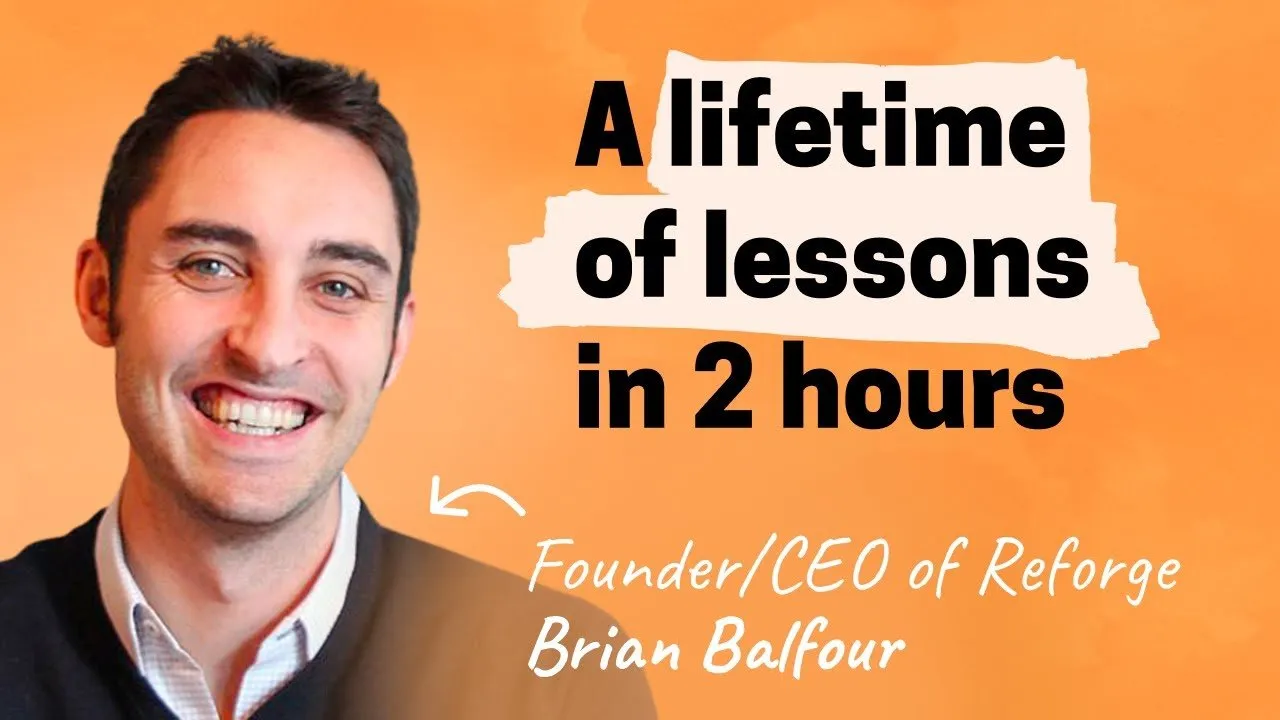
Brian Balfour, founder and CEO of Reforge and former VP of Growth at HubSpot, is widely considered one of the sharpest minds in product and growth. Over the course of his career, he has maintained a dedicated Notion document detailing over 100 distinct lessons learned from building startups, leading teams, and navigating the complexities of life.
Instead of focusing on standard growth frameworks or loops, this discussion dissects 10 of the most critical lessons from that list. From the psychology of leadership to the mechanics of product strategy, these insights offer a blueprint for navigating the messy reality of building high-growth companies.
Key Takeaways
- Inspect the work, not the person: Eliminate bias in hiring and promotions by focusing on actual output and artifacts rather than narrative or interview charisma.
- Growth is a system: You cannot isolate acquisition, retention, or monetization; changing one lever inevitably impacts the others.
- Solve for use cases, not personas: Demographics are often misleading. Focus on the specific problem, frequency, and alternatives a user faces.
- Find sparring partners, not mentors: Seek out peers who are "in the arena" with you and willing to challenge your thinking, rather than distant coaches offering generic advice.
- Problems never end: Success doesn't mean fewer problems; it means you earn the right to solve bigger, more complex challenges.
The Psychology of High-Performance Leadership
Founders and leaders often fall into a psychological trap: the belief that solving the current crisis will lead to a permanent state of ease. Balfour argues that this hope is the root of significant anxiety and frustration.
The more problems you solve you just end up taking on bigger and bigger problems over time and hoping it gets easier is the thing that just sets you up for this frustration this anxiety this stress.
Accept That Problems Never End
The reality of leadership is that you are essentially a professional firefighter. As companies scale, the complexity of challenges scales with them. The shift in mindset—from hoping for an easy finish line to accepting that solving one problem simply qualifies you to tackle a harder one—is the key to reducing stress. Ray Dalio refers to this as becoming a "problem-solving machine."
Seek Sparring Partners Over Mentors
In the pursuit of professional growth, many leaders seek mentors or coaches. However, Balfour suggests that "sparring partners" are far more valuable. Unlike a coach who shouts from the sidelines, a sparring partner is in the ring with you.
Attributes of a great sparring partner:
- They share a common set of goals and are often at a similar stage in their career.
- They are not afraid to "throw punches" (challenge your logic intensely).
- They provide specific, actionable feedback based on current reality, not outdated generalities.
Whether through co-founders or curated peer groups, these relationships provide the radical candor necessary for breakthrough growth.
Rethinking Talent and Evaluation
Traditional hiring and performance reviews are often flawed because they rely heavily on conversation and narrative. A charismatic candidate can talk their way into a role they aren't qualified for, while a high-performer might be overlooked because they lack self-promotion skills.
Inspect the Work, Not the Person
To mitigate bias, leaders must strip away the personality assessment and look directly at the artifacts created. In hiring, this means prioritizing portfolios, simulations, or practical exercises over behavioral interview questions.
This principle extends to internal promotions. Decisions should be based on a log of shipped work and its impact, rather than a manager's advocacy or an employee's ability to tell a compelling story about their year. By focusing on the output, organizations protect themselves from the "game of telephone" that often distorts performance reviews.
Strategic Planning and Momentum
How teams plan and allocate resources often determines whether they capture a market or stagnate. Two specific lessons stand out regarding how to approach winning and timing.
Define the Win Before the Cost
As organizations grow, ideas often get watered down before they even reach decision-makers. Teams filter their own proposals based on perceived budget constraints or fear of rejection. Balfour adopts a different approach: "Tell me what it takes to win, then tell me the costs."
You cannot compromise on the requirements for victory. Once the "winning scenario" is defined, the team can collaborate on how to achieve it within constraints. If you start with the constraints, you often end up with a strategy that fits the budget but fails to win the market.
The Year is Made in the First Six Months
Many annual plans rely on a "hockey stick" projection where growth miraculously accelerates in Q3 and Q4. This is rarely realistic. Due to sales cycles, implementation lag, and the time required for new features to propagate through a user base, the initiatives launched in the first half of the year drive the vast majority of the year's results.
If you aren't executing on your core growth drivers by June, the mathematical probability of hitting end-of-year targets drops precipitously. Front-loading effort is essential.
The Systems Approach to Product Growth
A common mistake in growth teams is treating metrics in isolation. A team might focus entirely on "fixing retention" without realizing the root cause lies in acquisition.
Growth is an Interconnected System
Acquisition, retention, and monetization are not separate silos; they are variables in a single equation.
Growth is a system between acquisition retention and monetization... you change one you affect them all.
System dynamics in action:
- Retention issues are often acquisition issues in disguise (acquiring the wrong users).
- Monetization struggles frequently stem from engagement problems (users aren't seeing value).
- Adding friction (e.g., qualifying leads harder) might lower conversion rates but drastically improve retention and LTV.
Great growth practitioners diagnose problems by looking at the entire ecosystem, not just the metric that is flashing red.
Use Cases Over Personas
Demographic personas (e.g., "Marketing Mary") often obscure the truth about why people buy. A more effective framework is mapping Use Cases. This involves defining:
- The specific problem the user is trying to solve.
- The alternative solutions available to them.
- The specific reason they choose your product over the alternative.
- The natural frequency of the problem.
This approach reveals that a single product might serve multiple distinct use cases that require different retention strategies. It also highlights opportunities to build relationships with users before they are "in market," similar to how HubSpot captured attention through content long before users needed a CRM.
Positioning, Focus, and Change Management
In a crowded market, the safest-looking choices are often the most dangerous. To break through noise and inertia, companies must be willing to take extreme stances.
Solving for Everyone is Solving for No One
Strategy is the art of sacrifice. It is easy to define who you are building for; it is much harder, yet more important, to define who you are not building for.
When HubSpot clarified they were building for "Marketing Mary" (mid-market) and explicitly not for "Enterprise Eddie" or tiny hobbyist businesses, they aligned their entire organization—product, sales, and support—around a cohesive goal. Without these "anti-personas," products become generic, and cultures become diluted.
Do the Opposite
When a channel or tactic becomes best practice, it eventually becomes saturated. To gain traction, look at what the majority of the market is doing, not to copy it, but to find the white space on the other side.
- Content: When everyone was doing short-form, high-volume blog posts, the opportunity shifted to long-form, low-volume deep dives.
- Education: When the market flooded with cheap, self-serve video courses (MOOCs), Reforge succeeded by launching high-price, cohort-based, selective programs.
The goal of analyzing competitors is to identify the pendulum swing and execute in the opposite direction.
Apply 2x Activation Energy for New Bets
Inertia is a powerful force. An existing business line has momentum, existing customers, and revenue. When a company tries to layer on a new bet (e.g., moving from single-product to multi-product, or shifting from paid ads to SEO), incremental effort is not enough.
For a new initiative to catch up to a fast-moving baseline, it requires 2x the activation energy. You cannot "dip your toes" into a strategic pivot. Leaders must over-invest in resources, attention, and talent to overcome the gravitational pull of the legacy business.
Conclusion
Whether it involves inspecting the work rather than the person, treating growth as a holistic system, or accepting that problems are a feature of success rather than a bug, these lessons share a common thread: they require moving beyond surface-level tactics to first-principles thinking.
Success in career and product doesn't come from finding a cheat code; it comes from rigorous discipline, clear definition of trade-offs, and the resilience to stay in the arena. For those looking to dive deeper into the actual artifacts and documents behind these lessons, Brian Balfour has made them available through Reforge Artifacts.