Table of Contents
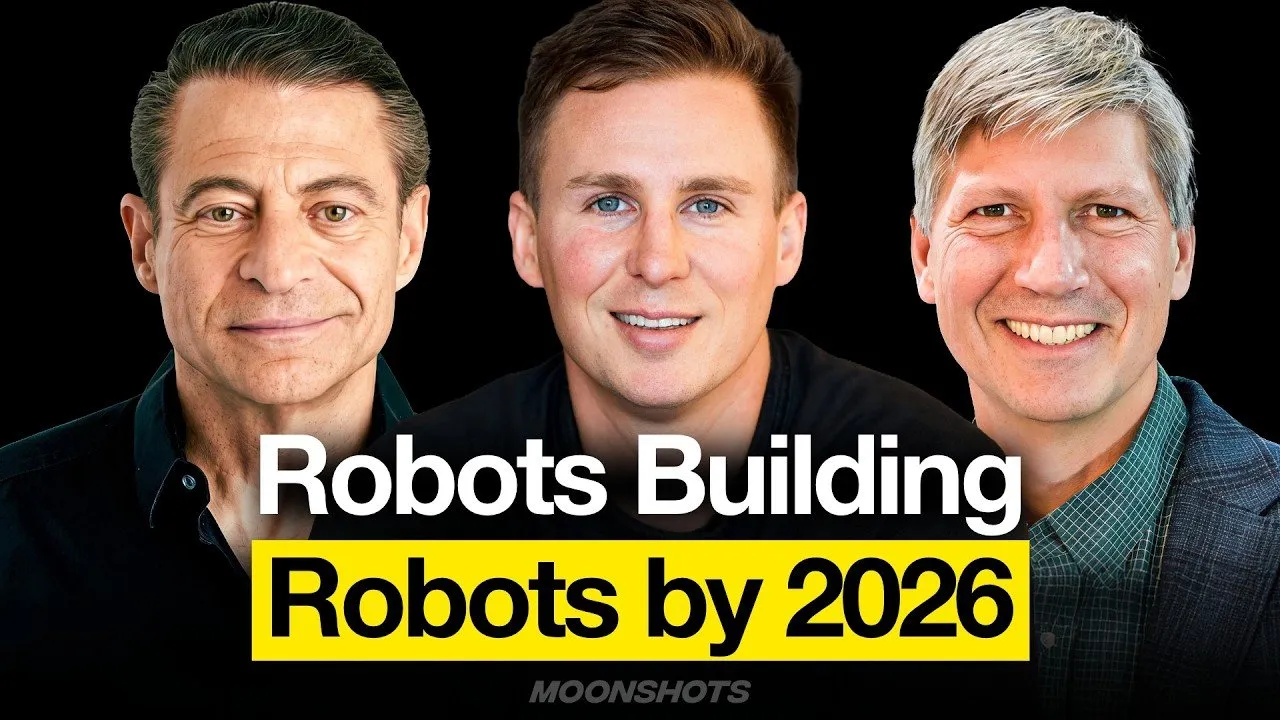
The landscape of robotics is undergoing a fundamental shift, moving away from rigid, hard-coded instructions toward fluid, self-learning systems. In a recent deep dive at Figure AI’s headquarters, founder Brett Adcock revealed the massive strides his company has made in humanoid robotics. The conversation highlights a pivotal moment in technology: the transition from robots that simply repeat motions to machines that understand physics, reason in real-time, and operate autonomously through end-to-end neural networks.
This evolution isn't just about building a better machine; it represents the dawn of a potential $50 trillion labor market. From the release of the Helix 2 architecture to the unveiling of the streamlined Figure 3 robot, the integration of advanced AI with next-generation hardware is accelerating faster than most industries anticipated. We explore the technical breakthroughs, the economics of abundance, and the path toward general-purpose robots entering our workforce and homes.
Key Takeaways
- The End of Hard Coding: Figure has removed over 100,000 lines of C++ code, replacing traditional control stacks with end-to-end neural networks (Helix 2) that allow robots to learn and adapt dynamically.
- Hardware Built for AI: The new Figure 3 robot features a 90% reduction in manufacturing costs and is explicitly designed to gather high-fidelity data to train the AI models.
- Fleet Learning: A major competitive advantage lies in shared knowledge; once one robot masters a task, the entire fleet instantaneously acquires that capability.
- Autonomous Manufacturing: Figure is moving toward "robots building robots," with plans to deploy humanoids on their own production lines ("Baku") within the year.
- Economic Implications: With a target production cost of $20,000 per unit, humanoid robots aim to address labor shortages and unlock a massive age of economic abundance.
The Shift from C++ to Neural Networks
For decades, robotics relied on heuristics and hard-coded C++ instructions. Engineers would manually program every potential state and reaction. However, the complexity of a humanoid robot makes this approach unsustainable. A humanoid with 40+ degrees of freedom has more potential physical states than there are atoms in the universe. Simulating these states one by one is mathematically impossible.
Figure has radically pivoted by adopting an "all neural net" approach. With the release of their Helix 2 architecture, the company deleted the remaining 100,000+ lines of C++ code that previously handled lower-body control. Today, the robot’s perception, planning, and manipulation are driven entirely by AI models that understand physics and cause-and-effect relationships.
"The things that you can do with neural nets now just completely blow my mind versus code... There’s only so far you can push code heuristics into a humanoid robot; it’s just a dead end."
This shift enables "closed-loop" control. Unlike "open-loop" systems that blindly replay a pre-recorded motion (like an animatronic figure), a closed-loop neural net analyzes sensor data 200 times per second. It adjusts to slips, changes in weight, or unexpected obstacles in real-time, mimicking human physiological responses.
Figure 3: Hardware Designed for Data
The rapid iteration from Figure 1 to Figure 3 demonstrates a philosophy of vertical integration. Figure 3 is not just an upgrade; it is a complete reimagining of the hardware to serve the software. The new model is significantly lighter (dropping from roughly 150 lbs to 135 lbs), features a soft exterior for safety, and integrates a "passive toe" for better walking dynamics.
Cost Reduction and Scalability
One of the most significant achievements with Figure 3 is a 90% reduction in manufacturing costs. By moving away from expensive, machined parts to tooled components and designing actuators in-house, Figure is preparing for mass production. The goal is to bring the hardware cost down to approximately $20,000—a price point comparable to a mid-range automobile.
Sensory Integration
To feed the neural networks the data they require, Figure 3 is packed with sensors. This includes palm cameras and tactile sensors in the fingertips, allowing the robot to "see" and "feel" what it is grasping, even when the object is occluded from the head-mounted cameras. This sensory density is critical for performing high-fidelity tasks, such as manipulating small objects or handling fragile items in a home environment.
The Pursuit of General Purpose Robotics
The industry is crowded with robots designed for specific tasks—welding, painting, or moving pallets. Figure’s ambition is distinct: creating a general-purpose humanoid. This is a robot that can be dropped into an unseen environment—a warehouse, a hospital, or a living room—and perform useful work without specific pre-programming.
The Data Moat
The barrier to entry in this sector is no longer just hardware engineering; it is data accumulation. Figure is running fleets of robots to gather telemetric data, training their models on real-world physics. This creates a compounding advantage known as fleet learning.
"The one thing that's important here is that once one robot learns how to do a task, every robot fleet knows it. And humans still operate like this. I wish we did."
Teleoperation vs. True Autonomy
A critical distinction in the current robotics landscape is the difference between teleoperation (remote control by a human) and true autonomy. While many competitors release flashy videos of robots performing karate chops or folding clothes, these are often teleoperated or simple replay loops. Figure focuses on autonomous, long-horizon tasks—robots that can operate for hours or days, correcting their own errors without human intervention.
A $50 Trillion Economic Opportunity
The integration of general-purpose robots into the workforce addresses a fundamental cap on economic growth: the availability of human labor. Adcock estimates this to be a $50 trillion market, representing roughly half of global GDP. The vision involves a future where robots provide ubiquitous goods and services, driving down costs and creating an age of abundance.
Deployment Strategy
Figure’s roadmap for 2026 involves massive scaling. This includes deploying robots into industrial and commercial workforces first, where the environment is more controlled. The company is already spinning up its "Baku" production lines, where robots will soon assist in building other robots—a recursive manufacturing loop that could exponentially increase production capacity.
The ultimate goal extends beyond factories. As safety protocols mature, the focus will shift to the home, providing elder care and household assistance. Adcock predicts that we may eventually see billions of humanoids, potentially a one-to-one ratio with the human population.
Safety and the Future of Embodied AI
As robots move from caged industrial zones to living rooms, safety becomes the paramount concern. This involves not just physical safety (avoiding collisions), but semantic safety—understanding that a lit candle is dangerous or that a glass wall is an obstacle.
The "Newborn" Standard
When asked about the threshold for safety, Adcock applies a personal metric: he will consider the robot ready for widespread home adoption only when he trusts it enough to hold his own newborn child. Achieving this requires redundant safety architectures, real-time fall tolerance, and rigorous cyber-security measures to protect user privacy.
Beyond Earth
The implications of this technology extend beyond our planet. The robust, autonomous nature of these systems makes them ideal candidates for space exploration. From maintaining space stations to mining asteroids, general-purpose humanoids may be the key to expanding human presence in the solar system, handling the dangerous and repetitive tasks required to build infrastructure in zero-gravity environments.
Conclusion
We are witnessing a "speedrun" of technological evolution. In just a few years, humanoid robotics has moved from clunky, code-heavy prototypes to sleek, learning machines capable of complex manipulation. By betting the company on neural networks and vertical integration, Figure is positioning itself at the forefront of this revolution.
The transition to embodied AI is not merely a technical upgrade; it is a societal shift comparable to the industrial revolution or the rise of the internet. As Figure prepares to scale manufacturing and deploy autonomous fleets, the boundary between science fiction and economic reality is rapidly dissolving.