Table of Contents
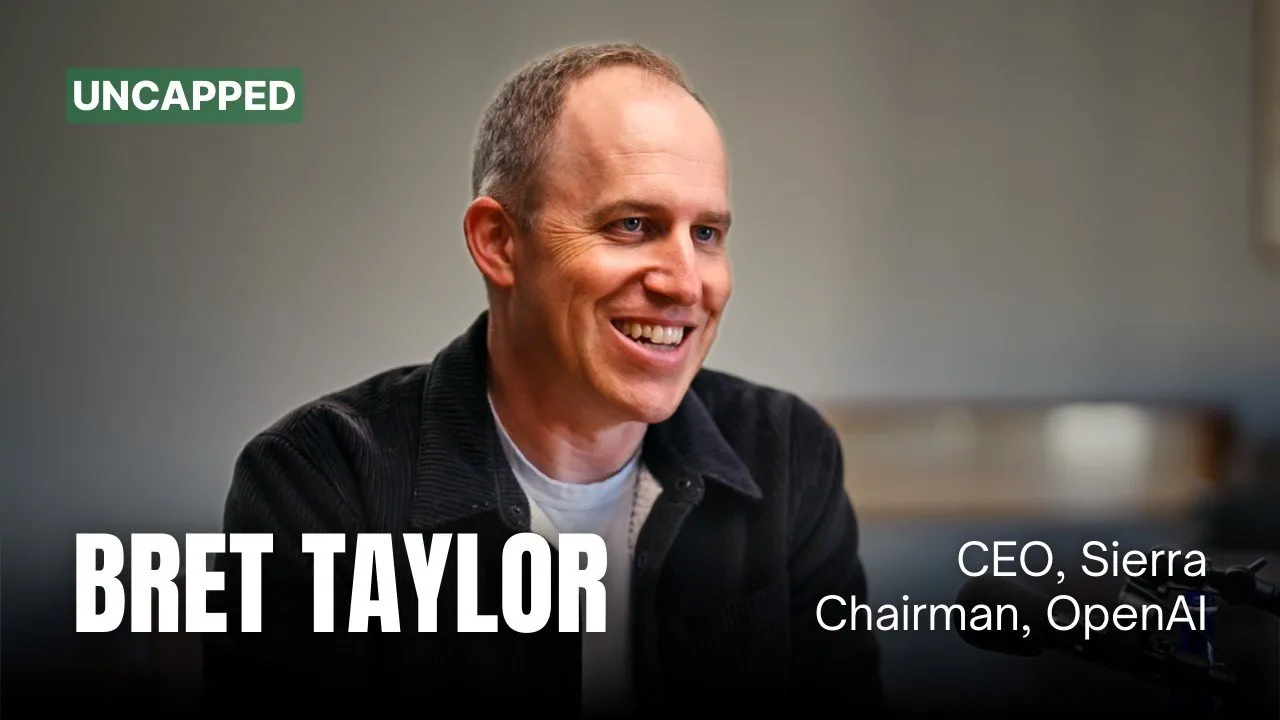
The software industry stands at a precipice. With public market valuations under pressure and the rapid ascent of generative AI, a central question has emerged: Are we facing a "SaaS Apocalypse," or simply the next great evolution of enterprise technology? Few people are better equipped to answer this than Bret Taylor. As the co-founder of Sierra, a board member at OpenAI, and the former co-CEO of Salesforce, Taylor possesses a unique vantage point that spans the legacy of systems of record and the frontier of AI agents.
In a recent comprehensive discussion, Taylor dissected the current state of the software market, the inevitable shift toward autonomous agents, and the structural "strategy taxes" that prevent incumbents from moving fast. He offers a pragmatic yet optimistic view: while the interfaces of the past may vanish, the value of solving complex business problems is only increasing.
Key Takeaways
- The shift from Applications to Databases: As AI agents take over workflows, traditional "systems of record" (CRMs, ERPs) may lose their interface value, becoming backend databases that agents manipulate.
- The "Strategy Tax" ties down incumbents: Large companies struggle to pivot not because they lack talent, but because their business models, sales incentives, and existing customer expectations act as anchors.
- Outcome-based pricing is the future: Pricing based on tokens (inputs) is misaligned with customer value. The industry must move toward pricing based on resolutions and successful outcomes.
- Software engineering is being reinvented: We are currently in a transition period similar to the adoption of CI/CD, where the best practices for AI-augmented coding are being written in real-time.
- The "Real World" acts as a buffer: While digital tasks will be automated rapidly, industries relying on physical logistics and human interaction will see a slower, more complex integration of AI.
The "SaaS-Mageddon" and the Evolution of Systems of Record
The anxiety in the software market—often jokingly referred to as "SaaS-Mageddon"—stems from a fear that AI will erode the competitive moats of traditional software companies. Historically, value in enterprise software accrued to "systems of record" like Salesforce, SAP, and Oracle. These platforms created gravity through vast ecosystems of integrations and high switching costs.
However, Taylor suggests that the role of these systems is fundamentally changing. In the past, these were applications where humans clicked buttons and filled out forms. In the near future, they may simply serve as the storage layer for AI agents.
"In other words, does a system of record have a place in the world if nobody logs into it? It does. But the real question is like how valuable is it? How important is it?"
If an AI agent is responsible for generating leads or onboarding vendors, the user interface of the CRM or ERP becomes invisible. The value shifts from the application layer to the agent layer—the entity doing the work. While incumbents have a "right to win" due to their data and customer relationships, history suggests that new interfaces (like the shift from desktop to mobile) often favor new entrants who can build "best of breed" experiences without the baggage of legacy systems.
The Incumbent's Dilemma: The Strategy Tax
Why do resource-rich incumbents often fail to capitalize on platform shifts? Taylor introduces the concept of the "Strategy Tax." This is not merely a lack of technical capability; it is the friction caused by existing assets becoming liabilities during a paradigm shift.
For a startup, pivoting to AI is a matter of writing code. For a public company, it involves:
- Cannibalizing Revenue: Shifting from per-seat licensing to usage or outcome-based models can disrupt quarterly earnings.
- Sales Incentives: Retraining and compensating a massive sales force for a completely new product type is operationally difficult.
- Legacy Support: Maintaining on-premise or older cloud versions prevents a full commitment to the new technology.
"All of the advantages that you had all of a sudden become anchors that are holding you back from actually doing the right thing... The wave that we're riding of large language models is greater than any company riding it."
This dynamic creates a window of opportunity for startups. Because they do not have to protect an existing business model, they can align entirely with the new technology, moving faster than competitors who are fighting against their own structural inertia.
Defining the Business Model of AI Agents
As AI matures, the industry is grappling with how to monetize it. Currently, many models rely on token-based pricing—charging for the computational input. Taylor argues this is a flaw in product-market fit. Customers do not care about how many tokens a model uses; they care about the result.
The Case for Outcome-Based Pricing
Taylor advocates for outcome-based pricing, where fees are tied to measurable business results. In the customer service sector, this might mean charging per resolved support ticket. In sales, it could be a commission on generated leads.
This aligns the incentives of the vendor and the customer. If an agent is inefficient and burns excessive tokens to solve a problem, the vendor absorbs that cost, not the client. This mirrors the evolution of digital advertising, which moved from impressions (CPM) to clicks (CPC) and finally to conversions (CPI).
"If you have to mention token utilization, it's probably a tool... It's probably not an applied AI. It's just sort of like a tool around AI."
By focusing on outcomes, AI moves from being a cost center to a value driver, making it easier for large enterprises—like the regulated industries Sierra targets—to justify the investment.
The Reinvention of Software Engineering
Perhaps no sector is feeling the impact of AI more acutely than software engineering itself. With tools like OpenAI's Codex, the barrier to generating code has dropped precipitously. Taylor compares this moment to the introduction of Continuous Integration/Continuous Delivery (CI/CD). Before CI/CD, releases were manual and risky; afterward, they became automated and safe. However, transitioning a team from one method to the other required entirely new best practices.
We are currently in the messy transition phase regarding AI coding.
- The Shift to Architecture: As generating code becomes commoditized, the engineer's role shifts toward system architecture, testing, and managing the "prompts" that serve as the new source code.
- Productivity vs. Headcount: While some predict 10-person billion-dollar companies, Taylor suggests that competition will likely absorb these efficiency gains. Companies may not hire fewer engineers; they might simply build much better software, or compete more aggressively on features.
"Clearly in three years we could talk about what are the best practices to set up a software team that's optimized for this technology... right now we're just figuring them out in real time."
AI in the Physical World and the Future of Work
A common narrative is that AI will solve everything, leading to massive deflation and job loss. Taylor offers a nuanced counterpoint: the "real world" is a significant buffer. While tasks involving "bits" (finance, coding, data entry) will face rapid automation, the physical economy (logistics, construction, healthcare delivery) involves constraints that AI cannot simply code away.
Identity and Adaptation
Taylor remains optimistic about humanity's ability to adapt. He draws a parallel to accountants before and after Microsoft Excel. The tool fundamentally changed the day-to-day work—removing the drudgery of manual calculation—but it didn't eliminate the need for financial insight. It elevated the profession.
Similarly, AI will likely decouple professional identity from rote tasks. A software engineer's worth will no longer be measured by lines of code written, but by the solutions they architect. Humans are status-seeking and competitive by nature; as the baseline for intelligence rises, people will find new ways to differentiate themselves and compete.
Conclusion
We are transitioning from a period of technological novelty to one of industrial-grade application. The "SaaS Apocalypse" is not an end, but a metamorphosis. Companies that can overcome their strategy taxes, embrace outcome-based business models, and integrate AI into complex, regulated workflows will thrive.
As Taylor notes, regulators may eventually demand AI agents in certain sectors, viewing the consistency and auditability of software as safer than human variability. The future belongs to those who view AI not as a tool to replace the old, but as a foundation to build entirely new classes of products.