Table of Contents
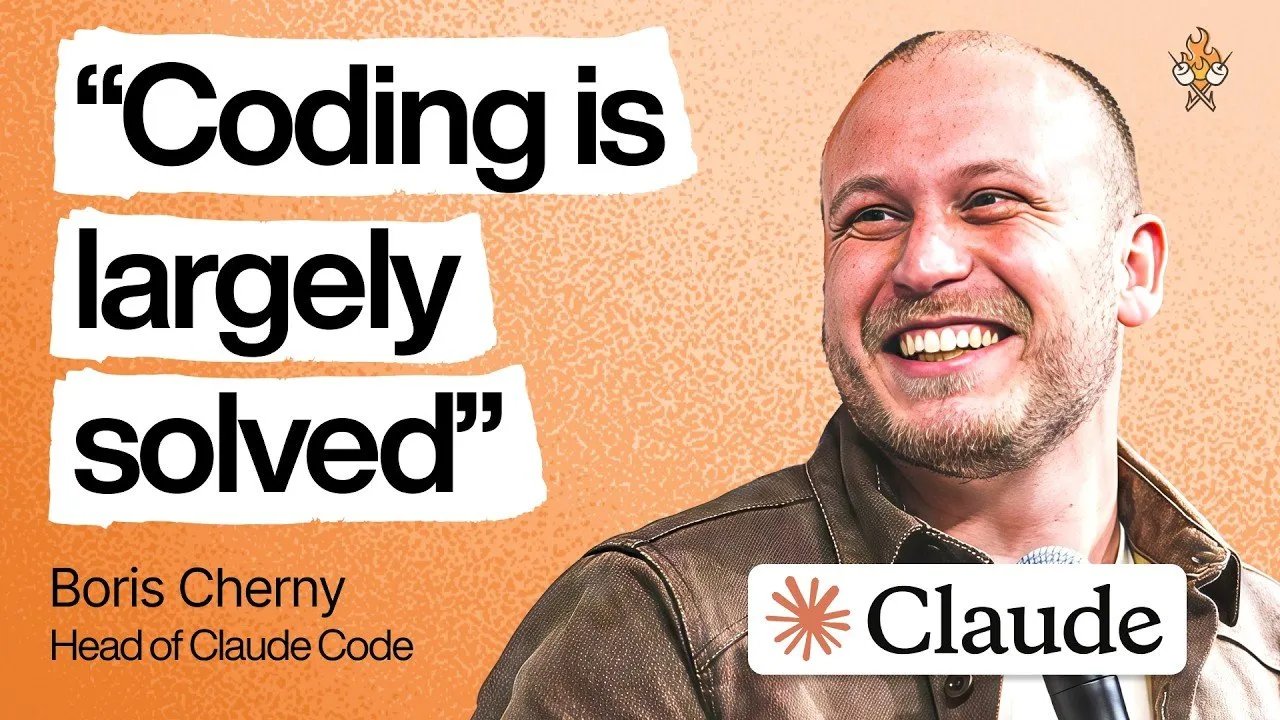
The landscape of software development is undergoing its most profound transformation in decades, driven by the rapid advancements in artificial intelligence. What was once the exclusive domain of human engineers, the act of writing code, is now increasingly handled by AI. Boris Cherny, Head of Claude Code at Anthropic, stands at the forefront of this revolution, witnessing firsthand how AI is not just assisting but actively authoring code. His journey, from personally generating 100% of his code with Claude to envisioning a future where "coding is largely solved," offers a compelling glimpse into an accelerating paradigm shift. This isn't merely about automation; it's about redefining roles, rethinking product development, and understanding the profound societal implications of an AI-powered world.
Key Takeaways
- Coding is "Solved" for Many: Leading engineers, including Boris Cherny, now rely on AI to write 100% of their code, marking a dramatic increase in developer productivity and signaling a shift where traditional coding skills may soon be less critical.
- AI as a Cognitive Co-worker: Claude Code is evolving beyond code generation to propose ideas, analyze feedback, and automate broader non-technical tasks, transforming its role into a more integrated "co-worker" for various functions.
- Strategic AI Product Development: Effective AI product strategies involve embracing "latent demand," building for future model capabilities, enabling generous token usage for experimentation, and empowering small, high-performing teams to leverage AI for rapid shipping.
- Shifting Professional Identities: The traditional "software engineer" role is transitioning into that of a "builder," emphasizing cross-disciplinary skills, business acumen, and user interaction over pure coding.
- Navigating Societal Impact: While AI promises to democratize programming and unlock unforeseen innovations, it also brings significant disruption and job displacement, necessitating urgent societal conversations and a strong focus on AI safety.
The Dawn of AI-Authored Code: A Paradigm Shift in Engineering
In a mere year since its inception, Claude Code has dramatically altered the trajectory of software engineering. Boris Cherny, leading the charge at Anthropic, shares an astonishing personal anecdote: he hasn't manually edited a single line of code since November, with 100% of his prolific output now generated by Claude Code. This isn't an isolated phenomenon; companies like Spotify report that their top developers are similarly AI-reliant.
The 100% AI-Authored Code Reality
The numbers speak for themselves. Recent reports indicate that 4% of all GitHub commits are now authored by AI, with predictions soaring to a fifth of all commits by year-end. This rapid adoption signifies a monumental shift. Boris Cherny notes,
"100% of my code is written by Claude Code. I have not edited a single line by hand since November."
This personal experience is echoed by a growing number of senior engineers, painting a picture of a profession fundamentally reshaped.
A Year of Unprecedented Transformation
Claude Code began as a "little hack," a terminal-based experiment within Anthropic. Its initial reception was modest, garnering only "two likes" internally. Yet, fueled by Anthropic's deep-seated belief in exponential progress and a relentless focus on model improvement, its growth quickly became vertical. Boris recalls the initial skepticism,
"it wasn't initially a hit... it actually took many months for everyone to really understand what this thing is."
This early struggle highlights the disruptive nature of true innovation, often requiring users to adapt their mindsets to entirely new paradigms.
The Terminal: An Unconventional Launchpad
The decision to build Claude Code primarily as a terminal-based tool was born out of necessity—it was the easiest way for a single engineer to build initially. This seemingly counter-intuitive approach proved serendipitous. The terminal's flexibility allowed it to keep pace with the rapidly evolving AI model, acting as a direct conduit to the model's increasing capabilities. This agility was crucial as the model improved at an accelerating rate, demonstrating tool use far beyond initial expectations.
Beyond Intuition: The Exponential Mindset
Anthropic's approach is rooted in an understanding of exponential growth, a concept deeply ingrained by its co-founders' work on scaling laws. This perspective allows them to make predictions that may seem audacious in the short term, such as the idea that engineers might not need an IDE by year-end. Boris explains that such predictions are simply "tracing the line" of observed exponential growth, even if they "do not match intuition at all." This mindset is key to anticipating and driving the future of AI.
Beyond Code: AI as a Cognitive Partner
The evolution of AI in software development is rapidly moving beyond mere code generation. Boris Cherny emphasizes that Claude Code is transforming into a more comprehensive "co-worker," capable of higher-level cognitive tasks that traditionally required human judgment and experience.
From Coder to Ideator: AI's New Frontier
Claude is beginning to generate ideas. By sifting through user feedback, bug reports, and telemetry data, it can proactively suggest bug fixes and new features. This advancement shifts the engineer's focus from writing code to evaluating and refining AI-generated proposals. As Boris states, "Claude is starting to come up with ideas," functioning more like an intelligent collaborator than a simple coding tool.
Automating Beyond Programming
The scope of AI's capabilities is expanding far beyond coding. With tools like Co-work, users can delegate a wide array of non-technical tasks. Examples range from paying parking tickets and managing project communications across Slack and email, to syncing spreadsheets. Boris illustrates this by detailing how Co-work manages his team's project updates: it messages engineers who haven't submitted their status, entirely autonomously. This demonstrates AI's growing ability to interact with diverse digital environments and automate complex workflows.
The Product Manager's New Reality
The profound impact of AI isn't limited to engineers. Product managers, designers, and data scientists are increasingly seeing their roles redefined. Boris envisions a future where "the title software engineer is going to start to go away. It's just going to be replaced by builder and it's going to be painful for a lot of people." This suggests a convergence of roles, where everyone becomes a "product manager" who also codes, blurring traditional boundaries and demanding cross-disciplinary fluency.
Enhanced Productivity and Mindset Shifts
The introduction of AI has led to astounding increases in productivity. At Anthropic, "productivity per engineer has increased 200%" in terms of pull requests since Claude Code's integration. This leap dwarfs previous industry benchmarks for developer productivity. However, this rapid advancement also presents a challenge: engineers must constantly update their mental models. Boris recounts a memory leak debugging scenario where a newer team member, by simply asking Claude Code to solve the problem, outpaced his own traditional debugging process. This highlights the need to "transport yourself to the current moment and not get stuck back in an old model because it's not Sonnet 3.5 anymore. The new models are just completely completely different."
Building the Future: Principles for AI Product Development
Boris Cherny's experience at Anthropic has yielded several unconventional but highly effective principles for building AI products. These insights challenge traditional development paradigms, emphasizing flexibility, user empowerment, and a forward-looking perspective.
Under-resourcing for Innovation
A surprising principle is the idea of "under-resourcing things a little bit at the start." By doing so, teams are "forced to Claude-ify," meaning they must leverage AI to automate tasks and overcome resource limitations. This intrinsic motivation, coupled with the speed AI enables, can lead to rapid iteration and innovation. Boris highlights that if you hire great engineers and empower them with AI, they will find ways to ship quickly even with lean teams.
The "Unlimited Tokens" Advantage
Boris strongly advises companies to be "loose with your tokens" in the early stages of AI experimentation. Rather than optimizing for cost-cutting upfront, he advocates for giving engineers unlimited access to tokens. This freedom allows for radical experimentation, enabling the exploration of ideas that might otherwise be deemed too expensive. Only once a valuable idea emerges and scales should optimization efforts, like using less expensive models, be considered. This approach acknowledges that the cost of an individual engineer's experimentation is often negligible compared to their salary and the potential value of groundbreaking innovation.
Embracing Latent Demand
The principle of "latent demand" is crucial for identifying genuine user needs. This involves observing how users "abuse" a product, using it in ways it wasn't originally intended, to solve their problems. Examples include Facebook Marketplace emerging from buying/selling activities in groups, or Co-work being born from users attempting non-technical tasks (like growing tomatoes or analyzing genomes) with Claude Code. Boris explains, "if you make people feel heard, then they want to contribute and they want to help make the thing better." The modern framing of latent demand extends to what the *model* itself wants to do, by exposing it with minimal scaffolding and allowing it to determine tool usage and sequencing.
Building for the Future Model, Not Today's
One of the most critical pieces of advice is to "bet on building for the model six months from now, not for the model of today." This foresight is challenging, as it means enduring a period where product-market fit might feel weak. However, by anticipating advancements—such as improved tool use, longer unattended runtimes, and increased intelligence—developers can position their products to "hit the ground running" when future models arrive. Boris notes that while early versions of Claude Code did little of his actual coding, the bet paid off with Opus 4, leading to exponential growth. This "bitter lesson" of AI development emphasizes that general models will always outperform specific, heavily scaffolded approaches over time.
Navigating the AI Era: Impact on Roles and Society
The widespread adoption of AI tools is not merely an engineering challenge; it is a profound societal shift, redefining professional roles, democratizing capabilities, and necessitating proactive discussions about its broader impact.
The Evolving Role of the Engineer
For Boris Cherny, the advent of AI in coding has made engineering more enjoyable. He views programming as a practical tool, not an end in itself. With AI handling the "minutia" and "tedious work," engineers can now focus on higher-level activities:
"The fun part is figuring out what to build and coming up with this. It's talking to users. It's thinking about these big systems. It's thinking about the future. It's collaborating with other people on the team."
This refocus on strategic, creative, and collaborative aspects transforms the job from a hands-on coder to a visionary builder. The historical analogy of the printing press is invoked: just as literacy exploded after Gutenberg, enabling a renaissance of knowledge, AI promises to democratize programming, allowing "anyone to just build software anytime."
Democratizing Programming
The printing press analogy is a powerful framework for understanding AI's potential societal impact. Historically, reading and writing were the domain of a tiny fraction of the population—scribes. The printing press democratized literacy, leading to an explosion of knowledge and societal transformation. Similarly, Boris imagines a world where "everyone is able to program," even those without traditional technical training. This universal access to building software could unlock unimaginable innovations, akin to the societal changes spurred by widespread literacy.
The Next Frontier for AI Impact
While coding is rapidly being "solved," the impact of agentic AI is expanding to roles "adjacent to engineering." This includes product managers, designers, and data scientists, as well as virtually any work conducted on a computer. The key is understanding "agentic AI" – an LLM that can use tools and act in the world, interacting with applications like Gmail, Slack, or running commands on a computer. This capability fundamentally changes how knowledge workers interact with their digital environments.
Addressing Disruption and Societal Conversations
Despite the immense potential, Boris acknowledges that the transition will be "very disruptive and it's going to be painful for a lot of people." He stresses the urgent need for a societal conversation about these changes. Anthropic, as a safety-first lab, is actively engaging economists, policy experts, and social impact teams to address these complex questions, emphasizing that solutions "shouldn't be up to us" alone.
The Race to the Top: Anthropic's Safety Commitment
Anthropic's commitment to safety is paramount. They approach AI safety through three layers:
- Mechanistic Interpretability: Studying how individual "neurons" within the model function and interact to understand its internal reasoning and ensure alignment.
- Evals (Laboratory Settings): Testing models in synthetic, controlled environments to assess their safety and alignment under specific conditions.
- Real-World Behavior: Releasing models cautiously (e.g., Claude Code was used internally for months) to observe their behavior in the wild, learn from real-world interactions, and continuously improve safety protocols.
This comprehensive approach, including open-sourcing safety tools like the Claude Code sandbox, is part of Anthropic's "race to the top" to ensure AI development progresses responsibly and benefits humanity.
Conclusion
Boris Cherny's insights paint a vivid picture of a future where AI is not just a tool but a fundamental partner in creation, transforming software engineering and beyond. The journey of Claude Code from a simple hack to a multi-billion dollar business underscores the exponential pace of AI innovation. Coding, as we know it, is rapidly being solved, freeing human ingenuity to focus on ideation, problem-solving, and cross-disciplinary collaboration. While the shift promises unprecedented productivity and democratization of capabilities, it also necessitates a proactive and thoughtful societal dialogue about job evolution and the ethical implications of powerful AI. As Boris succinctly puts it, despite the rapid advancements and widespread adoption, this revolution is still "1% done," with immense potential and challenges yet to unfold.