Table of Contents
As the crypto industry turns the page to 2026, investors and builders face a landscape defined by regulatory shifts, broken market patterns, and intense competition among Layer 1 blockchains. Following a mixed performance in 2025—which defied historical expectations—the consensus among leading researchers is that the industry has entered a "put up or shut up" phase. With the regulatory burden easing and infrastructure maturing, the focus has shifted entirely to delivering products that the average person actually wants to use.
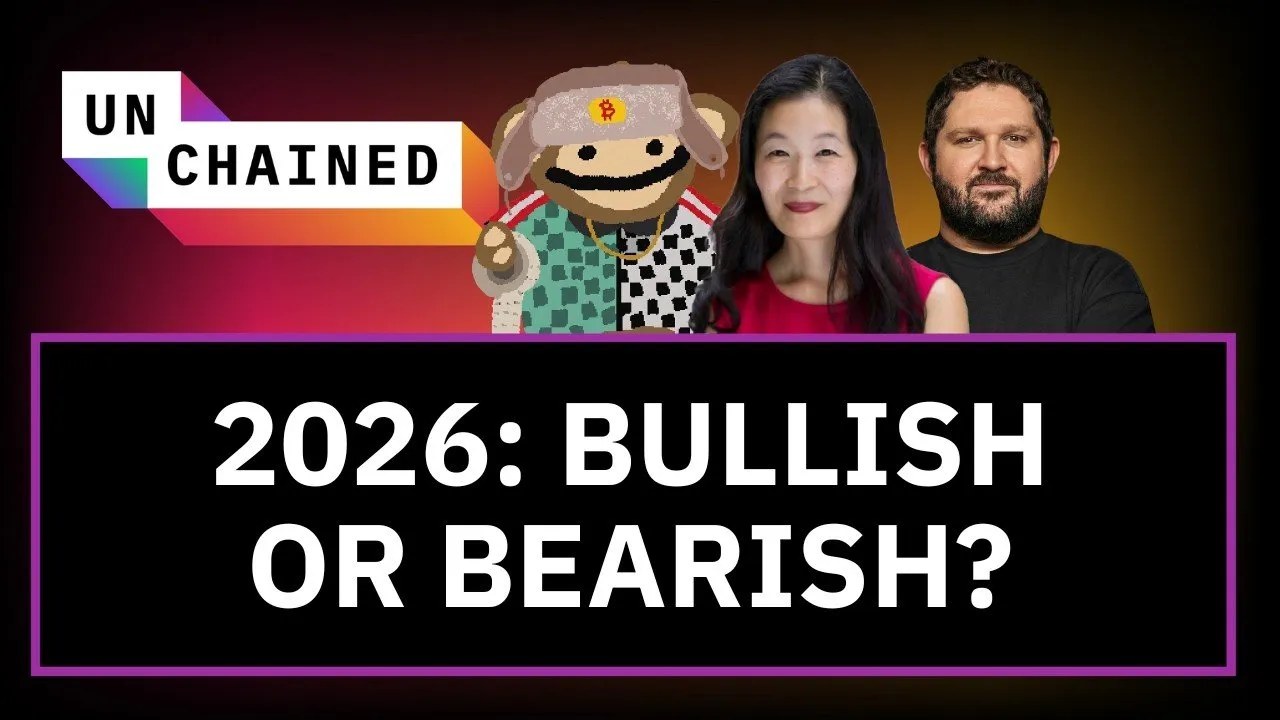
In a recent discussion hosted by Laura Shin, Alex Thorne of Galaxy Digital and Ryan (aka Average Joe’s Crypto) from Messari analyzed the chaotic signals entering the new year. From the death of the four-year cycle to the rise of "agentic commerce," 2026 promises to be a pivotal year where macroeconomic forces and technological utility collide.
Key Takeaways
- The four-year cycle is dead: Bitcoin’s performance in 2025 invalidated the traditional halving-cycle model, transitioning the asset into a macro-driven instrument influenced by global liquidity and geopolitics.
- Ethereum’s economic model is under scrutiny: While the network remains technically sound, the value accrual to ETH the asset has weakened due to Layer 2 scaling and reduced fee revenue, contrasting sharply with Solana’s consumer-led momentum.
- Stablecoins face a regulatory overhaul: The introduction of "Genius Act" compliant stablecoins creates a new battleground between regulated US-issued tokens and entrenched offshore giants like Tether.
- Perpetual DEXs are the new cash cows: Hyperliquid has set the standard for on-chain derivatives, generating more revenue than many Layer 1 blockchains and sparking fierce competition for distribution.
- Privacy and AI agents are emerging trends: Privacy is returning as a "super trend" amid dystopian fears, while AI agents conducting on-chain transactions (Agentic Commerce) are predicted to drive significant volume.
The Death of the Four-Year Cycle and Bitcoin’s Macro Turn
For over a decade, Bitcoin investors relied on the "four-year cycle"—a predictable pattern of boom and bust centered around the halving. However, market data from 2025 has effectively shattered this model. Empirically, Bitcoin finishing 2025 as a down year invalidated the simple design that governed previous epochs.
The market is now pricing in extreme uncertainty. Options markets for year-end 2026 suggest an equal likelihood of Bitcoin hitting $50,000 or $250,000. This variance indicates that crypto has graduated from idiosyncratic cycles to becoming a true macro asset. It is now heavily influenced by global liquidity, fiscal spending, and geopolitical instability.
I think the four-year cycle is empirically broken... You’re possibly going to see low new cycle lows and possibly new all-time highs all inside 26.
Geopolitics and Monetary Policy
Entering 2026, Bitcoin is reacting to broader economic levers. Analysts point to a potentially "hot" economy driven by administrative fiscal spending, which creates counteracting forces: bullish liquidity injection versus the bearish risk of rekindled inflation. Furthermore, in a world that is becoming increasingly multipolar, the demand for non-dollar, non-sovereign assets is rising. While gold has been the primary beneficiary of this trend recently, Bitcoin remains a compelling hedge against institutional distrust and fiat debasement over the medium to long term.
The Layer 1 Divergence: Ethereum vs. Solana
The competition between Ethereum and Solana has evolved from a technological race into a philosophical divergence regarding value accrual and target markets.
Ethereum’s Identity Crisis
Ethereum successfully "righted the ship" technically in 2025 with major upgrades like Pectra and Fusaka. However, a significant disconnect has emerged between Ethereum the platform and ETH the asset. The roadmap’s heavy reliance on Layer 2 rollups and blob space has decimated mainnet revenue, leading to declining yields for stakers.
Critics argue that Ethereum is building for a high-throughput future that may never arrive or may be captured entirely by L2 intermediaries like Base, which pay minimal rent to the mainnet. This structure has broken the direct correlation between network activity and token value.
I feel confident saying like I not bullish on direct value accrual network fees... revenue has been declining by like 50 60% every single year now.
Solana’s Consumer Momentum
Conversely, Solana is capitalizing on immediate utility. By focusing on consumer applications, tokenization, and payments, Solana is positioning itself as the "internet capital markets." It has gained ground in institutional headlines, particularly regarding real-world assets (RWAs) and stablecoin issuance. While Ethereum focuses on resilience and decentralization, Solana is aggressively targeting speed and usability, creating a clearer value proposition for current market demands.
The Evolution of On-Chain Markets
Beyond the base layers, the application layer is witnessing a consolidation of power and the birth of new financial giants.
The Rise of Perpetual DEXs
2025 was the year of Hyperliquid. The platform not only dominated volume but proved that decentralized perpetual exchanges (Perps) could generate more revenue than major Layer 1 blockchains. This success has spawned a category of competitors, including Lighter and Astra, all vying for market share.
In 2026, technical superiority alone will no longer be enough to win. The battle has shifted to distribution. Competitors must secure partnerships with major fintech platforms or exchanges—similar to how Lighter is viewed in relation to Robinhood or Astra to Binance—to challenge Hyperliquid’s dominance. Simultaneously, traditional finance is encroaching on this territory, with the CFTC poised to allow more sophisticated derivatives products, potentially bringing "perp-ified" equities to regulated US markets.
Prediction Markets: Regulation vs. Innovation
Prediction markets like Polymarket and Kalshi have found product-market fit, particularly in election cycles and sports betting. However, their reliance on sports for sustained volume places them in the crosshairs of regulators and the powerful sports gambling lobby. The legal battles unfolding in federal courts in 2026 will likely determine whether prediction markets are treated as financial derivatives or simple gambling.
There is a growing sentiment that the future of prediction markets lies not in competing with DraftKings, but in creating entirely new categories of speculation—such as cultural events, reality TV outcomes, and specialized information markets that do not currently exist.
The Stablecoin Wars and the "Genius Act"
The stablecoin landscape is undergoing a radical transformation following the passage of the "Genius Act." This legislation has legitimized US-issued stablecoins, paving the way for banks and fintech giants to enter the fray. This creates a bifurcation in the market:
- Compliant Coins: Issued by US entities under strict regulatory frameworks. These will likely see integration into traditional banking rails and payment apps (e.g., PayPal, Cash App).
- Offshore Giants: Tether (USDT) remains the dominant force globally, particularly in developing economies where it serves as a proxy for the US dollar.
A key area of contention in 2026 will be yield. While the "Genius Act" may restrict compliant stablecoins from passing interest income to holders, decentralized alternatives or "synthetic" dollars (like Ethena) may capture capital seeking yield. Furthermore, massive fintech platforms leveraging their distribution networks to push their own stablecoins poses a direct threat to Circle (USDC), though Tether’s entrenched "dollarization" of the non-Western world offers it a significant moat.
Emerging Narratives: Privacy and Agentic Commerce
Two disparate trends are gaining traction as the industry looks for the next massive growth unlock.
The Return of Privacy
After years of regulatory scrutiny, privacy is re-emerging as a "super trend." This is driven not just by ideology, but by practical necessity; businesses cannot operate on-chain if competitors can audit their every transaction. The resilience of assets like Zcash and Monero suggests a market appetite for hedging against a transparent, surveillance-heavy future. Moving forward, "practical privacy"—the ability to send stablecoins or transact on DEXs without revealing a full history—will be a critical development.
Agentic Commerce
Perhaps the most futuristic prediction for 2026 is the rise of Agentic Commerce—AI agents autonomously transacting on blockchains. With new standards like X42 gaining adoption, AI agents are expected to begin commanding a measurable percentage of blockchain transaction volume.
We got to deliver something here that, you know, the average person really wants to use.
Whether it is AI paying for API services or managing portfolio rebalancing, the convergence of crypto rails and artificial intelligence represents a high-growth frontier that moves beyond human speculation into automated economic activity.
Conclusion
2026 is shaping up to be a year of separation. The assets and protocols that can transition from speculative vehicles to foundational infrastructure for payments, trading, and AI will thrive. While the comfortable predictability of the four-year cycle is gone, it has been replaced by a more mature, albeit chaotic, integration with the global macro economy. For investors and builders alike, the mandate is clear: utility and distribution are the only metrics that matter.