
Table of Contents
The global financial landscape is currently navigating a period of unprecedented volatility as February 2026 brings a convergence of geopolitical instability and historic technical oversold conditions. While Bitcoin has reached its most oversold level on the weekly Relative Strength Index (RSI) in the asset's history, the traditional technology sector is facing a "software armageddon" driven by artificial intelligence (AI) disruption and the looming threat of military conflict between the United States and Iran.
Key Points
- Bitcoin (BTC) has hit a historic weekly RSI low, signaling extreme oversold conditions not seen in previous market cycles, even as it trades with a high correlation to software equities.
- The iShares Expanded Tech-Software Sector ETF (IGV) plummeted 15% in February alone, marking its worst monthly performance since the 2008 financial crisis.
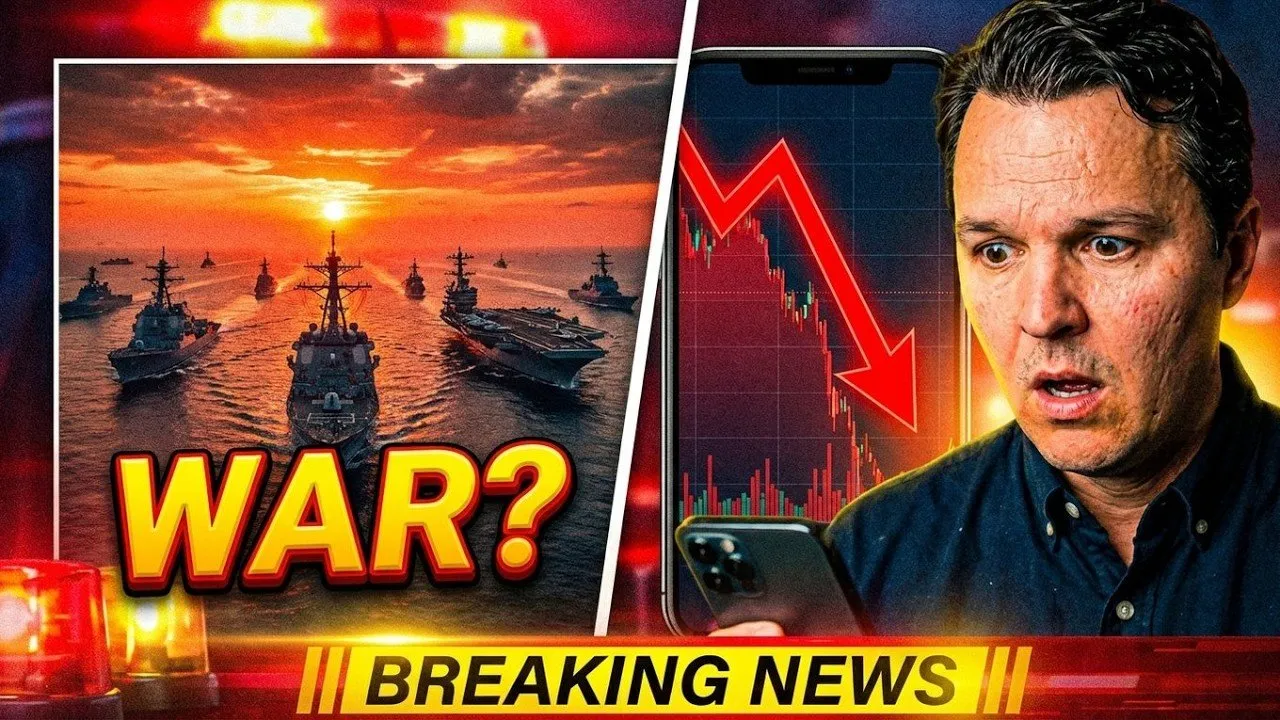
- Geopolitical tensions have reached a critical point as the U.S. Navy redeploys hardware from Bahrain, signaling a potential shift to a maximum wartime footing in the Middle East.
- Market analysts anticipate a 12% correction for the S&P 500 in the coming months, though many maintain a long-term price target of 8,000 before a structural secular crash.
- A massive capital rotation is underway, with 60% of S&P 500 stocks currently beating the index as investors flee high-growth tech for consumer staples.
Geopolitical Tensions Drive Market Uncertainty
The primary catalyst for the current "risk-off" environment is the escalating standoff between Washington and Tehran. Following months of failed diplomacy, the United States has significantly increased its military presence in the Middle East. Reports from Pentagon observers indicate that naval assets at the Bahrain base have been moved to open waters, a maneuver typically reserved for the hours preceding a strategic strike.
The potential for a protracted conflict has investors weighing the impact on global oil markets and the possibility of intervention from Russia and China. While some analysts argue that a military scenario is already "priced in" to current valuations, the sheer scale of Iran’s military compared to previous regional conflicts suggests a much "stickier" economic situation than the markets may be prepared for. Conversely, a diplomatic breakthrough could trigger a sharp relief rally across all risk assets.
The Software Armageddon and AI Disruption
While geopolitical fears dominate the headlines, the technology sector is grappling with an internal crisis. The IGV ETF is currently down 35% from its peak, testing lows not seen since April 2025. This "software armageddon" is being fueled by the rapid advancement of large language models (LLMs) from firms like Anthropic, which investors fear will displace legacy software giants such as IBM and CrowdStrike.
For the third time in seven years, the forward Price-to-Earnings (P/E) ratio of the tech sector has reached parity with consumer staples. This valuation anomaly previously occurred during the COVID-19 pandemic and the 2022 bear market, both of which were followed by significant market recoveries. However, the current decline is characterized by extreme volume and capitulation-level selling.
"People are overestimating the short-term impact of AI and underestimating the long-term impact. Mass productivity will come, but there will be a painful adjustment period for legacy firms," notes a recent market analysis from Catrini.
Bitcoin Reaches Historic Technical Extremes
In the cryptocurrency markets, Bitcoin has effectively decoupled from its "digital gold" narrative, instead trading as a high-beta proxy for software stocks. For the first time in history, the weekly RSI for Bitcoin has dipped into territory that suggests the asset is more oversold than at any point since its inception. Despite this, Bitcoin remains under the 20-day Exponential Moving Average (EMA), which currently sits near $69,000.
Technical indicators show a significant "liquidity drainage" in stablecoins, reaching levels comparable to the FTX collapse. Historically, such liquidity droughts tend to occur near the end of a major market downturn. Large speculators remain net long, while commercial players are heavily net short—a configuration that often precedes a bottoming process.
- Support Levels: Key support is identified at $59,000 (capitulation lows) and $58,000 (200-week Simple Moving Average).
- Resistance Levels: A weekly close above $68,000 (200-week EMA) is required to maintain the current structural integrity of the bull market.
- Altcoin Performance: Major assets like Ethereum (ETH) and Solana (SOL) are showing similar technical fragility, with Solana testing a critical double-bottom formation.
Market Rotation and the S&P 500 Outlook
The S&P 500 has remained relatively resilient compared to individual tech stocks, primarily due to a massive rotation into stable assets. While the tech sector craters, 60% of the index is currently outperforming, preventing a full-scale market crash. Analysts suggest this creates a unique environment for stock pickers, as many tech companies are now trading at "ridiculously low" valuations despite maintaining large client lists and deep moats.
Strategic repositioning is the prevailing advice for the second quarter of 2026. A move down to the 200-day EMA for the S&P 500—a correction of approximately 12%—is viewed by many institutional traders not as a reason to exit, but as the final "dip buying" opportunity of the year before an anticipated run toward 8,000.
"The market is now valuing tech at the same multiple as boring, slow-growth staples. Every time this has happened in the last decade, markets boomed shortly after," says Mike Investing.
As the week draws to a close, all eyes remain on the U.S. State Department and the Middle East. A failure to hold the 200-week EMA on the Sunday close for Bitcoin could signal further downside toward $50,000, while a stabilization in the software sector could provide the necessary floor for a broader market recovery. Investors are advised to maintain high levels of cash reserves (stables) until the current geopolitical uncertainty finds a clearer resolution.



)