Table of Contents
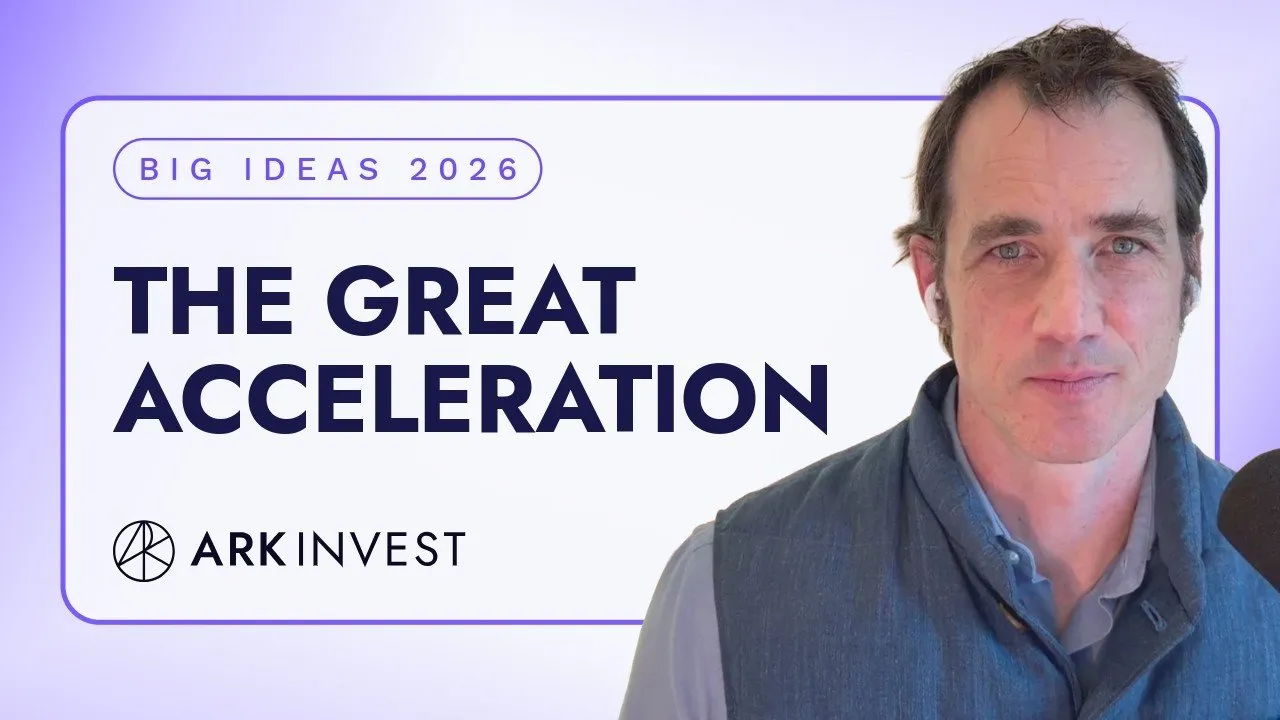
Welcome to a deep dive into ARK Invest's "Big Ideas 2026," where the central theme revolves around "The Great Acceleration." At its core, this thesis posits that Artificial Intelligence (AI) acts as the primary catalyst, an energetic dynamo that is rapidly advancing five pivotal innovation platforms. This convergence is not merely incremental; it is igniting an entirely new era of macroeconomic growth, poised to redefine industries and significantly enhance global prosperity.
Key Takeaways
- AI as the Central Dynamo: Artificial Intelligence is the driving force behind the acceleration of five major innovation platforms, fostering unprecedented macroeconomic growth.
- Five Transformative Platforms: AI, public blockchains, robotics, energy storage, and multiomics are each undergoing steep cost declines and converging to create new value.
- Radical Investment Cycle: We are entering an investment cycle for foundational technology assets that is projected to surpass any historical period, including the railroad era.
- Four Pillars of Economic Growth: Disruptive technologies accelerate capital formation, yield superior returns on capital, transform non-market activities into market activities, and free up productive human time.
- Innovation Imperative: As innovation-driven market capitalization is set to dominate, investors must ensure significant exposure to these disruptive technologies to avoid being left behind.
The Nexus of Innovation: AI and Five Transformative Platforms
The foundation of "The Great Acceleration" rests upon the synergy of five major innovation platforms. These are not isolated advancements but interconnected technological ecosystems, each characterized by steep cost declines, cross-sector applicability, and the capacity to serve as platforms for further innovation.
The Five Pillars of Disruption
ARK Invest identifies these five platforms as the engines of future growth:
- Artificial Intelligence (AI): Encompassing neural networks, intelligent devices, and next-generation cloud computing, AI is the "feedstock" that powers and accelerates all other platforms.
- Public Blockchains: Including cryptocurrencies, smart contracts, and digital wallets, this platform offers decentralized, transparent, and secure infrastructure for digital transactions and data management.
- Robotics: From humanoid robots and specialized industrial robots to reusable rockets, robotics is transforming physical labor and infrastructure development.
- Energy Storage: Driven by advancements in autonomous mobility, distributed energy generation, and advanced battery technology, this platform is democratizing access to power and reshaping transportation.
- Multiomics: Focusing on core sequencers, precision therapies, and programmable biology, multiomics is revolutionizing healthcare by enabling a deeper, more personalized understanding of biological data.
The Power of Convergence
These platforms are increasingly interconnected, with advancements in one catalyzing growth in another. This "convergent scoring" reveals a rapidly expanding network density among technologies, showing a 35% year-over-year increase in their mutual enhancement. For instance, the demand for AI compute is so immense that novel solutions are emerging.
AI is accelerating so quickly is why the entire technology cycle is accelerating quickly because it's feedstock into all of these innovation platforms.
A compelling example is the concept of lofting satellites equipped with computer chips into orbit to power AI training and inference. This approach is anticipated to be cost-competitive, potentially even offering better unit costs than traditional ground-based data centers. By leveraging solar power in space, it bypasses the complexities of land acquisition, permitting, and energy infrastructure on Earth. This innovative application could lead to a staggering 60x increase in demand for the underlying technology of reusable rockets, such as those developed by SpaceX, demonstrating how AI's needs drive demand across seemingly disparate sectors.
Similarly, multiomic data, which provides a comprehensive view of an individual's biological systems, is envisioned to reside in users' digital wallets. This secure, decentralized storage could then be utilized to train neural networks, enhancing their ability to interpret biological information and accelerate the development of precision therapies.
Fueling Unprecedented Growth: A Radically New Investment Cycle
The convergence and acceleration of these technologies are initiating an investment cycle unlike any seen before. Significant capital is now flowing into foundational assets like data centers, advanced software, robo-taxis, and, looking ahead to the 2030s, humanoid robots. This investment is projected to inflect and exceed any prior period in history, including the foundational build-out of railroads that significantly contributed to GDP in their time.
Four Drivers of Macroeconomic Acceleration
When disruptive technologies integrate into the economy, they typically generate four distinct types of macroeconomic acceleration:
- Accelerated Capital Formation: This involves massive investment in the underlying infrastructure required to deploy and utilize new technologies. For example, large tech companies, historically sitting on substantial cash reserves, are now strategically investing in data centers, enterprise software, and fleets of autonomous vehicles to maintain competitive edge.
- Superior Return on Capital: Transformative technologies are expected to deliver significantly higher returns on invested capital compared to prior allocations. Data centers, for instance, are projected to yield better returns on investment, generating more cash for both owners and the broader economy.
- Transformation of Non-Market Activity into Market Activity: Disruptive technologies can convert previously unrecognized economic activity into measurable GDP contributions. Robo-taxis illustrate this perfectly. In the U.S. alone, manual driving represents over $4 trillion in unpaid, imputed wages. When people opt for robo-taxi services, they pay a discounted rate for transportation, converting this previously unaccounted-for labor into recognized market activity.
- Additional Productive Time and Leisure: The time saved through automation and efficiency gains becomes a new source of economic productivity. Individuals using robo-taxis, for example, can use their travel time for work, contributing their full wage rate to the economy, or for leisure activities like watching streaming services, which still represents productive consumption and economic activity.
The Humanoid Robot: A Case Study in Economic Transformation
To make this economic transformation tangible, consider the impact of a single humanoid robot in a household. Currently, an average U.S. homeowner spends approximately $2,600 annually on external services (electricians, housekeepers, handymen). Additionally, they perform an imputed $65,000 worth of unpaid labor annually to maintain their homes.
Introducing a single humanoid robot fundamentally alters this dynamic. With an amortized annual cost of roughly $20,000 (over a five-year lifespan) and operating costs of about $3,600 (for electricity and maintenance), the robot undertakes tasks previously done by household members or external services. The value of the homeowner's freed-up labor time is estimated at $30,000, while previously undone tasks (e.g., disorganized sock drawers, neglected vacuuming) gain an economic value of $7,000. In total, a single humanoid robot could contribute an astonishing $60,000 per year to the economy, a more than 30-fold increase from the $2,600 previously recognized for external services.
If humanoid robots achieve 80% market penetration over a five-year business cycle, this single technology alone could accelerate annual GDP growth from the historical 2-3% range to 5-6%. In aggregate, the influx of these technologies is projected to drive average real GDP growth to more than 7% in the latter half of this decade, a significant leap from the 3% average observed over the past 125 years. This implies a substantial increase in collective wealth.
Separating Hype from Reality: Identifying Investable Disruptions
While the future promises remarkable technological advancements, not all emerging technologies are ripe for significant investment today. ARK Invest employs specific criteria to determine whether a technology is truly disruptive and investable:
- Steep Cost Decline: The unit cost of the technology must be rapidly decreasing.
- Compelling Unit Economic Cases: The technology must offer clear and attractive economic advantages across multiple sectors.
- Scalability and Platform Potential: It must be capable of commercialization at scale and serve as a foundation for further innovations.
Disruptive technologies require a steep cost decline, unit economic cases across multiple sectors that prove compelling, and that allows them to commercialize and get to scale.
Technologies like quantum computing and fusion power, while fascinating, do not yet meet these criteria. Quantum computing, for instance, has demonstrated only modest cost declines, with leading players doubling qubits every four years. Even with accelerated development, significant applications like cracking RSA encryption are not anticipated until the mid-2040s or even 2050s. Similarly, fusion power and advanced fuel cells are still far from achieving the necessary cost declines and widespread commercial viability for current investment consideration. For investors, the immediate future holds more tangible and impactful opportunities.
The Innovation Imperative: Navigating the Future Market Landscape
The profound macroeconomic shifts driven by "The Great Acceleration" will inevitably reshape market capitalization. Innovation-driven companies are set for unprecedented growth, potentially at the expense of traditional, non-innovation exposed incumbents.
From 2015 to 2020, innovation market cap compounded at 18%, accelerating to 20% between 2020 and 2025. This trend is expected to intensify as these technologies contribute an increasingly significant share of global economic growth. In stark contrast, non-innovation market cap – representing incumbent companies often found in broad market indices – could potentially shrink over the next five years. This presents a critical challenge for investors: a period of accelerating GDP growth globally could still result in negative portfolio returns if one is not adequately exposed to innovation.
ARK Invest predicts that innovation will comprise more than 60% of global market capitalization by 2030. While this might sound extreme, it aligns with historical precedents. In the late 1800s, railroads accounted for over 60% of equity market cap, driven by massive capital investment and superior returns due to their revolutionary efficiency. Like the railroads, today's disruptive technologies convert non-market activities into economic value, free up human time, and serve as platforms for endless new innovations.
Everybody needs to make sure that they are positively exposed to innovation in a meaningful way, given the point we are in the technological cycle.
The future global economy, much like the development of the American West depended on railroads, will largely depend on the radical capabilities delivered by AI and its convergent platforms in the coming decades. Prudent investors must recognize this fundamental shift and strategically position their portfolios to capture the immense value creation ahead.
Conclusion
The "Great Acceleration" is not merely a theoretical concept; it is a tangible, observable phenomenon driven by the rapid advancement and convergence of AI, public blockchains, robotics, energy storage, and multiomics. These platforms are not only transforming industries but are also igniting a macroeconomic growth cycle that promises to be unparalleled in history, leading to significantly increased global wealth. By understanding the dynamics of this acceleration, the four drivers of economic growth, and the critical importance of being innovation-exposed, investors can navigate the evolving landscape and capitalize on the profound opportunities of the future.