Table of Contents
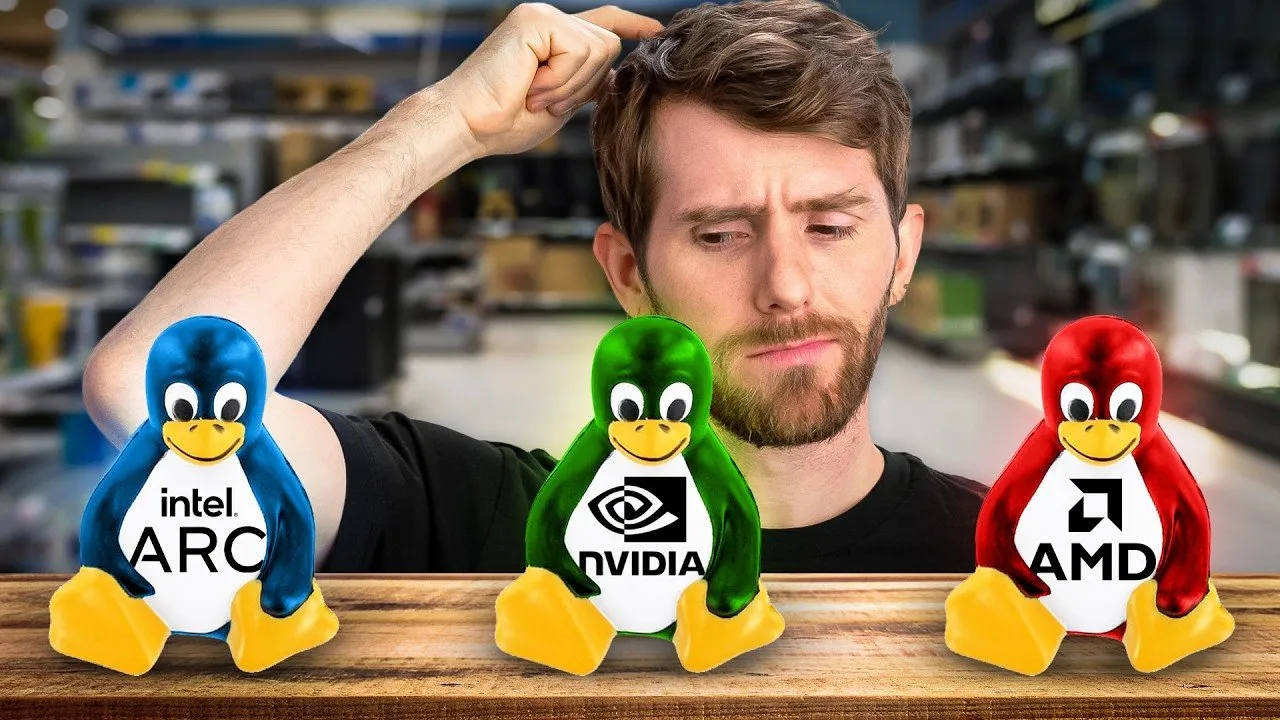
As user dissatisfaction with Windows grows due to forced updates and invasive AI integration, a significant number of PC enthusiasts are revisiting Linux as a viable daily driver. However, the transition involves more than just swapping operating systems; it requires identifying which hardware ecosystem provides the most stability and performance. A comprehensive new analysis testing the latest GPUs from Nvidia, AMD, and Intel reveals that while the gap is closing, significant disparities remain in gaming optimization and driver support.
Key Takeaways
- AMD remains the leader: Due to robust open-source driver integration, AMD GPUs demonstrated the least performance loss compared to Windows, with some titles running at near parity.
- Performance penalties for competitors: Both Intel and Nvidia cards suffered an approximate 30% performance drop on Linux compared to their Windows benchmarks.
- Driver support is critical: Newer GPU architectures (such as the Arc B580 and RTX 5060 Ti) struggled on standard Long-Term Support (LTS) distributions, requiring upgrades to newer Linux kernels for stability.
- Distro-agnostic gaming: Benchmarks across various Linux distributions—including Manjaro, Bazzite, and Ubuntu—showed functionally identical gaming performance.
The Hurdle of Initial Setup and Driver Maturity
For users migrating from Windows, the immediate challenge lies in driver compatibility, particularly for early adopters of cutting-edge hardware. The testing protocols utilized Ubuntu 24.04 LTS (Long-Term Support) as a baseline, representing a stable, user-friendly environment. However, the results highlighted a disconnect between the latest hardware releases and LTS software cycles.
Out of five GPUs tested, four failed to function correctly "out of the box" on the standard LTS distribution. While the Nvidia RTX 4060 Ti was easily remedied via Ubuntu’s additional drivers page, newer silicon proved more problematic. The RTX 5060 Ti and AMD Radeon 970 lacked immediate baked-in support, while Intel’s Arc B580 appeared functional initially but failed upon launching 3D applications.
The solution for all three manufacturers was to migrate to a distribution utilizing a newer Linux kernel, such as Ubuntu 25. This underscores a critical reality for Linux gaming: hardware support relies heavily on kernel timing.
"It turns out that for us, the bottom line is that it comes down less to which brand of GPU you choose and more down to the age and the exact timing."
Gaming Performance: The AMD Advantage
While day-to-day usability—web browsing, document editing, and media consumption—proved indistinguishable across all three brands, gaming performance revealed distinct tiers of optimization. The analysis utilized in-game benchmarking tools to compare Linux performance directly against Windows equivalents.
AMD emerged as the clear victor for gaming workloads. By leveraging open-source drivers, AMD cards maintained performance levels closest to their Windows counterparts. In Cyberpunk 2077, the Radeon cards saw almost no performance loss, and in specific instances, such as Strange Brigade, the hardware actually outperformed its Windows benchmarks.
Conversely, Nvidia and Intel faced optimization struggles. The data showed a consistent performance regression of approximately 30% for both manufacturers when switching to Linux. Intel’s Arc B580 struggled significantly, even in native Linux titles. Dota 2, which does not rely on the Proton compatibility layer, ran at barely half the frame rate observed on Windows.
Nvidia’s results were mixed. While older cards like the 4060 Ti remained within striking distance of Windows performance, newer iterations like the 5060 Ti saw substantial drops. Furthermore, updating to Ubuntu 25 resulted in a regression for Nvidia optimization compared to the older Ubuntu 24 environment.
Usability and Distro Impact
Beyond raw frame rates, the investigation sought to determine if the choice of Linux distribution (distro) impacted gaming capabilities. Testing the AMD RX 7700 XT across Bazzite, Manjaro, Ubuntu 24, and Ubuntu 25 revealed that the underlying software environment had virtually no impact on frame rates.
This finding suggests that users can select a Linux distribution based on interface preference or feature sets—such as pre-installed tools or UI design—without fearing a loss in gaming performance.
Regarding general computing, the "browser-based" nature of modern work has leveled the playing field. Even Linus Torvalds, the creator of the Linux kernel, recently noted that for his workflow, the specific GPU brand mattered less than acoustic performance, leading him to utilize an Intel Arc card for his daily driver.
For consumers looking to abandon Windows, the hardware barrier is lower than perceived, though AMD remains the optimal route for hardcore gamers. As resources for new users expand and compatibility layers mature, the viability of the Linux desktop continues to accelerate, offering a stable alternative for those willing to navigate the initial setup curve.


![Bitcoin: An Unfortunate Pattern [Update]](/content/images/size/w1304/format/webp/2026/03/bitcoin-unfortunate-pattern-update.jpg)