Table of Contents
In the modern venture capital landscape, the dominant strategy has been one of massive expansion. Firms like Sequoia, Andreessen Horowitz, and Founders Fund have scaled their assets under management, team sizes, and product offerings to become comprehensive financial institutions. Benchmark, however, stands as a defiant outlier. By maintaining a small team, a constrained capital base, and a singular focus on early-stage investing, the firm has preserved a "craftsman" approach to venture capital.
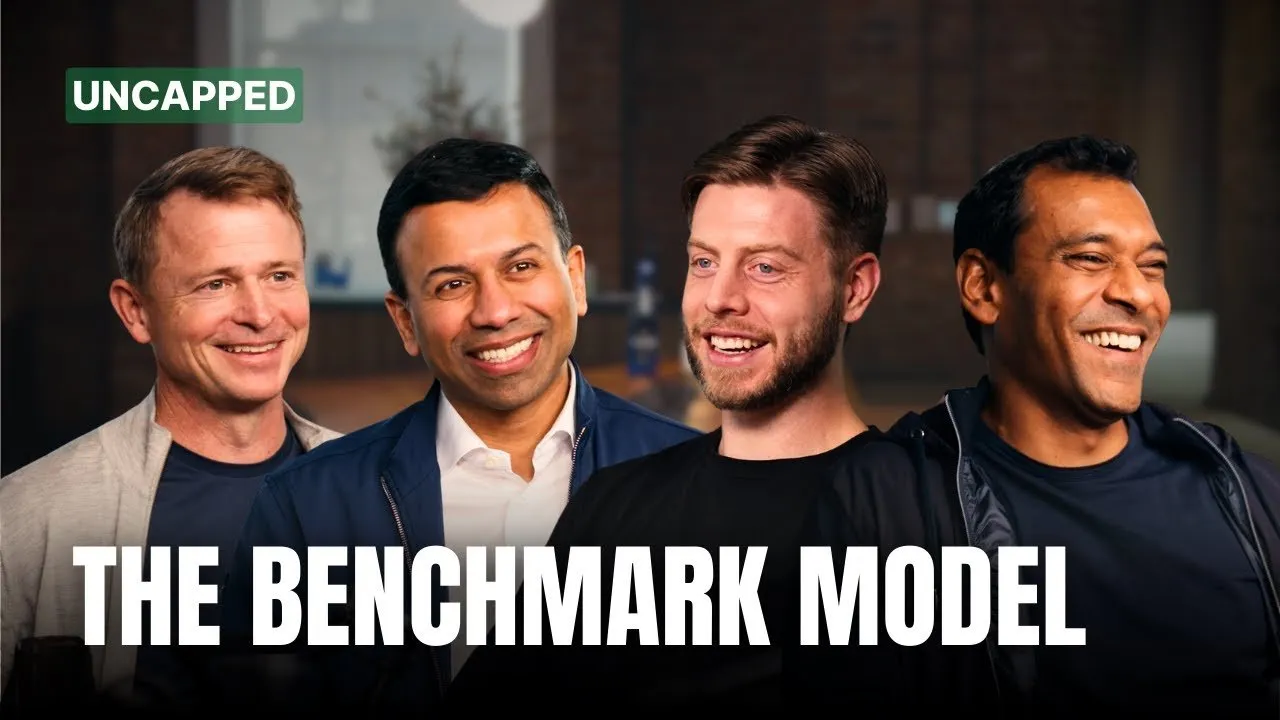
This distinct philosophy is not merely about staying small for the sake of tradition; it is a calculated mechanism to maximize alignment, decision-making quality, and professional fulfillment. In a recent detailed discussion, the Benchmark partnership—comprising Peter Fenton, Eric Vishria, Chetan Puttagunta, and newest partner Ev Randle—unpacked the internal mechanics of their firm. From their radical "equal partnership" structure to their counter-intuitive approach to the AI boom, their insights offer a rare glimpse into a firm that prioritizes "happiness maximization" alongside financial returns.
Key Takeaways
- The "Happiness Maximizing" Strategy: Benchmark intentionally rejects scaling assets under management because it degrades the quality of the partnership and the depth of founder relationships.
- Radical Equality and No Residuals: The firm operates as an equal partnership where retiring partners hand off economics entirely to the current generation, ensuring the firm constantly "refounds" itself.
- Active Service Over Passive Capital: Contrary to the industry trend of "hands-off" investing, Benchmark views board service as a demanding, high-engagement "sparring partner" role.
- Founder-Centric AI Investing: The firm’s success in the recent AI wave (investing in companies like Sierra and Cerebras) came not from a top-down market thesis, but by backing "true believers" during the market correction of 2022–2023.
The Strategic Refusal to Scale
The prevailing logic in asset management is that "more is better"—more capital, more fees, and more portfolio coverage. Benchmark argues that while this strategy may be financially lucrative, it is detrimental to the core work of venture capital.
Preserving the "Monday Morning" Dynamic
The heart of Benchmark’s culture is the Monday partner meeting. According to Peter Fenton, the quality of this meeting is a barometer for the firm’s health. When a firm scales, the administrative burden and the friction of managing a large organization bleed into the investment process.
"The quality of the relationship with the entrepreneur is degraded by scaling... The outcome of maximum cash-on-cash multiple I think is degraded with scaling."
For Chetan Puttagunta, the limitation on capital is a feature, not a bug. By keeping fund sizes manageable, the partners are forced to invest with high conviction. They cannot simply "option" a market by placing bets on every competitor. Instead, they must partner deeply with founders at the earliest stages—often pre-launch or idea phase—where the alignment between investor and entrepreneur is strongest.
Happiness vs. Finance
Eric Vishria introduces a critical distinction between financial maximization and happiness maximization. While Benchmark’s returns are historically exceptional, the partners acknowledge that they could likely extract more fees by raising multi-billion dollar funds. However, doing so would fundamentally alter their day-to-day lives.
The partners emphasize that their model filters for investors who derive joy from the actual work of company building rather than asset accumulation. The constraint is not capital; it is time. A partner can only serve as a true "co-founder" type board member for a limited number of companies—typically engaging for a decade or more.
The Mechanics of an Equal Partnership
Perhaps the most unusual aspect of Benchmark is its economic structure. Unlike most firms where founders retain economics in perpetuity, or where carry is distributed based on seniority, Benchmark splits economics equally among active partners.
No Residual Economics
When a partner retires from Benchmark, they do not retain a "tail" of economics from future funds. They hand the brand and the capital base over to the next generation. This creates a culture of "creative destruction" where the firm effectively resets with every generation.
"The founders gave us permission to basically not take it too seriously... No one's going to be around in a million years. Everything's ephemeral."
This structure prevents the accumulation of "dead equity" and ensures that the investors doing the work today are the ones incentivized by the results. It also empowers new partners immediately. As Ev Randle noted, despite being the newest member, the equal partnership model creates an immediate sense of ownership and responsibility, rather than the "earning your stripes" hierarchy found at other firms.
Unconditional Positive Regard
Peter Fenton cites the work of psychologist Carl Rogers as a foundational influence on the firm’s culture. The concept of "unconditional positive regard" underpins their approach to founders. To be effective, an investor must first seek to understand the entrepreneur fully and support them without judgment, even—and especially—when things go wrong. This creates a psychological safety net that allows for radical transparency in the boardroom.
Redefining Board Service in an Era of "Hands-Off" Capital
The venture landscape has seen a shift toward "founder-friendly" marketing that equates friendliness with passivity. Some firms pitch "no board seats" or promise to stay out of the way. Benchmark rejects this premise entirely, arguing that it creates a transaction rather than a partnership.
The Board Member as Sparring Partner
The partners describe their role not as "advisors" giving instructions, but as "sparring partners." The goal is to sharpen the founder's thinking through rigorous questioning and debate. This relationship requires proximity and trust. If a founder is afraid to share bad news because they fear the board's reaction, the partnership has failed.
"Winning is a moment in time... We average in our boards 10 plus years. Winning was a transaction... we say yes once or twice a year and serve for a decade long."
The Flaw in "Don't Do Harm"
While the "Hippocratic oath" of doing no harm is popular in VC marketing, Vishria argues that in practice, it often manifests as laziness. Startups are inherently difficult, and even the best founders benefit from an external perspective that challenges their assumptions. The "no board seat" trend often leaves founders isolated during critical crises, turning the investor-founder relationship into a purely financial transaction.
Navigating the AI Wave Through Founder-Centricity
Despite not having a publicized "AI Thesis" or a massive research arm, Benchmark managed to invest in several defining companies of the current AI cycle, including Sierra, Cerebras, Leya, and HeyGen. Their entry into these companies illustrates their "people-first" methodology.
The "True Believer" Filter of 2022–2023
During the market correction of late 2022 and 2023, "tourist capital" fled the technology sector. Interest rates rose, and the hype cycle cooled. Benchmark notes that founders starting AI companies during this trough were qualitatively different. They were not chasing trends; they were true believers driven by a specific insight.
By focusing on these individuals rather than a market map, Benchmark built a portfolio that looks thematically consistent in hindsight (infrastructure, vertical AI, agents) but was constructed bottom-up based on founder quality.
Thesis vs. Agility
Ev Randle points out that in the current AI paradigm, the underlying technology changes so rapidly that any static thesis becomes obsolete within quarters. A product roadmap designed in 2022 might be irrelevant by 2024 due to updates in foundation models.
In this environment, "founder-centricity" is not just a cultural preference; it is a risk mitigation strategy. Because the "moats" in AI are deteriorating and shifting quickly, the only investable asset is a founder capable of navigating high-velocity change. Benchmark bets on the navigator, not the map.
Conclusion
Benchmark remains a singular case study in the world of finance—a firm that has refused to evolve into an asset aggregator. By adhering to constraints on capital and headcount, they force a discipline that prioritizes deep partnership and high-conviction investing. Whether through their "equal partnership" economics or their rigorous approach to board service, Benchmark operates on the belief that venture capital is ultimately a craft business that cannot be industrialized without losing its soul.