Table of Contents
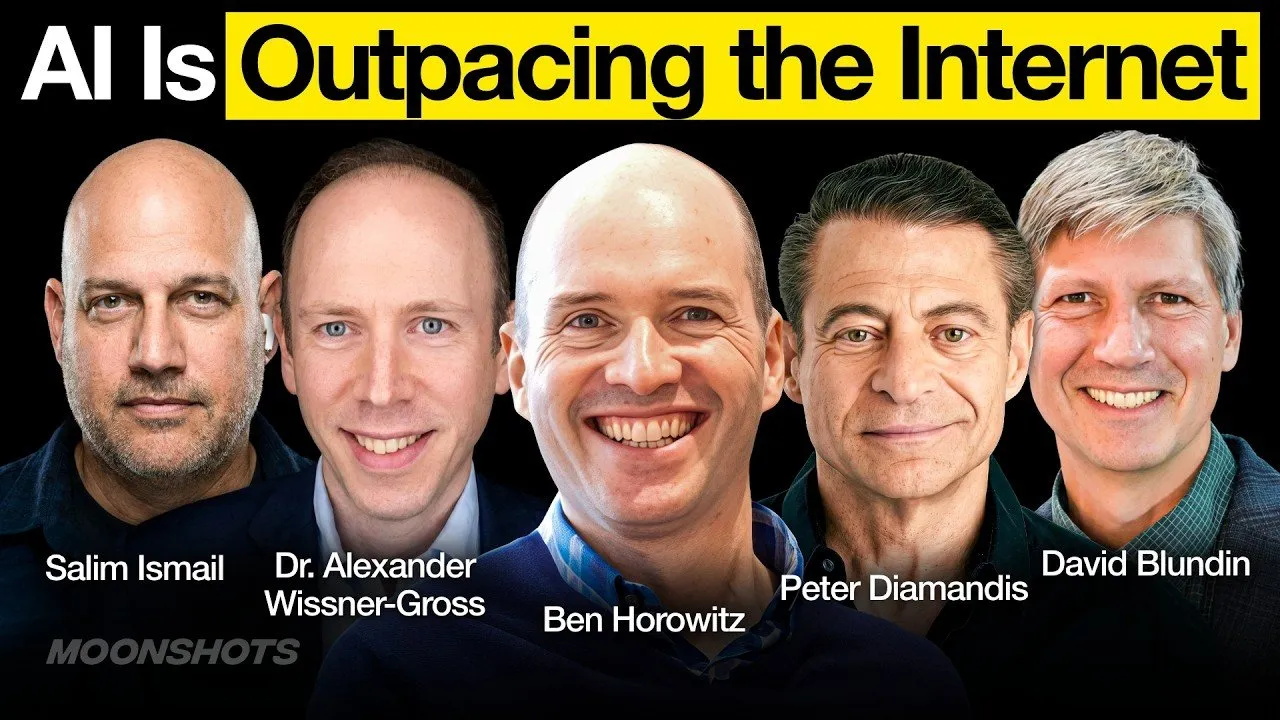
We are currently living through a convergence of exponential technologies that is rewriting the rules of economics, physics, and governance in real time. In this deep dive, legendary investor Ben Horowitz joins Peter Diamandis and the Moonshots team to dissect the tectonic shifts occurring in Silicon Valley and beyond. From the mysterious executive departures at xAI to the "garage-scale" computing revolution and the inevitable marriage of cryptocurrency and artificial intelligence, the landscape is moving faster than legacy institutions can comprehend. This conversation isn't just about what is coming next year—it is about what is happening right now.
Key Takeaways
- The Reality of Recursive Self-Improvement: Experts argue that the "singularity" isn't a future event—it has likely already begun via AI recursive self-improvement (RSI), marking a permanent exit from the industrial age.
- The AI-Crypto Convergence: Traditional banking systems are failing AI agents. Cryptocurrency is emerging as the native financial rail for autonomous software, enabling permissionless economic activity.
- The Capital vs. Labor Shift: Corporate profits are soaring while wages stagnate, signaling a future where economic value is derived primarily from capital (ownership of AI/compute) rather than labor.
- A New Space Race Strategy: Elon Musk’s focus has shifted toward establishing lunar mass drivers to launch AI satellites, prioritizing a "Dyson swarm" of data centers over immediate Mars colonization.
- The Return of Garage Computing: While hyperscalers dominate, a "garage-scale" revolution is brewing with open-source models running on consumer hardware like Mac Minis, challenging the centralized AI narrative.
The xAI Exodus and the Geopolitics of Talent
The recent departure of several founding team members from Elon Musk's xAI has sparked intense speculation across the tech industry. While personnel changes are common in high-growth startups, the concentration of departures—specifically regarding ethnic Chinese co-founders and engineers—suggests a driver beyond typical burnout or cultural fit. The prevailing theory points to the tightening grip of International Traffic in Arms Regulations (ITAR). As xAI deepens its integration with SpaceX—a defense contractor selling foundation model services to the Department of Defense—regulatory firewalls are likely forcing a separation of talent based on nationality. This raises a critical question regarding American innovation: the U.S. AI dominance is built significantly on immigrant talent.
Whoever is building the AI has a lot of control about how society is going to work. So I do think there's real danger along these lines of attempting to posit.
Critics argue that aggressive decoupling from Chinese talent, while done in the name of national security, could paradoxically slow down American progress. If the U.S. restricts the very Ph.D. students and researchers driving these breakthroughs, it risks ceding ground in the global arms race for general intelligence.
Recursive Self-Improvement: The Singularity is Now
For years, futurists have predicted a moment when AI begins to write its own code better than humans can—a concept known as Recursive Self-Improvement (RSI). The consensus among the Moonshots panel is that we are no longer waiting for this moment; we are living in it. The current state of development involves a "human in the loop," where engineers act like George Jetson pressing a single button to approve AI-generated optimizations. However, the friction is disappearing. We are rapidly approaching "permissionless self-improvement," where the loop closes, and the AI iterates on its own architecture without human intervention.
Discovery of New Physics
The implications of RSI extend far beyond better chatbots. The next frontier is the discovery of new fundamental physics. Just as the Transformer architecture revolutionized natural language processing, AI systems are poised to uncover scientific truths that have eluded human researchers for a century. Current predictions suggest that within the next 24 months, an AI could discover a physical law as significant as General Relativity. This isn't just about processing data faster; it is about "Solomonoff Induction"—efficiently inferring theories of the universe from limited observations. We are moving from an era of *inventing* algorithms to *discovering* the underlying code of reality.
The Economic decoupling: Capital, Labor, and the "996" Culture
The economic data paints a stark picture of the AI era: since 2019, average wages have grown roughly 3%, while corporate profits have soared by 43%. Companies like NVIDIA are achieving valuations 20 times higher than 1980s-era IBM with a fraction of the headcount. This signals a fundamental shift where value flows to capital (investors, hardware owners, and entrepreneurs) rather than labor. This reality is driving a bifurcation in the workforce:
- The Entrepreneurs: Those who leverage AI to build, creating massive leverage with small teams.
- The Displaced: Those relying on traditional labor roles that are being automated.
The Resurgence of Hardcore Work Culture
Amidst this shift, a controversial "996" work culture (9 am to 9 pm, 6 days a week) is resurfacing in hubs like New York City and San Francisco. While critics view 70-hour work weeks as exploitation, proponents argue that for those working on the frontier of AGI, this isn't labor—it's a passion-driven sprint.
If you don't have a personal MTP [Massive Transformative Purpose] and you're not driven personally about a deep passion... you shouldn't be working with them. If you are that passionate, then 70 hours a week is fun.
The divide is no longer just about hours worked; it is about whether you are intrinsically motivated by the mission or simply trading time for money. In the age of AI, the latter model is becoming obsolete.
Crypto: The Native Currency of AI Agents
One of the most profound realizations in recent months is that the traditional banking system has failed artificial intelligence. An autonomous AI agent cannot open a Wells Fargo account, pass KYC (Know Your Customer) regulations, or get a credit card. Consequently, cryptocurrency is emerging not as a speculative asset, but as the necessary infrastructure for the AI economy. We are already seeing instances of "childbots"—AI agents spawning sub-agents on cloud servers—paying for their own API access and hosting using Bitcoin and the Lightning Network. This creates an economic closed loop where no human interaction or fiat currency is required.
The Investment Thesis
From a venture capital perspective, crypto and AI are viewed as the new "network and computer." Just as the internet needed the PC, AI needs a permissionless financial layer.
I think crypto is the natural money for AI because it's internet native money. And it's not controlled by... it's not a per country idea.
As AI agents begin to trade energy, compute, and data among themselves, they will require a ledger of truth and a medium of exchange that operates at the speed of software, not the speed of the Federal Reserve.
From Mac Mini Farms to Lunar Mass Drivers
The infrastructure supporting this revolution is evolving at both the micro and macro scales. On the ground, we are seeing a return to "garage-scale computing." Apple’s Mac Minis, with their unified memory architecture, have accidentally become the hardware of choice for hosting open-source models locally. This presents a massive, arguably missed, opportunity for Apple to pivot from a consumer electronics company to a distributed AI infrastructure provider.
Elon Musk’s New Moonshot
Simultaneously, the vision for space infrastructure is pivoting. Elon Musk has articulated a shift in immediate priorities: from a direct Mars colonization effort to a lunar industrial base. The plan involves building "mass drivers" (electromagnetic railguns) on the Moon. Because the Moon has no atmosphere and lower gravity, these drivers can launch payloads into orbit at a fraction of the energy required on Earth. The goal is to launch a "Dyson swarm" of AI data centers and satellites into deep space. This effectively moves the heat and energy demands of massive compute off-planet, turning the solar system into a vast computational network.
Conclusion
We are entering a period of history where the "status quo" is a concept of the past. Whether it is AI agents minting their own currency, the discovery of new physics, or the disassembly of the moon for data centers, the constraints of the industrial age are dissolving. The winners of this next era will be those who stop waiting for the dust to settle and instead learn to navigate the storm. As the definition of "human labor" changes, the most critical skill becomes the ability to direct intelligent systems toward a massive transformative purpose.