Table of Contents
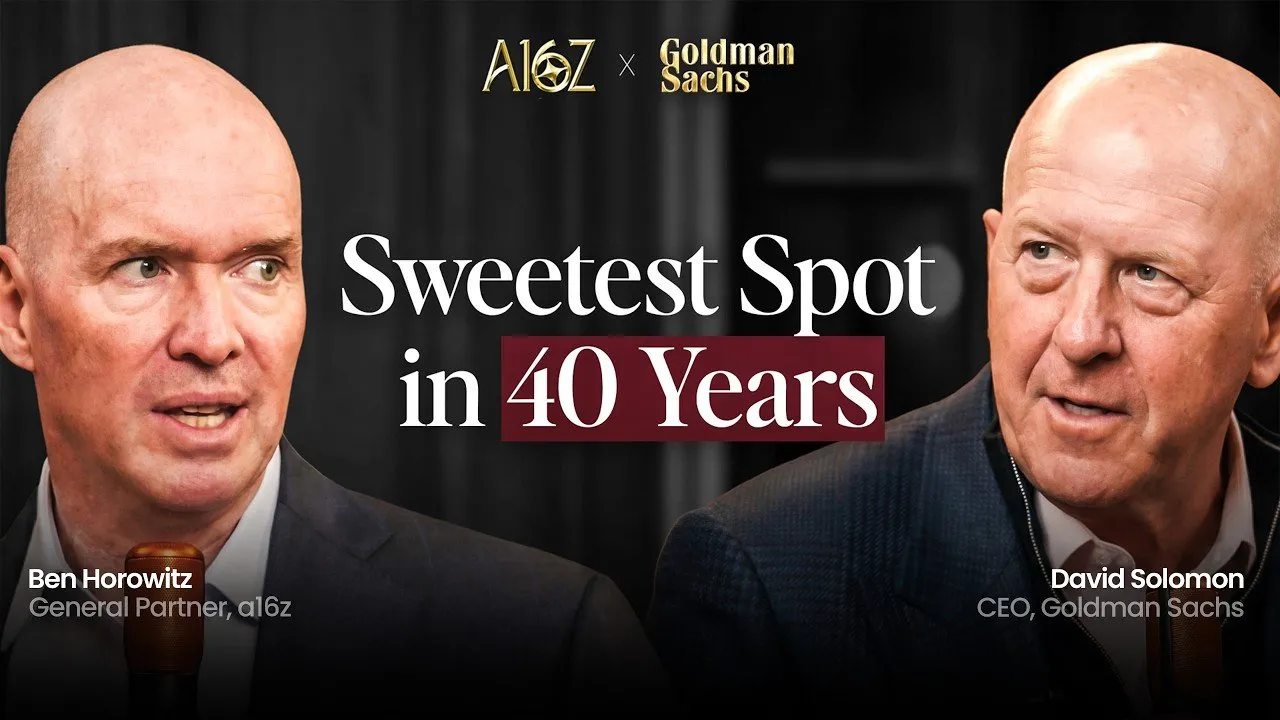
When the CEO of one of the world’s oldest financial institutions sits down with a founder of Silicon Valley’s most influential venture firm, the conversation inevitably turns to the intersection of capital, technology, and national interest. David Solomon of Goldman Sachs and Ben Horowitz of Andreessen Horowitz (a16z) recently shared the stage to discuss the evolving landscape of global finance. Their dialogue revealed a striking consensus: despite geopolitical turbulence, the United States is currently positioned in an economic "sweet spot" driven by a unique convergence of fiscal stimulus, technological innovation, and a shifting regulatory environment.
Key Takeaways
- The "Sweet Spot" Thesis: David Solomon argues the U.S. is in its best macro environment for financial assets in 40 years, fueled by a "cocktail" of fiscal stimulus, monetary easing, and an AI investment super-cycle.
- The Return of M&A: After years of regulatory headwinds, confidence is returning to the deal-making sector, with predictions that the coming year could see historic levels of mergers and acquisitions.
- AI Changes Capital Efficiency: Ben Horowitz suggests AI shatters the traditional "Mythical Man-Month" rule in software; unlike traditional coding, throwing more capital (GPUs and data) at AI problems actually yields faster results, driving a need for larger IPOs.
- Scale is Survival: Both leaders emphasized that in modern finance and venture capital, scale is no longer optional—it is a prerequisite for relevance and global competitiveness.
- The Policy Battleground: There is a critical focus on establishing clear regulatory frameworks for crypto and AI to ensure the U.S. maintains its technological edge over global competitors like China.
The "Sweetest Macro Spot" in Decades
For investors focused on headline risks—from inflation to geopolitical conflict—David Solomon offered a contrarian and decidedly bullish perspective on the U.S. economy. While acknowledging that the average consumer feels the pinch of cumulative inflation, Solomon argued that for those attached to investable assets, the environment is historically prime.
Solomon identified a "cocktail of stimulus" that makes it nearly impossible to slow the economy down:
- Fiscal Stimulus: Continued government spending remains high.
- Monetary Easing: The Federal Reserve has entered a rate-cutting cycle.
- Capital Investment: An infrastructure and AI super-cycle is driving massive enterprise spending.
- Deregulation: A shift toward a lighter regulatory touch is boosting business confidence.
"If you're in our kind of businesses, if you're attached to financial assets, this is as sweet a spot that I've seen... Last year the four largest companies contributed 1% to GDP growth with their $400 billion of spending."
This environment is fundamentally changing the psychology of corporate leadership. For the past four years, regulatory friction meant the answer to most strategic questions was "no." Today, the answer is "maybe," and frequently "yes." This shift is expected to unlock a backlog of M&A activity and IPOs, as CEOs look to deploy capital and grow through acquisition.
The Evolution of Institutional Scale
A recurring theme in the discussion was the absolute necessity of scale. David Solomon reflected on Goldman Sachs' transition from a private partnership to a public company, noting that while the partnership culture remains aspirational, the firm needed permanent capital to compete globally. He pointed out that scale provides leverage during turbulent times.
The Banking Reality
Solomon highlighted a stark competitive reality: size matters more than ever. He noted that while Goldman Sachs is an institutional giant, it is small compared to retail banking behemoths like JPMorgan Chase. To remain competitive over the next decade, Goldman must significantly expand its balance sheet and diversify its funding sources away from wholesale funding toward more stable deposits.
The Venture Capital Industrial Complex
Ben Horowitz drew parallels to the evolution of a16z. Historically, venture capital was a boutique industry where a firm might manage a small basketball team of investors. However, the thesis that "software is eating the world" changed the math. Instead of 15 tech companies reaching $100 million in revenue annually, the market now produces hundreds. To capture this opportunity, a16z had to industrialize the venture process, moving from a boutique model to a scaled firm capable of servicing a massive portfolio.
"It turns out that the best time to raise money is when nobody has money... People always want to invest high and they always want to walk away when the market is low."
How AI is rewriting the Rules of Business
The conversation shifted to how Artificial Intelligence is altering both the internal operations of financial firms and the very nature of software development.
Goldman’s "1GS 3.0" Strategy
For Goldman Sachs, AI is a tool for efficiency and capacity creation. Solomon described a strategy of reimagining core operating processes to automate workflows. The goal is not merely cost-cutting, but creating the fiscal capacity to invest in growth. By saving billions through efficiency, the firm can reinvest in technology without degrading returns for shareholders.
The Death of the "Mythical Man-Month"
Horowitz provided a profound insight into how AI changes the economics of startups. For decades, the software industry operated under the law of the "Mythical Man-Month"—the idea that adding more people to a late software project only makes it later. You could not simply throw money at engineering problems to speed them up.
AI reverses this dynamic. With generative AI, if you have proprietary data and enough GPUs (computing power), you can solve problems faster by spending more money. This shift means:
- Technical leads are less defensible than they used to be; competitors can catch up by spending more.
- Startups will need to go public sooner to access the massive capital required to compete on compute power.
- The era of "staying private forever" may end for AI infrastructure companies because the capital demands are too high for private markets alone.
The Regulatory Fight for the Future
Both leaders expressed a deep sense of responsibility toward U.S. national interests, particularly regarding competition with China. Horowitz and a16z have taken an unusually active role in Washington D.C., focusing on two main pillars: Crypto and AI.
Crypto and Financial Rails
Horowitz criticized the previous regulatory approach to crypto, describing it as "extra-legal" attempts to debank an entire industry. He argued that blockchain technology is essential for the future of digital property rights and efficient financial rails. The passing of the Stablecoin Bill and the push for market structure clarity are seen as vital steps to keep web innovation within the United States.
The Right to Mathematics
On AI regulation, the stance is clear: do not regulate math. Horowitz warned against alarmist policies that seek to ban open-source models or treat algorithms as sentient beings. The argument is that the underlying model is mathematics, while the application is what should be policed. If the U.S. hampers its own development through fragmented state-level laws or draconian copyright restrictions that prevent training on data, it risks ceding AI dominance to China.
Conclusion
The dialogue between Horowitz and Solomon paints a picture of a financial world in transition. We are exiting a period of regulatory freeze and entering an era of aggressive capital deployment. The winners in this next cycle will likely be those who possess the scale to navigate complex compliance landscapes and the capital to fuel the insatiable hunger of AI infrastructure. As the macro environment aligns with a technological super-cycle, the message to founders and executives is clear: the window to build, acquire, and expand is open.