Table of Contents
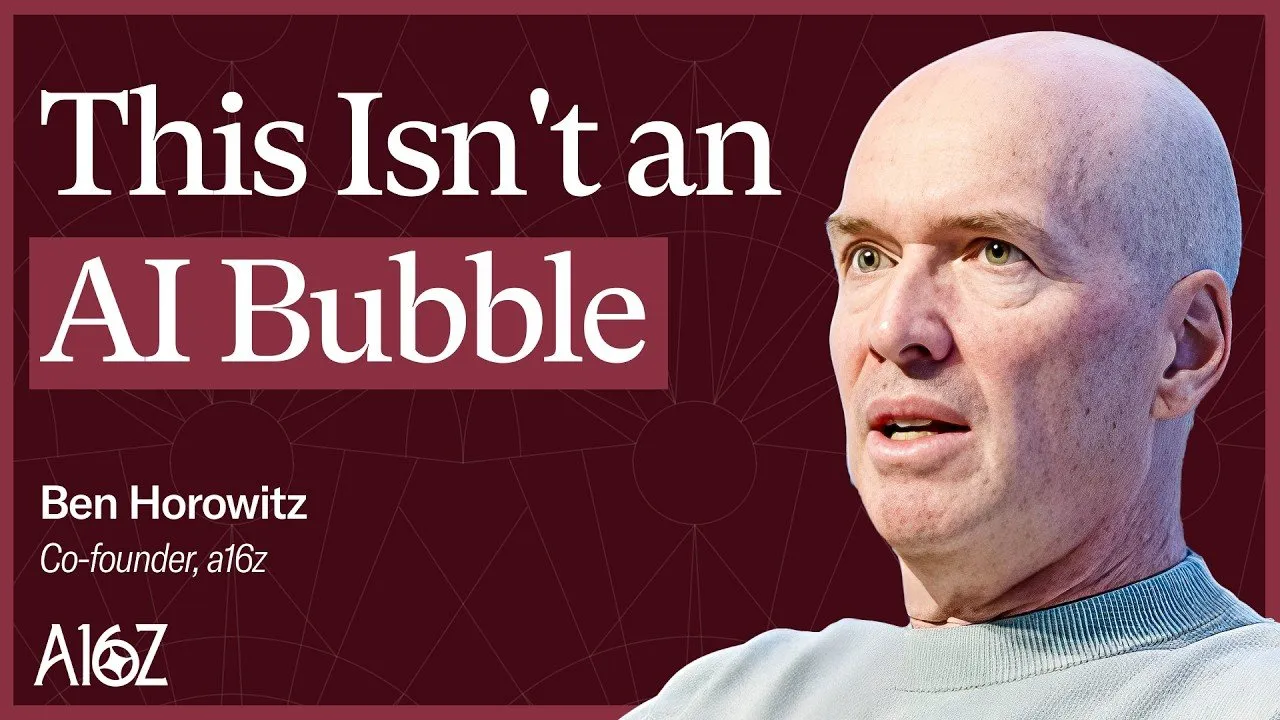
In the high-stakes world of venture capital, few voices carry as much weight as Ben Horowitz. As a co-founder of Andreessen Horowitz (a16z), he has navigated the firm through the rise of mobile, the crypto boom, and now, the generative AI revolution. But navigating this landscape requires more than just capital; it requires a fundamental rethinking of how firms are structured, how talent is assessed, and how we define value in a market that moves at breakneck speed.
In a recent candid discussion, Horowitz opened up about the internal mechanics of scaling a top-tier VC firm, his controversial stance on ESG versus "American Dynamism," and why the current AI market—despite its sky-high valuations—might not be the bubble skeptics fear it is. For founders and investors alike, his insights offer a blueprint for surviving and thriving in a "brave new world" of technology.
Key Takeaways
- Talent "Spikes" Over Well-Roundedness: When investing or hiring, Horowitz prioritizes individuals who are "literally the best in the world" at one specific thing rather than generalists who lack weaknesses but possess no superpowers.
- The Basketball Team Rule: To maintain high-quality decision-making while scaling, investment teams should not exceed the size of a starting basketball team (roughly five people).
- AI Market Fundamentals: While AI valuations are historically high, they are matched by unprecedented demand and revenue growth, distinguishing this cycle from traditional speculative bubbles.
- The "DNA of the Future" Strategy: We are entering a period of increased M&A activity where incumbents must acquire startups not just for products, but to integrate the "DNA" necessary to survive the AI transition.
- American Dynamism: The firm explicitly rejected traditional ESG frameworks in favor of "American Dynamism," focusing on critical national sectors like defense, energy, and supply chain modernization.
Investing in the Age of AI: Bubble or Brave New World?
The question dominating every boardroom today is whether the current AI boom is a sustainable economic shift or a speculative bubble waiting to burst. Horowitz offers a contrarian view to those calling for a correction. While he acknowledges that valuations have risen with extraordinary speed, he points out that the underlying fundamentals differ significantly from previous hype cycles.
In past bubbles, valuations often detached from reality, fueled by metrics that ignored revenue. Today, the surge in valuation is mirrored by a surge in actual customer adoption.
"We've never seen valuations rise like this, but we've never seen demand rise like this either. We are in a bit of a brave new world... Even the Nvidia multiples, particularly when you look at the growth rate and the size of the earnings, they're not historically nuts."
The Complexity of the Application Layer
Early assumptions about AI suggested that massive foundation models would become "giant brains" capable of doing everything, potentially commoditizing the application layer. However, the market has not played out that way. Instead, the complexity of human behavior and specific use cases has made the application layer incredibly robust.
Horowitz cites Cursor, an AI-powered code editor, as a prime example. It isn't powered by a single generic model; it utilizes roughly 13 different models working in concert to handle different aspects of programming and user interaction. This indicates that the future isn't just about who owns the biggest GPU cluster, but who can orchestrate multiple models to solve complex, fat-tail problems.
The "Basketball Team" Theory of Management
As a16z grew from a boutique firm to a financial powerhouse, Horowitz and co-founder Marc Andreessen had to solve a structural paradox: How do you get big enough to cover every emerging market (software, bio, crypto, defense) without losing the agility and intimacy required for great investment decisions?
The solution came from a conversation with the late Dave Swensen of Yale’s endowment, who posited that an investment team should never be much larger than a basketball team. Once a group exceeds five or six active participants, the quality of the conversation degrades. To solve this, a16z adopted a strict verticalization strategy.
By splitting the firm into distinct verticals—such as Bio, Crypto, and Games—they created specialized "basketball teams." This structure allows them to:
- Maintain high-bandwidth communication within groups.
- Deploy deep domain expertise rather than generalist oversight.
- Scale the firm's total assets without diluting the quality of individual investment decisions.
Assessing Talent: Ignoring Weaknesses to Find Genius
Whether evaluating a founder for investment or a General Partner (GP) for the firm, Horowitz applies a counter-intuitive filter. In a corporate environment, hiring often focuses on eliminating risk—finding candidates who are "safe" and lack glaring deficiencies. In venture capital, this leads to mediocrity.
Horowitz argues that the difference between a mediocre company and a magical one often lies in a single, overpowering strength. The firm explicitly looks for "spiky" individuals.
"What you're really trying to find is: are they literally the best in the world at a thing? That's always the thing worth investing in, as opposed to 'they're pretty good at a lot of things, and I can't figure out what they're not good at.' That's generally a worse investment."
This philosophy extends to how they manage their own GPs. The firm avoids getting "wrapped around the axle" regarding a partner's weaknesses and instead leans heavily into their specific zone of genius—whether that's networking architecture or deal-making capability.
American Dynamism vs. ESG
In recent years, the investment world has been awash in ESG (Environmental, Social, and Governance) mandates. Horowitz reveals that a16z consciously decided against launching an ESG fund. They viewed the framework as often being a marketing message that could lead to "weird decision-making" decoupled from economic reality.
Instead, they developed the thesis of American Dynamism. This focuses on companies that support the national interest—modernizing defense, improving public safety, and solving energy crises. The logic is grounded in the belief that for the United States to maintain its standing, it must win technologically.
Horowitz emphasizes that this isn't charity; it is a recognition that the U.S. government is a massive customer with antiquated systems desperately in need of modernization. The opportunity lies in the intersection of patriotic duty and immense technological overhaul.
The Return of M&A: Acquiring the DNA of the Future
Looking toward the exit landscape, Horowitz predicts a resurgence in "Little Tech M&A." The disruption caused by AI is so profound that incumbent companies cannot simply build their way out of it using legacy talent pools. They are under existential threat.
To survive, these incumbents must acquire startups not necessarily for their revenue streams, but to transplant the "DNA of the future" into their organizations. This necessity will likely drive a wave of acquisitions as traditional companies scramble to reconstruct how they work before they are made obsolete by nimble, AI-native competitors.
Conclusion
Ben Horowitz’s perspective serves as a reminder that in technology, the rules are constantly being rewritten. Whether it’s abandoning traditional management hierarchies for verticalized teams, or rejecting safe investments in favor of "spiky" talent, success requires the courage to diverge from the consensus.
As AI continues to reshape the economy, the winning organizations will be those that move with clarity, embrace the complexity of the application layer, and understand that changing the world starts with the unwavering belief that you can.