Table of Contents
Pricing remains one of the most paralyzing decisions for B2B startup founders. That moment when a promising sales call ends with "Can you send us your pricing?" often triggers complete panic. Without experience at enterprise companies, many founders default to consumer software pricing they know – $19 or $49 per month – leaving massive revenue on the table.
Key Takeaways
- Build a value equation with your champion that quantifies specific cost savings, time savings, or revenue increases your product delivers
- Price between 25-50% of the value you create, allowing customers to keep roughly two-thirds while you capture one-third
- Use cost only as a pricing floor, not a starting point – aim for 80-90% software margins
- Avoid price wars by differentiating your product rather than competing solely on price
- Start with higher prices and test downward – losing 25% of deals due to price indicates you're in the right ballpark
The Value Equation: Your Pricing Foundation
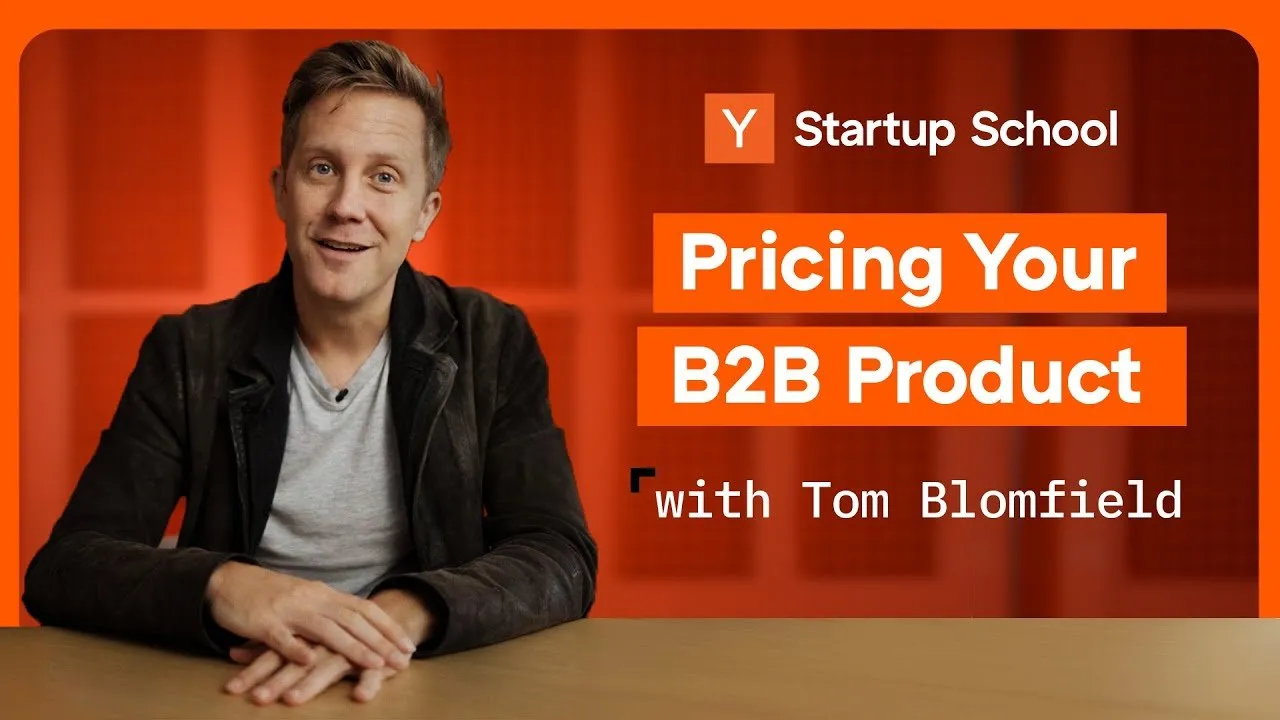
The most critical element in B2B pricing is what Y Combinator partner Tom Blomfield calls the value equation. This involves sitting down with your champion – the person at the customer company who believes your product solves their biggest problem – and systematically writing down the expected value your product will deliver.
Quantifying Business Impact
Value typically falls into three categories: cost savings, time savings, or revenue increases. Consider a customer service AI tool targeting a company with 100 support agents. If each agent costs $100,000 annually in fully-loaded expenses (salary, benefits, office space), that's $10 million in total customer service costs.
If your AI tool eliminates 20% of queries or reduces agent time by 20%, you're delivering $2 million in potential cost savings. This concrete calculation becomes the foundation for your pricing strategy.
Building Champion Buy-In
The value equation serves a dual purpose. Beyond justifying your price, it becomes a tool for your champion to secure internal approval. They can present clear ROI calculations to their CFO or executive team, making the purchase decision logical rather than emotional.
Write down with this champion what they expect your product to do for them and get the customer to challenge it and prod it.
Strategic Pricing Framework
The One-Third Rule
Once you've established the value equation, pricing becomes straightforward. Charge between 25-50% of the value you deliver. Using the customer service example, $2 million in savings justifies roughly $700,000 in annual contract value. The customer retains $1.3 million in benefits – an excellent ROI that makes approval easier.
Cost as a Floor, Not a Foundation
Never start with cost-plus pricing. Calculate your costs only to ensure they don't exceed your value-based price. If your value-based pricing yields $700,000 but your costs are $200,000, you're in excellent shape with strong margins.
However, if your value calculation only supports $150,000 in pricing while your costs are $200,000, you have a fundamental business problem. You must either demonstrate more value, reduce costs dramatically, or pivot your approach entirely.
Margin Expectations
Software businesses should target 80-90% gross margins. While companies like OpenAI and Anthropic continue reducing API costs, don't bank on dramatic cost reductions. Treat promotional credits from AWS, Microsoft, or OpenAI as real cash costs in your calculations.
Competitive Positioning and Differentiation
Avoiding the Price War Trap
When direct competitors undercut your pricing, resist the urge to engage in a bidding war. Price wars create a race to the bottom that destroys margins for everyone involved. The airline industry exemplifies this dynamic – despite moving millions of passengers, airlines average just 2.7% net profit margins due to commoditization.
Creating Product Differentiation
Instead of competing on price alone, differentiate your product based on functionality or value. Focus on specific industries, unique integrations, or specialized features that competitors can't easily replicate. Your goal is to avoid apples-to-apples comparisons that reduce your product to a commodity.
If there's extreme competition in an industry for a commodity product, all the margin gets driven out.
Pricing Structure and Sales Strategy
Understanding Customer Payment Preferences
Research how your target customers typically pay for similar software. Do they prefer monthly flat fees, per-seat pricing, usage bands, or credit systems? Aligning with familiar payment structures reduces friction in the sales process.
Keep pricing simple. Overly complex pricing structures kill deals. When possible, prioritize committed recurring revenue over pure usage-based pricing, as it provides more predictable revenue during economic downturns.
The 5:1 Sales Compensation Rule
Your pricing level dictates your sales strategy. Use a 5:1 ratio between new signed ARR and total salesperson compensation as a benchmark. A salesperson earning $100,000 annually should generate approximately $500,000 in new ARR.
This could mean closing one $500,000 deal annually, twenty $25,000 deals, or five hundred $1,000 deals. Each scenario requires different sales approaches – from whale hunting to inside sales support.
Enterprise vs. Self-Service Pricing
For enterprise deals, avoid publishing fixed prices on your website. The value equation varies significantly between customers, meaning a single price either overprices some prospects (losing deals) or underprices others (leaving money on the table).
Instead, offer one or two lower-priced plans for individuals and small teams, while gating enterprise features like SOC 2 compliance, single sign-on, or audit logs behind custom pricing tiers.
Testing and Iteration Strategies
Pilot Programs and Proof of Concept
Keep free trials and pilots extremely short – two to four weeks maximum – with crystal-clear success criteria derived from your value equation. Better yet, push for annual contracts with 30-60 day money-back guarantees. This approach generates immediate recurring revenue while providing an escape hatch for unsatisfied customers.
The 50% Price Increase Method
When you're genuinely uncertain about pricing, start with a number similar to comparable software, then increase by 50% for each new prospect. If you start at $10,000 and they accept, try $15,000 with the next customer, then $22,500 with the third.
When you begin losing more than 25% of potential deals based solely on price, you've found your pricing range. Remember: you don't need to win every deal, and if every prospect accepts immediately, you're almost certainly underpricing.
Conclusion
Pricing paralysis kills more startup deals than actual competition. Your first five or ten customers represent a tiny fraction of your potential lifetime revenue, so focus on closing deals and learning rather than optimizing every dollar.
Start with the value equation – quantify the specific business impact you deliver and price at roughly one-third of that value. Ensure your costs remain well below your pricing to maintain healthy margins. When facing competition, differentiate rather than engaging in price wars.
Most importantly, remember that pricing gets easier over time. As you gain validation logos, improve your product, and develop sales expertise, you'll command higher prices with greater confidence. The first few sales are always the hardest – get them closed and build momentum from there.