Table of Contents
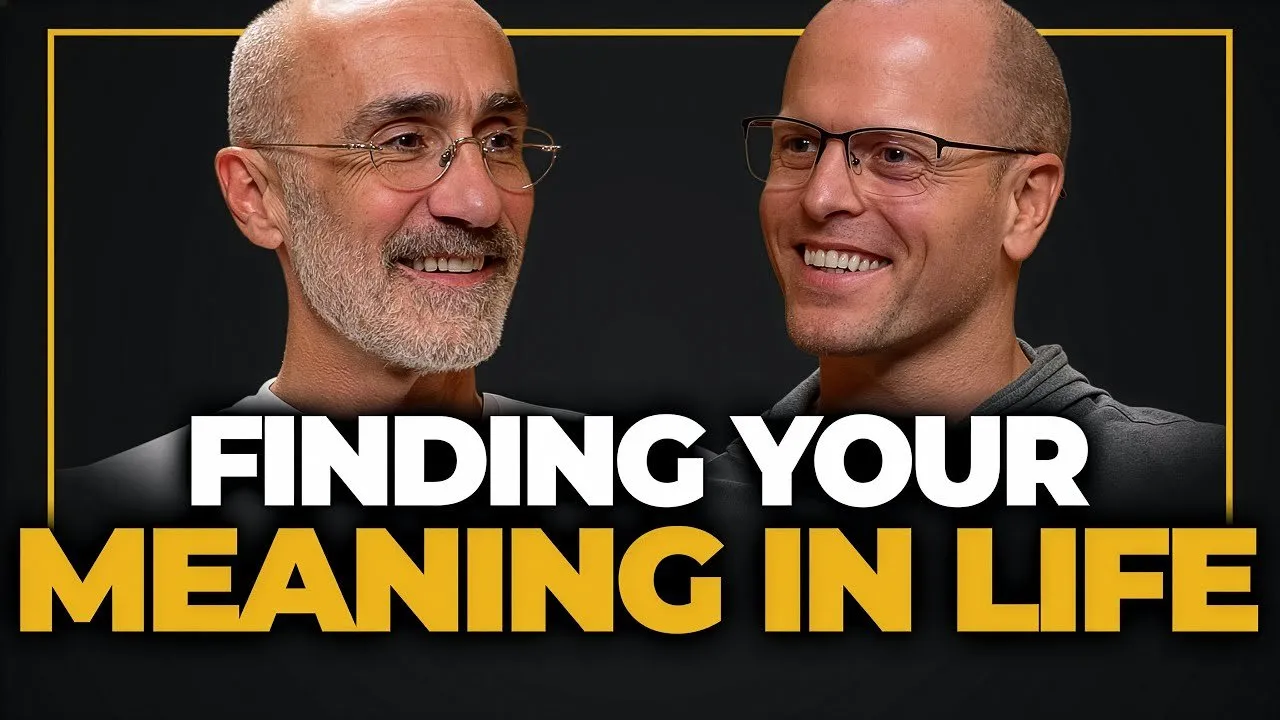
In a world increasingly dominated by digital distractions and simulated experiences, Harvard professor Arthur Brooks has spent years investigating one of humanity's most pressing questions: How do we find genuine meaning in modern life? His research reveals that despite unprecedented technological advancement and material prosperity, young adults are experiencing clinical depression and anxiety at record levels—not because they lack resources, but because they're missing something fundamental to human flourishing.
Key Takeaways
- Morning routines combining physical exercise, spiritual practice, and focused work can unlock 4+ hours of peak creativity and productivity
- The meaning of life consists of three components: coherence (why things happen), purpose (why you're doing what you're doing), and significance (why your life matters)
- Self-transcendence—moving from the "me self" to the "I self"—is essential for finding significance and reducing suffering
- Modern technology creates simulated experiences that can never replicate the complex, meaningful aspects of real human life
- The Marine Corps "80% rule"—make decisions and commitments when you have enough information rather than seeking perfect certainty—applies to life's biggest choices including marriage and career
The Neuroscience of Peak Performance: Brooks' Morning Protocol
Brooks has developed what he calls a scientifically-backed morning routine designed to optimize both mood management and creative output. His approach is rooted in ancient wisdom validated by modern behavioral science.
The Brahmamurhurta Principle
Drawing from Vedic tradition, Brooks wakes at 4:30 AM, following the concept of Brahmamurhurta—"the creator's time"—which occurs approximately 96 minutes before dawn. Ancient texts suggested this timing for enhanced creativity and spiritual connection, and modern research confirms that pre-dawn rising significantly impacts productivity, focus, and happiness.
"If you're getting up when the sun is warm, you've lost the first battle for mood management and productivity," Brooks explains.
Strategic Exercise and Zone 2 Training
Brooks dedicates one hour daily to exercise, following a "push-pull-legs" resistance training split using exclusively dumbbells for joint safety. He combines this with 20-40 minutes of Zone 2 cardio on an elliptical machine, often without headphones to maximize creative thinking time.
His approach emphasizes:
- Higher repetitions over maximum weight as he ages
- Joint preservation through full range of motion movements
- Consistent tracking in workout journals dating back decades
- The "talk test" for Zone 2 intensity—maintaining conversation ability with short sentences
The Delayed Caffeine Strategy
Unlike most people, Brooks avoids caffeine immediately upon waking. Instead, he waits 2-3 hours, allowing natural adenosine to clear from his system before consuming his substantial 380mg daily caffeine dose. This approach, supported by neuroscientist Andrew Huberman's research, prevents afternoon crashes and sleep disruption while maximizing focus benefits.
The Three Pillars of Life's Meaning
Through extensive research and interviews with thousands of individuals, Brooks has identified that meaning consists of three essential components, each answering a fundamental "why" question.
Coherence: Why Do Things Happen?
Coherence requires developing a framework for understanding how the world operates—whether through religion, science, philosophy, or a hybrid approach. Without this foundational understanding, life feels random and meaningless.
Key insight: The framework doesn't need to be objectively perfect, but it must provide a consistent way of making sense of events and circumstances.
Purpose: Why Am I Doing This?
Purpose involves having clear goals and direction—what Spanish speakers call "el rumbo," meaning the navigational line from where you are to where you're going. This doesn't require rigid linear progress, but rather intentional movement toward meaningful objectives.
Significance: Why Does My Life Matter?
This proves most challenging for many people today. Brooks emphasizes that significance comes not from macro-level achievements like social media fame or global activism, but from micro-level love relationships—marriage, children, close friendships, and spiritual connection.
"You don't find significance by getting a million Instagram followers. You will never find significance by doing that. Significance comes from love—whom I love and who loves me."
The Search vs. Presence Balance
Brooks identifies two crucial dimensions in the meaning-seeking process: search (how intensively you're looking for answers) and presence (how satisfied you are with current answers).
The Chronic Seeker's Trap
Many high-achieving individuals become trapped in perpetual seeking mode, never allowing themselves to accept satisfactory answers. Brooks advocates for the Marine Corps leadership principle: make decisions at 80% certainty rather than seeking impossible 100% knowledge.
Practical Applications of the 80% Rule
This principle applies to life's major decisions:
- Marriage: If you love someone, share compatible values, and believe you could be best friends within 3-5 years, commit rather than continuing to search for perfection
- Career: Choose a path that aligns with your purpose rather than waiting for the "perfect" opportunity
- Faith: Commit to a spiritual practice that resonates at 80% rather than endless theological searching
Self-Transcendence: Moving Beyond the Me-Self
Modern culture's focus on self-optimization often paradoxically increases misery by keeping people trapped in what psychologist William James called the "me-self"—constant self-focused rumination.
The Three Pathways to Transcendence
Brooks identifies three primary methods for accessing transcendent experiences:
1. Spiritual Practice
Whether through organized religion, meditation, or contemplation of the divine, spiritual practices consistently produce transcendent states that reduce anxiety and increase meaning.
2. Service to Others
Focusing attention outward through acts of service naturally shifts consciousness from self-concern to connection and contribution.
3. Flow States
Complete absorption in challenging activities—from writing to exercise to artistic creation—produces what Mihaly Csikszentmihalyi termed "flow," characterized by self-forgetting and timeless engagement.
Reducing the Me-Self
Brooks emphasizes not just cultivating transcendent experiences but actively reducing self-focused attention through:
- Eliminating literal and metaphorical "mirrors" including excessive social media use
- Practicing gratitude for both pleasant experiences and difficulties
- Spending time in nature and contemplating beauty
- Engaging in activities that induce awe and wonder
Living Beyond the Simulation
One of Brooks' most compelling insights concerns how modern technology creates what he terms a "simulated life"—a complicated replica of human experience that can never satisfy our need for meaning.
Complex vs. Complicated Experiences
Brooks distinguishes between complicated problems (difficult but solvable, like building jet engines) and complex problems (easy to understand but impossible to solve, like love and relationships). Meaning emerges from complex experiences that must be lived rather than solved.
"You can't simulate the meaning of your life. You can only live the meaning of your life."
Hemispheric Brain Function
Drawing on Ian McGilchrist's research on brain hemispheres, Brooks explains that modern life over-activates our left hemisphere (focused on "how" and "what" questions) while neglecting our right hemisphere (concerned with "why" questions, meaning, love, and mystery).
Most transcendent and meaningful experiences require right-hemisphere activation, which occurs through:
- Face-to-face human interaction
- Physical movement through space
- Spiritual or meditative practices
- Engagement with beauty and art
- Time in natural environments
The Sacred Nature of Suffering
Perhaps counterintuitively, Brooks argues that suffering plays an essential role in finding meaning and that attempts to eliminate all discomfort ultimately backfire.
The Buddhist Formula
Brooks references the Buddhist understanding: Suffering = Pain × Resistance. Rather than trying to eliminate pain (often impossible), we can reduce suffering by lowering our resistance to difficult experiences.
Reframing Challenges
Brooks recommends starting each day with gratitude for both pleasant experiences and anticipated difficulties, recognizing that growth and learning come primarily through challenges rather than comfort.
"You have a choice. You can learn and grow from your suffering, or you can try to avoid your suffering and have the same amount of suffering and not learn and grow."
Practical Protocols for Daily Meaning
Beyond morning routines, Brooks emphasizes evening practices that reinforce meaning and deepen relationships.
Evening Reading Protocol
Brooks reads material designed to stimulate the right hemisphere before sleep, particularly:
- The Psalms (especially Psalm 121)
- Love poetry, particularly Pablo Neruda
- Content focused on beauty, transcendence, and meaning rather than information acquisition
Relationship Strengthening
For married couples, Brooks recommends four evidence-based practices:
1. Prioritize Fun Over Grievance
Spend more time enjoying each other's company rather than rehashing problems.
2. Pray or Meditate Together
Shared transcendent experiences create what Brooks calls "right hemisphere fusion."
3. Always Make Eye Contact During Conversations
This oxytocin-boosting practice is particularly important for women, who have three times more of this bonding hormone than men.
4. Always Be Touching (ABT)
Physical contact, from holding hands to brief touches, maintains biochemical bonding and is especially important for men.
Conclusion: Love as the Ultimate Answer
After decades of research into human happiness and meaning, Brooks has arrived at a remarkably simple conclusion: the meaning of life fundamentally comes down to love—both giving and receiving it.
This doesn't mean romantic love exclusively, but rather the full spectrum of human connection: marriage, parenthood, friendship, service to others, and relationship with the divine. These relationships provide the significance component of meaning while giving us compelling reasons to engage with life's challenges and mysteries.
"If you don't know what to do today and meaning feels out of reach, turn off your device and go love somebody. It doesn't matter how you feel because love is an act, a commitment, a decision. You'll lift up yourself and that person and a little bit of the whole world."
In an age of digital simulation and artificial connection, Brooks' message is both ancient and urgently contemporary: the path to meaning runs through authentic human relationships, transcendent experiences, and the willingness to engage fully with both joy and suffering. The protocols and practices matter not as ends in themselves, but as scaffolding that enables us to live more meaningfully—to love more deeply, serve more fully, and find our place in the grand complexity of human existence.