
Table of Contents
When most teams discuss pricing, they immediately gravitate toward a dollar figure. However, pricing is not just a math problem; it is a measure of value. It answers the fundamental question: do people want your product, and will they actually exchange money for it?
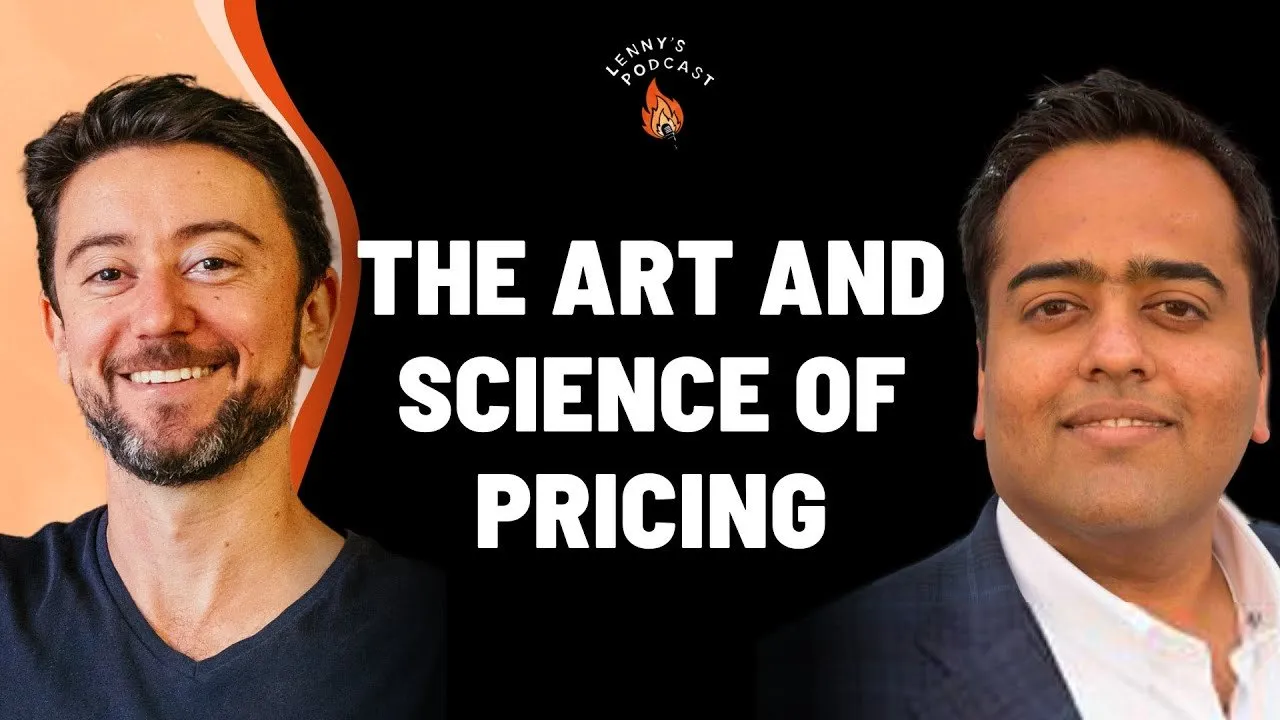
Despite the critical nature of this validation, a staggering number of innovations fail—not because the technology didn't work, but because they were built without a clear monetization strategy. Madhavan Ramanujam, Senior Partner at Simon-Kucher and author of the seminal book Monetizing Innovation, argues that companies often treat pricing as a last-minute decision rather than a foundational product pillar.
Drawing from experience working with over 250 companies and unicorns like Uber, LinkedIn, and Asana, Ramanujam outlines a comprehensive framework for "designing the product around the price." By shifting the conversation from "how much" to "how" and "why," product leaders can escape the trap of building features no one wants to buy.
Key Takeaways
- Price before product: You cannot effectively prioritize a product roadmap without first validating willingness to pay; doing so ensures you build what customers value.
- Segmentation relies on needs, not demographics: True segmentation requires "acting differently" toward different groups based on their specific needs and value perceptions.
- How you charge outweighs how much: The pricing metric (e.g., per seat vs. usage-based) is often more critical to success than the actual price point.
- Use the "Leaders, Fillers, Killers" framework: Optimize packaging by bundling "leaders" (must-haves) and "fillers" (nice-to-haves), while selling "killers" (niche features) separately to avoid devaluing the bundle.
- Leverage behavioral psychology: Utilizing tactics like the decoy effect and price thresholds can significantly increase conversion without changing the core product.
The "Willingness to Pay" Conversation
The most common failure mode in innovation is the "spray and pray" approach: building a product, obsessing over engineering, launching it, and then slapping a price on it. To reverse this, founders must determine willingness to pay (WTP) before a single line of code is written.
You cannot prioritize a product roadmap without having a willingness to pay conversation.
Understanding WTP is not about extracting maximum profit immediately; it is a proxy for understanding if you have Product-Market-Pricing fit. Without this trifecta, you are essentially guessing.
Prioritizing the Roadmap
- The 20/80 Rule: In almost every case, 20% of the features drive 80% of the willingness to pay. Identifying this critical 20% early prevents wasted engineering cycles.
- Validation as a Litmus Test: If a customer says they love the product but won't pay for it, you do not have a business. You have a hobby.
- The "Why" Matters Most: When a customer refuses to pay, asking "why" provides the most valuable product design feedback you will ever receive.
- Early Conversations: There is no such thing as "too early." Even at the idea stage, you can test value propositions against WTP.
- Continuous Iteration: WTP is not a one-time check. It should be revisited every 6 to 12 months, or whenever major features or business models change.
- The Porsche Example: When designing the Cayenne, Porsche determined the price point and features customers would pay for before drawing the blueprints, ensuring every feature (like cup holders) justified its cost.
Tactics for Extracting Price Sensitivity
Directly asking "How much would you pay for this?" yields garbage data. Customers will either lowball you to negotiate or give a polite answer to end the conversation. To get actionable data, you must use indirect, relative, and psychological questioning techniques.
Effective Questioning Frameworks
- Relative Indexing: Ask customers to anchor against a known entity. "If Salesforce is 100 in value, where are we?" followed by "If Salesforce is 100 in price, where should we be?"
- The Psychological Thresholds: Pitch the product value, then ask for three specific price points:
- Acceptable: A fair price where they feel the product is a good deal.
- Expensive: A price where they have to think twice but would still buy.
- Prohibitively Expensive: A price so high they would laugh you out of the room.
- Purchase Probability: Instead of a binary "would you buy," use a 1-5 scale. Treat anything below a 4 as a "no." Even a 5 usually implies only a 50% real-world purchase rate.
- Most/Least Important (MaxDiff): Present a list of features and ask customers to pick only the "most important" and "least important." This forces tradeoffs and reveals true value drivers better than a 1-10 ranking scale.
- Trade-off Scenarios: For advanced stages, simulate buying scenarios. "If we removed feature X and lowered the price by $Y, would you prefer that over the full bundle?"
- Buying Context: Mimic the actual sales environment. If you are B2B, have the conversation with the actual decision-making unit, not just a user.
Segmentation: One Size Fits None
Many companies confuse segmentation with creating user personas. Knowing a customer's age, title, or location is demographic data, not segmentation. True segmentation is based entirely on differing needs, value perceptions, and willingness to pay.
If you build the entire product and try to position it to different segments, you’ve already lost.
The "Act Differently" Test
- Actionable Strategy: A segmentation strategy is only valid if it forces you to act differently. This means building different products, setting different prices, or using different sales channels for each group.
- Heterogeneity is the Norm: There is no market where customer needs are truly homogeneous. Treating them as such leaves money on the table.
- Productizing to Segments: Apple is a prime example. They don't just sell "an iPhone." They sell the SE, the standard model, and the Pro Max to address budget-conscious buyers, standard users, and tech enthusiasts respectively.
- The Water Bottle Analogy: Water is free at a fountain, $2 in a bottle, and $5 in a hotel minibar. The product is physically identical, but the need state (thirst, convenience, immediacy) dictates the price.
- Start Simple: You do not need to launch five products on day one. Identify the most lucrative segment, build for them first, and expand later.
- Dynamic Segmentation: Modern tech allows for dynamic segment recognition. A user might be price-sensitive on a Tuesday commute (UberX) but value-insensitive on a Friday date night (Uber Black).
The Art of Packaging: Leaders, Fillers, and Killers
Packaging is the strategic tool used to unlock segmentation. By bundling features correctly, you can appeal to a broader market without sacrificing revenue. The "Leaders, Fillers, Killers" framework provides a clear heuristic for bundle construction.
Constructing the Perfect Bundle
- Leaders: These are the "must-haves." They drive the purchase decision for the vast majority of the segment. This is the burger in a Happy Meal.
- Fillers: These are "nice-to-haves." Customers won't buy the product just for these, but they add perceived value and reduce churn. These are the fries and the drink.
- Killers: These are features that actively devalue the bundle for certain prospects. If you include coffee with a burger meal, non-coffee drinkers feel they are paying for waste and may reject the whole offer.
- The Add-On Rule: If a feature is highly valued by only 10-20% of your user base, it should never be in the core bundle. Sell it as a standalone add-on (like the coffee) to monetize that specific niche without alienating the mass market.
- Avoid "Kitchen Sink" Bundles: Putting every feature into a single "Pro" plan often confuses customers and creates "Killers."
- Segment-Specific Packaging: Create packages where the "Leader" of one segment aligns with the core offering of that tier (e.g., Enterprise security features belong only in the Enterprise tier).
Pricing Models: How You Charge > How Much You Charge
The metric you use to charge (the "how") often dictates success more than the actual price tag (the "how much"). A shift in pricing capability can realign a company’s incentives with their customers' success.
Selecting the Right Model
- Align with Value: The pricing metric must scale with the value the customer receives. Michelin shifted from selling tires (unit price) to selling "miles driven" (usage price), aligning their longevity innovation with customer costs.
- Predictability vs. Fairness: Subscription models offer predictability (good for budgeting), while usage-based models offer fairness (pay for what you use). Choose based on what your specific customers prioritize.
- The "Indifferent" Test: When testing models, ask customers if they prefer Model A (e.g., flat fee) or Model B (e.g., % of transaction). If they say "I'm indifferent," the math is equal. However, customers always have a preference based on risk profile.
- Usage-Based Considerations: Only use usage-based pricing if the metric is strictly trackable, undisputed by the customer, and correlates with value.
- Hybrid Models: Often the best approach is a hybrid structure—a platform fee for access (subscription) plus a variable fee for volume (usage). This covers costs while capturing upside.
- Transparency: Complex pricing models kill deals. If a customer cannot easily calculate their estimated bill, your model is too complicated.
Behavioral Pricing: The Psychology of Purchasing
Humans are predictably irrational. Even B2B buyers, who claim to be purely rational economic actors, are influenced by framing, context, and behavioral nudges. Understanding these psychological triggers allows you to optimize revenue without changing the product.
If you cross from... 99 to 101, [you might find] 20% or 30% say it is expensive.
Psychological Levers
- The Decoy Effect: Introducing a high-priced "decoy" can make the middle option look like a bargain. A $7 small popcorn makes an $8 large popcorn look like a steal, even if $8 is expensive for corn.
- Price Thresholds: Demand curves are not smooth; they have cliffs. Crossing a psychological threshold (e.g., moving from $99 to $101) can drop demand disproportionately. Always test for these cliffs.
- The Panini Effect: Humans have a compulsion to complete sets (like a sticker album). Visualizing product adoption as a "puzzle" or "collection" can drive cross-sell ratios significantly higher than a standard list.
- Compromise Effect: When presented with three options (Good/Better/Best), customers tend to avoid extremes and pick the middle. Ensure your "Better" option is the margin optimizer.
- Reframing Cost: Expressing a price as "pennies a day" or "less than a cup of coffee" reduces the psychological burden of a large annual sum.
- Razor/Razorblade: Lowering the barrier to entry (the platform fee) to capture revenue on the consumables (transaction fees or add-ons) aligns with how people prefer to pay—low upfront risk, pay as you grow.
Navigating Economic Downturns
When the economy slows, the knee-jerk reaction is often to slash prices. This is dangerous; it resets price expectations that are incredibly difficult to raise later. Instead, companies should look for non-destructive ways to handle budget constraints.
Defensive Strategies
- Launch a "Fighter" Brand: Create a de-featured, lower-cost version of your product. This allows you to capture price-sensitive customers without cannibalizing your premium tiers or damaging your brand's price integrity.
- Non-Price Concessions: Offer value instead of discounts. Can you offer better payment terms (Net 60 vs Net 30)? Can you bundle in more volume or seats for the same price?
- Change the Metric: Downturns are excellent times to switch to usage-based or outcome-based pricing. Customers hesitate to commit to large fixed fees but are willing to pay if the cost scales down when their usage drops.
- Preserve the Core Price: If you must give a discount, frame it as a one-time "hardship" discount or sign-on bonus, ensuring the contract renewal reverts to the list price.
- Focus on Retention: It is far cheaper to retain a customer through temporary flexibility than to acquire a new one in a recession.
- Re-evaluate Willingness to Pay: Value perceptions change in a recession. Run your WTP research again to see if your "must-haves" have shifted.
Conclusion
Pricing is not a "set it and forget it" activity. It is a dynamic capability that touches every part of the organization, from product design to sales and marketing. The companies that win—the ones that become unicorns and sustain growth—are those that treat pricing as a science rather than an art.
By having willingness-to-pay conversations early, segmenting based on needs, and respecting the psychology of the buyer, you can unlock significant growth. The goal is not just to build a product that works, but to build a product that works as a business.

)