Table of Contents
Arm Holdings is demonstrating the expansive versatility of its processor architecture through a diverse lineup of new partner devices, signaling a strategic push beyond its stronghold in the smartphone market to dominate robotics, health technology, and home entertainment. By powering everything from stair-climbing vacuums to privacy-focused gaming consoles, the semiconductor giant is showcasing how its low-power, high-performance chips are serving as the critical infrastructure for the next generation of physical AI and edge computing.
Key Points
- Robotics Innovation: Roborock revealed the Saros, a vacuum capable of climbing and cleaning stairs using advanced Arm-based sensors.
- Industrial Application: The Lynx M20 Pro quadruped robot leverages three octa-core processors to achieve speeds of 6 meters per second for disaster relief scenarios.
- Health Tech Efficiency: Relajet’s Otoadd hearing aids utilize efficient processing to deliver 10 to 12 hours of battery life while performing real-time voice extraction.
- Privacy-First Gaming: The Nex Playground console processes motion data locally on an Amlogic SoC, eliminating the need for cloud storage of video feeds.
Powering the Next Wave of Robotics
While Arm is widely recognized for powering Apple Silicon and Android devices, the company’s latest showcase emphasizes its critical role in complex robotics. A standout application is the Roborock Saros, a prototype robot vacuum engineered to solve a longstanding hurdle in home automation: verticality. Utilizing an Arm compute platform, the device features an "adaptive chassis 3.0" that allows it to balance, lift itself, and vacuum stairs—a capability previously absent in the consumer market.
According to Roborock, the Saros utilizes a suite of IR and LiDAR sensors processed locally to navigate thresholds and transition seamlessly between hard surfaces and carpets. The consumer-ready version, the Saros 20, is slated for release this spring.
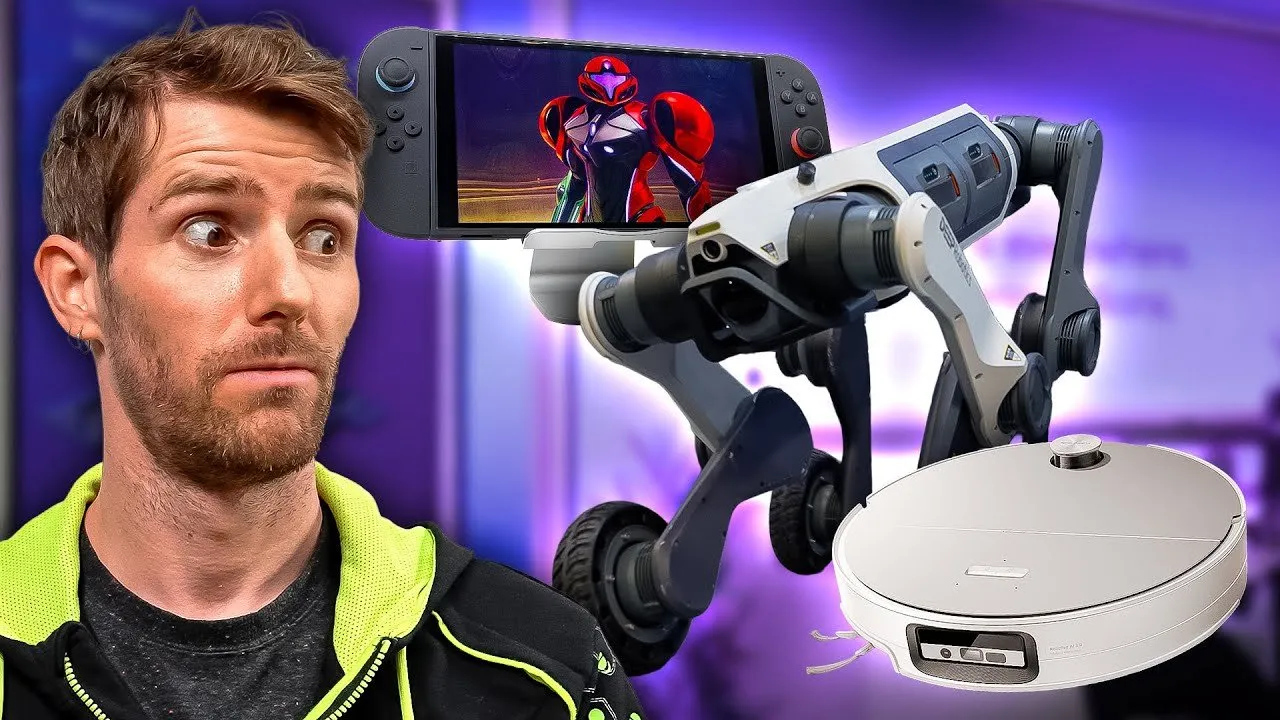
In the industrial sector, the Lynx M20 Pro represents a significant leap in autonomous mobility. This mid-sized quadruped robot, equipped with wheels for hybrid movement, is powered by three separate Arm octa-core processors. This computational density enables the machine to handle both remote control and fully autonomous missions suitable for earthquake disaster relief, tunnel inspections, and scientific research.
"The Lynx M20 Pro can go up to 6 meters per second... thanks to its powerful onboard processing, it can handle both remote control as well as autonomous missions."
Arm emphasizes that its expertise in "physical AI compute" is essential for these machines, balancing the high-performance processing required for navigation with the power efficiency needed for sustained field operations.
Edge Computing in Healthcare and Entertainment
Beyond robotics, Arm architecture is driving advancements in the "wearables" and "hearables" sectors, particularly within the over-the-counter (OTC) hearing aid market. Relajet’s new Otoadd line leverages Arm processors to perform snappy, local audio processing. This allows the devices to extract voices from background noise and clarify audio in real-time without the heavy power drain associated with traditional x86 architectures.
The efficiency of the underlying silicon enables these devices to achieve 10 to 12 hours of battery life—a metric that currently outperforms much of the OTC hearing aid market.
In the entertainment sector, the Nex Playground console demonstrates the importance of local data processing for privacy. Powered by an Amlogic A311D SoC (System on Chip) combining an Arm Cortex A-series CPU with a Mali G52 GPU, the device offers controller-free, motion-based gaming.
Unlike previous generations of motion-capture technology that relied on cloud processing, the Nex Playground processes all image recognition locally. This architecture ensures that video data from the onboard RGB camera never leaves the device, addressing parental concerns regarding privacy in family-friendly technology.
As manufacturers continue to demand higher performance per watt, Arm is positioned to remain the dominant architecture for devices requiring sophisticated onboard processing without constant tethering to power sources. The rollout of these devices throughout the spring will serve as a litmus test for consumer adoption of this new wave of AI-integrated hardware.