Table of Contents
Apple is reportedly poised to expand its services portfolio with a new AI-powered healthcare offering, tentatively dubbed "Apple Health+," which aims to synthesize personal health data into actionable medical advice. Amidst a broader industry push by competitors like OpenAI and Anthropic to digitize medical coaching, Apple’s potential move represents a significant shift toward paid, personalized health monitoring powered by advanced algorithms and third-party biosensors.
Key Points
- New Service Rumors: Reports suggest Apple is developing "Apple Health+," a paid subscription service utilizing AI to act as a personal health coach and medical advisor.
- Hardware Integration: The service relies on an expanding ecosystem of tracking devices, from Abbott’s glucose biosensors to hormone trackers by Eli Health, to feed data into the Apple Health app.
- Market Competition: The move follows similar healthcare initiatives from OpenAI (ChatGPT Health) and Anthropic (Claude for healthcare).
- Financial Stakes: With Apple’s services division generating over $28 billion last quarter, a health subscription offers a high-margin revenue stream independent of hardware sales.
- Accuracy Concerns: Apple faces the challenge of avoiding AI "hallucinations," a problem that recently forced Google to retract AI health summaries for providing erroneous medical data.
The Emergence of Apple Health+
According to recent reports, Apple is developing a sophisticated AI capability designed to interpret the vast amounts of biometric data users already collect. Bloomberg indicates that this new service, which may launch in conjunction with a major iOS update later this year, could function as a premium tier within the Apple ecosystem.
The concept mirrors recent developments by major AI firms. OpenAI has launched ChatGPT Health to analyze records from app data, while Anthropic recently introduced a healthcare integration for its Claude model. These systems link with platforms like Apple Health and Android Health Connect to summarize test results and detect patterns in metrics. Apple’s proprietary version aims to close the loop, keeping users within its walled garden while offering nutrition advice and medical suggestions.
"An AI coach is only as useful as the data you feed it... getting an AI doctor right might be Apple's most important product launch this year."
Fueling the Algorithm: The Hardware Explosion
For an AI health coach to be effective, it requires granular, continuous data streams. The market has responded with a surge of consumer-grade medical devices that integrate seamlessly with smartphones. Beyond the standard heart rate and temperature tracking of the Apple Watch, users can now access clinical-grade technology at home.
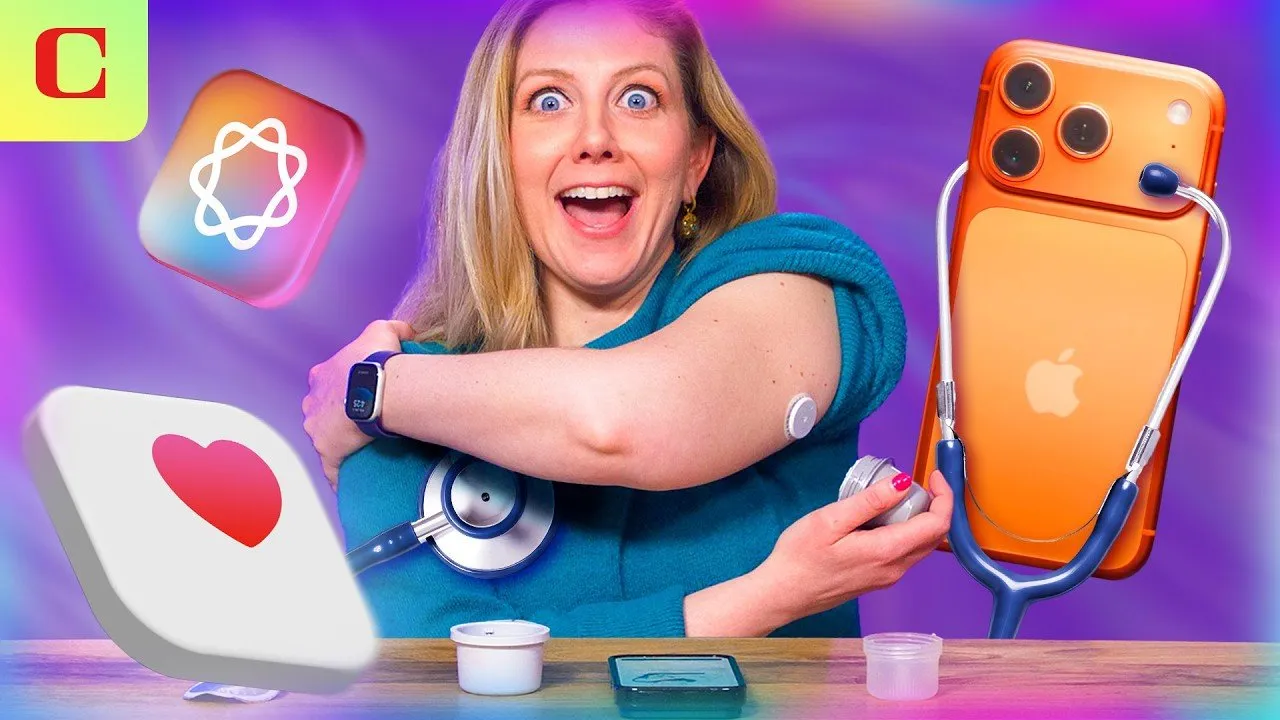
Abbott has introduced the Lingo, a glucose biosensor designed for non-diabetics. The device attaches to the arm to track blood sugar in real-time, allowing users to monitor metabolic responses to specific foods. Similarly, Eli Health is launching hormone trackers that utilize saliva samples to measure cortisol, testosterone, and progesterone levels, using the iPhone camera to scan and digitize results.
The sensor market is expanding rapidly, with innovations extending to smart scales and even bathroom fixtures capable of analyzing waste. This flood of data is intended to be aggregated within the Apple Health app, creating a comprehensive physiological profile that an AI model can analyze to provide "nudge" notifications regarding potential health anomalies.
The Services Strategy: Beyond Hardware
The push into paid health subscriptions aligns with Apple’s broader financial strategy to reduce reliance on iPhone unit sales. Services have emerged as the company’s second-largest revenue driver. In the last quarter alone, subscriptions—including iCloud, Apple Pay fees, and AppleCare—generated more than $28 billion in revenue.
Unlike hardware, which grapples with supply chains and manufacturing costs, subscription services offer higher profit margins. Apple has already laid the groundwork with Apple Fitness+, a subscription service that has expanded to include dubbed versions in Spanish, German, and Japanese. The company currently bundles various services under the Apple One Premier plan, which costs approximately $38 per month. Adding a high-value medical AI tier could significantly increase average revenue per user (ARPU).
Furthermore, health integration serves as a powerful retention tool. A recent four-year study of Apple Watch users indicated that customers who engaged with fitness tracking features were statistically more likely to maintain activity levels, reinforcing their commitment to the ecosystem.
The Trust Barrier: Avoiding the "Hallucination" Trap
While the potential for revenue is high, the risks associated with medical AI are substantial. Trust is the primary currency in digital health, and competitors have already stumbled. In January, an investigation by The Guardian revealed that Google’s AI health summaries provided factually incorrect information regarding liver function tests. The AI failed to account for patient variables such as sex, ethnicity, or age, presenting generic data that could lead patients to misinterpret pathological results as normal.
For Apple, maintaining its reputation for privacy and accuracy is critical. The company must ensure its algorithms can discern the nuance required for medical advice rather than simply processing raw numbers.
"The company cannot afford to launch a quack doctor Siri... relying on those [flawed] summaries could lead to ill patients thinking that they had normal test results."
What's Next
As the industry awaits the official announcement of the next iOS operating system, the focus will shift to how Apple balances utility with safety. The success of an AI health coach will depend not just on its ability to aggregate data from devices like the Lingo or Eli Health wands, but on its ability to provide context-aware, safe medical guidance. If successful, Apple could transform the iPhone from a passive tracker into an active participant in preventative healthcare, potentially streamlining doctor visits by providing physicians with organized, pre-analyzed datasets.