Table of Contents
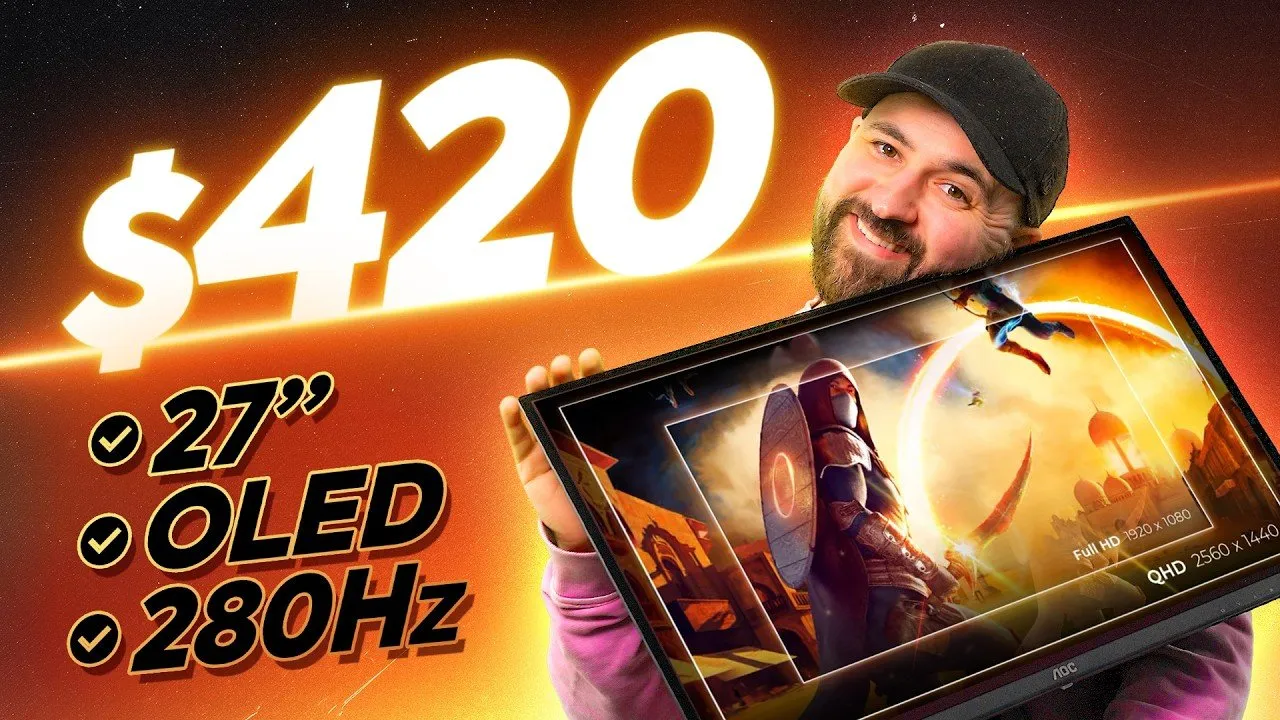
AOC has disrupted the high-end display market with the release of the Q27G4ZD, a 27-inch QD-OLED gaming monitor priced at $420. This launch marks a significant milestone in the commoditization of Quantum Dot OLED technology, bringing features previously reserved for the $1,000-plus premium segment into the mid-range enthusiast market. By utilizing older-generation panels, AOC provides the signature "perfect blacks" and near-instantaneous response times of OLED technology at a price point that challenges traditional IPS and VA displays.
Key Points
- The AOC Q27G4ZD introduces QD-OLED technology to the $420 price bracket, a historic low for the category.
- The monitor features a 1440p resolution and a native 240Hz refresh rate, which can be boosted to 280Hz via HDMI 2.1.
- Performance testing reveals elite-level input lag of just 0.3ms at maximum refresh rates.
- To achieve this price, AOC utilizes an older-generation panel that carries trade-offs in physical durability and text clarity.
Market Context and Value Proposition
The transition of QD-OLED from a luxury niche to an affordable consumer standard has occurred rapidly. Only four years ago, displays with these specifications commanded prices exceeding $1,000. AOC’s aggressive pricing strategy positions the Q27G4ZD as a direct competitor to high-end IPS monitors, offering superior contrast and motion handling for a marginal price increase.
"To put this in perspective, just 4 years ago, this would have been $1,000 easily. And if we go back further, an IPS with these specs would have been priced similarly just 10 years ago," the report notes.
The monitor includes a three-year warranty covering dead pixels and a one-time accidental damage replacement within the first year. This is particularly relevant given the inherent fragility of OLED panels compared to traditional liquid crystal displays.
Technical Performance and Motion Clarity
The primary draw of the Q27G4ZD is its motion performance. Because OLED pixels can change states in microseconds rather than milliseconds, the display eliminates the ghosting and blurring common in older technologies. In testing, the monitor achieved an input lag of 0.3ms over theoretical perfection at 280Hz, making it a viable tool for competitive esports.
Color and Brightness Specifications
While the display delivers the infinite contrast ratio characteristic of OLED, its brightness and color accuracy vary by mode:
- SDR Brightness: Approximately 265 nits, which is standard for OLED but lower than high-end Mini-LED options.
- HDR Peak: Reaches the advertised 1,000 nits in specific modes, though color accuracy may decrease at these peaks.
- Color Gamut: The panel covers 80% of the BT.2020 color space in SDR, though testing showed a dip to 69% in certain HDR configurations.
Hardware Trade-offs and Limitations
To reach the sub-$450 price point, AOC has integrated an older generation of Samsung QD-OLED panels. This hardware choice results in three specific drawbacks that users should consider. First, the sub-pixel layout is not a traditional RGB stripe, which can cause text fringing—a slight blurring or color bleeding around text in productivity applications. Second, the panel surface is more susceptible to physical scratches than modern fifth-generation OLEDs.
Third, the monitor exhibits a magenta hue when used in brightly lit rooms. This is a known characteristic of older QD-OLED panels that lack a traditional polarizer. Furthermore, while the stand offers height, tilt, and pivot adjustments, the build quality is described as less robust than premium competitors.
"It definitely feels like one of the most rickety kind of cheap stands I’ve ever used, but you’re never going to really notice that while you’re gaming," according to the product assessment.
The Future of Affordable Gaming Displays
The arrival of the AOC Q27G4ZD signals a permanent shift in the gaming monitor hierarchy. As manufacturers clear inventory of older QD-OLED glass, the "OLED tax" is evaporating, forcing IPS and VA manufacturers to innovate or lower prices further. For consumers currently using 144Hz IPS panels, the upgrade to a 280Hz QD-OLED represents a transformative jump in visual fidelity and responsiveness.
As 2024 progresses, industry analysts expect more brands to follow AOC’s lead, utilizing older panel generations to capture the "budget enthusiast" market. This trend will likely continue until OLED becomes the de facto standard for all gaming-centric displays above the entry-level tier.