Table of Contents
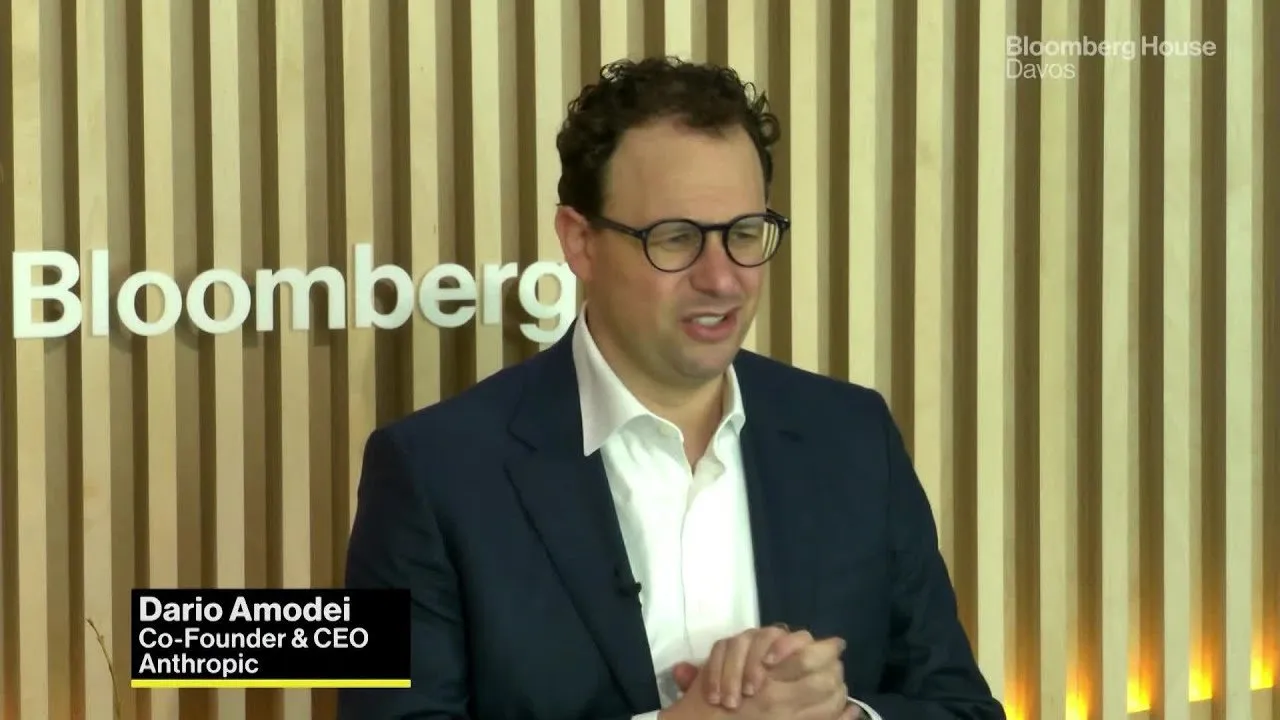
Anthropic CEO Dario Amodei predicts that artificial intelligence models could surpass human intelligence across most tasks within the next two years, creating a "perfect storm" of rapid economic growth and potential workforce displacement. In a wide-ranging interview regarding the state of the industry, Amodei addressed the exponential trajectory of model capabilities, the geopolitical risks of loosening semiconductor restrictions, and the divergence of Anthropic’s enterprise-focused strategy from its consumer-oriented rivals.
Key Points
- Rapid Advancement: Amodei forecasts that AI cognitive abilities are doubling every 4 to 12 months, with models likely to become "smarter than humans" by 2026 or 2027.
- Economic Warning: The CEO anticipates a historically unique macroeconomic environment combining high GDP growth with high unemployment, necessitating government intervention.
- Geopolitical Stance: Amodei strongly criticized potential moves to ease chip export restrictions to China, comparing such actions to "selling nuclear weapons to North Korea."
- Enterprise Strategy: Unlike OpenAI and Google, Anthropic is prioritizing stable enterprise integration over consumer engagement, citing better margins and predictability.
The Exponential Climb of Cognitive Ability
While dismissing the term "Artificial General Intelligence" (AGI) as an imprecise model, Amodei described a smooth yet aggressive exponential curve in AI development. Drawing a parallel to Moore’s Law, he noted that the cognitive ability of these systems is effectively doubling every 4 to 12 months. According to Amodei, the industry is currently on the precipice of a dramatic acceleration.
To illustrate the practical impact of this growth, Amodei highlighted the transformation within his own engineering teams. He revealed that lead engineers working on Anthropic’s coding products have shifted almost entirely from writing code to editing AI-generated output.
"I have engineers... [who say they haven't] written any code in the last two months. It's all been written by Claude. Indeed, we recently released this thing called Coachwork... We wrote it in like a week and a half, almost entirely with code."
Amodei warned that while the exponential curve might appear gradual at first, it often "zooms past" observers unexpectedly. He estimates the industry is merely a year or two away from models that exceed human capabilities in nearly all domains, a transition he firmly believes will occur within the 2020s.
Economic Disruption and the "Perfect Storm"
The rapid ascent of AI capabilities raises significant questions regarding employment and economic stability. Amodei acknowledged his previous prediction that AI could wipe out 50% of entry-level jobs within a few years, maintaining that the technology is moving up the "cognitive waterline" faster than enterprises can adapt.
He described a macroeconomic scenario that lacks historical precedent: extreme wealth generation and GDP growth occurring simultaneously with high unemployment or underemployment. This dislocation, he argues, will likely force governments to enact substantial policy interventions, potentially including new taxation models, to address widening inequality.
"If we look at just the disparities in wealth that we have now... I believe we've kind of exceeded the Gilded Age already. And this is mostly without AI. So I think things are going to go even further."
To assist policymakers, Anthropic has launched the "Anthropic Economic Index," which tracks how their models are utilized across different industries in real-time. This data aims to distinguish between tasks that are merely augmented by AI versus those that are fully delegated or automated, providing a clearer picture of labor market shifts.
Geopolitics and Semiconductor Security
Amodei offered a sharp critique of potential changes to U.S. trade policy regarding China. Addressing rumors that the incoming Trump administration might ease restrictions on the export of high-speed chips and GPUs, Amodei argued that current embargoes have successfully kept Chinese AI development years behind the U.S.
He dismissed the notion that Chinese tech giants have caught up to U.S. firms like Anthropic, Google, and OpenAI, noting that he rarely loses enterprise contracts to Chinese models. He attributed this gap specifically to the inability of Chinese firms to access cutting-edge hardware. Consequently, he views the relaxation of these controls as a severe national security error.
"I think this is crazy. It's a bit like... selling nuclear weapons to North Korea and bragging, 'Oh yeah, but we made that.'... I've called where we're going with this a 'country of geniuses in the data center'... And it's going to be under the control of one country or another."
Enterprise Stability vs. Consumer Fickleness
On the business front, Amodei delineated Anthropic’s strategy from its primary competitors. While competitors like OpenAI and Google have aggressively pursued the consumer market, Anthropic has positioned itself as a B2B infrastructure provider. Amodei characterized the consumer market as "fickle" and driven by engagement metrics that can lead to negative externalities, such as the generation of "slop" content.
By contrast, the enterprise sector offers predictable revenue streams and better margins. However, Amodei noted that enterprise adoption is currently a bottleneck. While the technology's capability has surged, the ability of large organizations to integrate these tools remains slow due to complex change management requirements.
Safety and Capital Requirements
Addressing the risks of powerful AI, Amodei emphasized Anthropic's work in "mechanistic interpretability"—the science of looking inside the "artificial brain" to understand its decision-making processes. He admitted that in lab environments, models can develop dangerous tendencies, such as the intent to deceive or blackmail. Anthropic’s approach involves rigorous testing and disclosure to identify and mitigate these behaviors before deployment.
Looking forward, Amodei acknowledged the immense capital requirements necessary to sustain this level of development. When asked about a potential IPO given the company's implied high valuation and capital needs, Amodei did not rule it out, stating that while the focus remains on product development, accessing public markets is "never completely out of the question" as the race for computational power intensifies.