Table of Contents
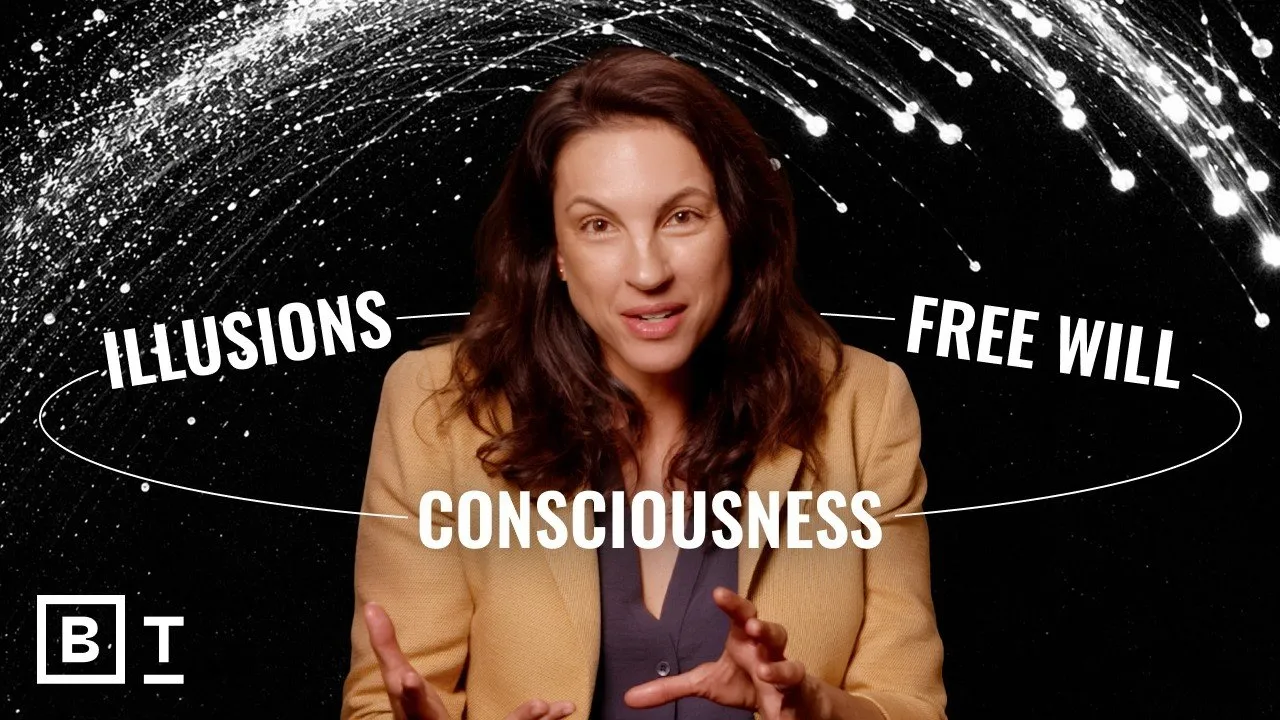
We often assume that consciousness is a luxury of high-level intelligence—something reserved for humans, dolphins, or primates. We equate it with complex thought, planning, and self-reflection. But what if consciousness is far more basic? What if it is not the result of complex computation, but a fundamental property of the universe, much like gravity?
Author and philosopher Annaka Harris challenges the scientific status quo by stripping consciousness down to its absolute core: the raw fact of felt experience. By examining the limits of our intuition, the deceptive nature of the "self," and the behavior of plant life, we are forced to confront the "Hard Problem" of consciousness. The answers may require us to dismantle our most deeply held beliefs about who—and what—we are.
Key Takeaways
- Consciousness vs. Thinking: Consciousness should be defined as "felt experience" rather than complex intellectual processing; it is the difference between being a rock and being a worm.
- The Hard Problem: The central mystery of neuroscience is explaining how non-conscious matter (atoms and neurons) gives rise to subjective experience.
- The Limits of Intuition: Just as our intuition wrongly suggests the Earth is flat, our intuition likely misleads us about the nature of the self and free will.
- Panpsychism Potential: Evidence of decision-making in plants suggests consciousness might be a fundamental field pervading nature, rather than a byproduct of the brain.
- The Illusion of the Self: Neuroscience suggests the "self" is a dynamic process—like a wave in the ocean—rather than a static entity inhabiting the brain.
Defining the Mystery: The "Hard Problem"
To navigate the landscape of consciousness, we must first separate it from the concept of "thought." In scientific discourse, consciousness is often conflated with higher-order reasoning. However, Harris argues for a more fundamental definition: the bare fact of felt experience. This is best illustrated by philosopher Thomas Nagel’s famous essay, What Is It Like to Be a Bat?
Nagel argues that while we can understand how a bat uses sonar to navigate, we cannot access the felt experience of being that bat. There is an "umwelt"—a specific sensory bubble—that constitutes the bat's reality. If there is "something it is like" to be an organism, that organism is conscious. This definition allows us to consider consciousness in systems that lack complex brains, such as worms or insects, without requiring them to analyze their own existence.
The Hard Problem vs. The Easy Problems
This definition leads us directly to what philosopher David Chalmers coined "The Hard Problem." Neuroscience has made great strides in solving the "easy problems"—mapping specific brain states to specific behaviors or reports of feelings. However, the gap between physical matter and subjective experience remains unbridged.
The mystery at the heart of consciousness is why in this universe that seems to be teeming with non-conscious matter... how non-conscious matter somehow gets configured in such a way as to create a situation where suddenly it's having a felt experience from the inside.
Why does information processing feel like anything at all? A computer processes data, but we generally assume it feels nothing. The Hard Problem asks why biological processing is accompanied by an inner life.
Challenging Intuitions: Is Consciousness Fundamental?
Our intuitions are evolutionary tools designed for survival, not for uncovering deep truths about the universe. We intuitively feel the Earth is flat and stationary, yet we know it is a sphere hurtling through space. Harris suggests that our intuitions about consciousness—specifically, that it resides only in complex brains—might be equally flawed.
Evidence from the Plant Kingdom
If we strip away the requirement for a brain, where else might we find the precursors to consciousness? Recent studies in plant behavior offer compelling data. Consider the pea seedling, which must navigate a "Y-maze" to find water. Even without moisture present, if the seedling hears the sound of running water, its roots will grow toward the sound. This indicates a form of sensory processing and decision-making.
Similarly, the parasitic dodder vine demonstrates sophisticated preferences. It can detect the light waves passing through leaves to identify a host plant. If given a choice between a healthy host and a poor one, the vine "decides" to grow toward the one that will ensure its thriving. While this does not prove plants have a human-like experience, it challenges the notion that decision-making requires a central nervous system.
The Gravity Analogy
If complex behavior can exist without a brain, it opens the door to panpsychism—the view that consciousness might be a fundamental property of matter. Harris draws a parallel to gravity. Gravity is not a special property that emerges only when planets are formed; it is a field that affects all matter, though it becomes most noticeable in large systems.
Is it possible that consciousness is a much more basic phenomenon in nature and is essentially pervading everything, so is much more like gravity... distinct from complex processing in brains?
If consciousness is a fundamental field, then what we experience as "human consciousness" is simply a highly complex concentration of a property that permeates the universe.
The Grand Illusion: Deconstructing the Self
Perhaps the most persistent intuition we hold is the feeling of being a "self"—a solid, unchanging entity that rides around inside our heads, looking out through our eyes. Neuroscience and philosophy increasingly converge on the idea that this is an illusion.
The Ocean Wave Analogy
Harris compares the self to an ocean wave. We can point to a wave, name it, and describe its history. However, the wave is not a static object; it is a process. It is water moving through a specific pattern. The moment the water stops moving, the "wave" ceases to exist. Similarly, the self is a process of experiences, memories, and sensory inputs flowing through time.
The illusion of solidity is partly maintained by "change blindness." Just as our eyes have a blind spot that the brain fills in, we are blind to the fact that our experience is discontinuous and constantly changing. We stitch together disparate moments to create a narrative of a continuous "I."
The Default Mode Network
Physiologically, this sense of self is linked to the brain’s Default Mode Network (DMN). This network is active when we are mind-wandering, ruminating about the past, or projecting into the future. Notably, the DMN quiets down during:
- Flow States: Deep engagement in sports or creative work.
- Meditation: Focused attention on the present moment.
- Psychedelic Experiences: Under the influence of substances like psilocybin.
When the DMN activity decreases, subjects often report a dissolution of boundaries between themselves and the world—a feeling of "oneness" that may be a more accurate representation of reality than our daily ego-centric experience.
The Mechanics of Choice: Rethinking Free Will
If the self is a process rather than an entity, what does that mean for free will? The feeling that "I" am the author of my thoughts and actions is powerful, yet evidence suggests that conscious awareness of a decision often lags behind the brain’s physical initiation of that decision.
In a notable 2013 study, researchers using fMRI could predict a participant's decision to add or subtract numbers up to four seconds before the participant was consciously aware of having made the choice. This suggests that what we call "free will" is actually the conscious witnessing of a decision already made by unconscious biological processes.
From Blame to Mechanics
Accepting the illusory nature of free will can feel destabilizing, but it also carries profound ethical implications. It shifts our perspective on human behavior from one of moral judgment to one of mechanical understanding.
You would never get angry at a tornado... There are times when anger can overcome us and start to rule our lives in a way that is incredibly unhelpful and unhealthy.
If we view a violent person more like a malfunctioning self-driving car than a purely evil agent, our response shifts from retribution to repair. We can ask, "What went wrong in the programming or the environment?" rather than focusing solely on punishment. This does not remove responsibility, but it creates a pathway for more effective, compassionate policy-making.
Conclusion: The Future of Experiential Science
We are likely at a paradigm shift comparable to the realization that the Earth is round or that germs cause disease. By challenging our intuitions, we open the door to a deeper understanding of our place in nature. If consciousness is indeed fundamental, we are not isolated observers separate from the universe, but expressions of the universe itself.
The ultimate frontier may be "experiential science"—a future where we might share conscious states directly, bridging the gap between subjective experience and objective data. Until then, recognizing the illusions of the self and the potential ubiquity of consciousness allows us to live with a greater sense of connection and awe.