Table of Contents
Every few years, market commentators sound the alarm that we are on the precipice of another Great Depression. With the rapid rise of artificial intelligence, ballooning national debt, and geopolitical instability, the parallels to historical market crashes are easy to draw. However, history is rarely a carbon copy of itself.
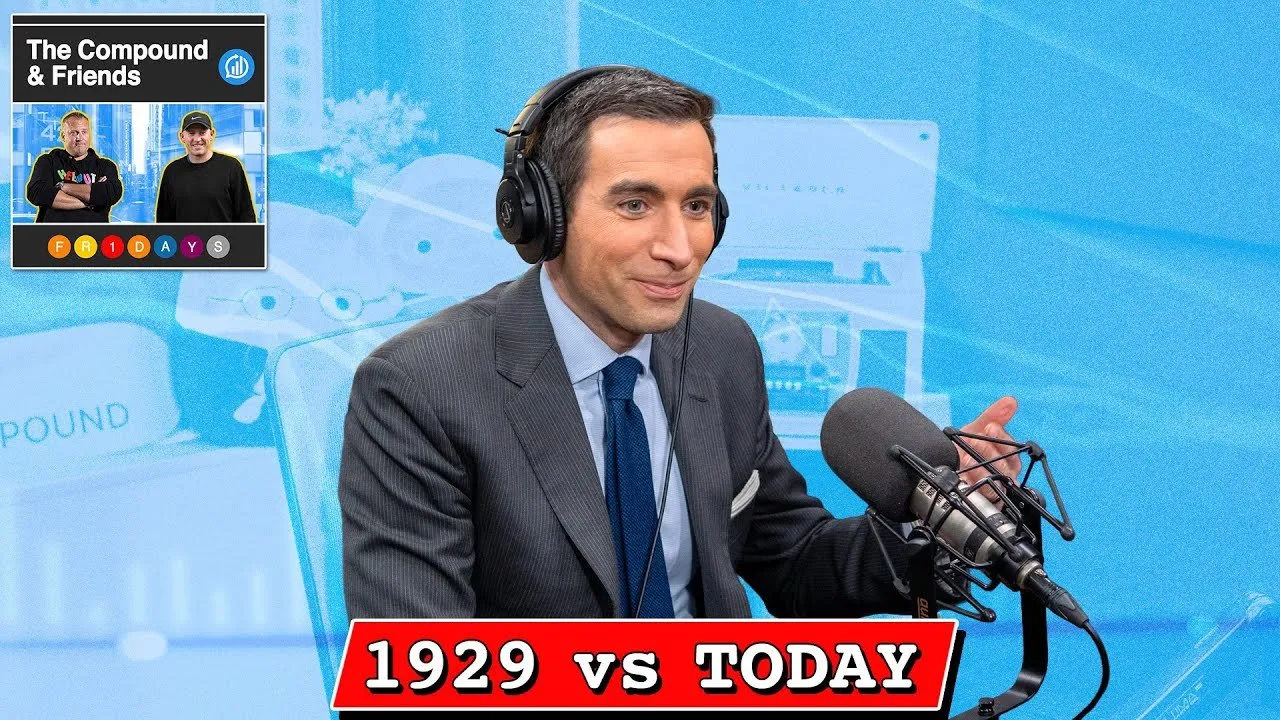
Andrew Ross Sorkin, author of Too Big to Fail and the new book 1929: The Crash that Ruined the Roaring Twenties, joined The Compound and Friends to dismantle the lazy comparisons between today’s economy and the catastrophe of 1929. By accessing previously sealed Federal Reserve minutes and personal diaries from the era, Sorkin provides a nuanced look at what actually broke the global economy a century ago—and why our modern financial system faces a distinctly different set of risks.
Key Takeaways
- Structural Safety Nets: The 1929 market was an "unlicensed casino" lacking the SEC, FDIC insurance, or capital requirements—safeguards that define the modern financial system.
- Debt is the Catalyst: While the specific trigger changes, every major systemic crisis is ultimately fueled by excessive leverage and credit.
- Policy Errors Amplified the Crash: The Great Depression was not inevitable after the crash; it was exacerbated by rigid adherence to the gold standard and a lack of liquidity.
- The Pattern Matching Trap: Investors often confuse healthy market corrections with systemic collapse due to an evolutionary desire to spot danger patterns.
- Private vs. Public Valuations: Today's speculative excesses are likely concentrated in private markets and tokenized assets rather than the publicly traded stocks that drove previous crashes.
Why It Is Not 1929 All Over Again
The prevailing anxiety in financial media often centers on the idea that stock market valuations are dangerously high, mimicking the setup of the Roaring Twenties. Sorkin argues that while optimism is high, the structural reality of the market is fundamentally different. The 1929 crash occurred in a regulatory vacuum that simply does not exist today.
The "Wild West" of Wall Street
In the late 1920s, market manipulation wasn't just common; it was legal and normalized. Insider trading was standard practice, and the banking system operated without the safety net of Federal Deposit Insurance Corporation (FDIC) insurance. When banks failed, depositors lost everything, triggering panic that rippled through the real economy.
"Back in 1929, there was no SEC. There was no insider trading rules manipulation. It was legal, normalized... It was almost like an unlicensed casino."
Furthermore, the technology of the era exacerbated the panic. Ticker tapes were often hours behind reality, meaning investors were making decisions based on stale prices. This information asymmetry caused indiscriminately selling, sucking confidence out of the system in a way that modern high-frequency trading and instant liquidity generally prevent.
Leverage and Capital Requirements
The primary mechanic of the 1929 collapse was the excessive leverage available to retail investors. Brokerages allowed individuals to buy stocks on 10:1 margins—putting down one dollar to borrow ten. When the market turned, margin calls forced immediate liquidation, creating a downward spiral.
Today, strict capital requirements and margin regulations act as guardrails. While leverage still exists, particularly in derivatives, the systemic fragility caused by retail investors trading on massive margin is significantly lower than it was a century ago.
The Real Threat: Debt and Policy Response
If there is a common thread between 1929, 2008, and potential future crises, it is debt. Sorkin identifies credit and leverage as the "match that lights the fire" of every financial disaster. However, the modern playbook for handling these fires is the exact opposite of the 1929 approach.
From Austerity to Stimulus
Following the 1929 crash, the United States maintained a budget surplus and adhered to the gold standard. This limited the Federal Reserve's ability to print money and inject liquidity into the system. Policy choices—such as raising interest rates to curb speculation and enacting protectionist tariffs—turned a stock market crash into the Great Depression.
Today, the playbook is derived from Ben Bernanke’s study of the Great Depression: when a crisis hits, you flood the system with liquidity. We saw this in 2008 and again during the COVID-19 pandemic. The risk today is not a lack of intervention, but potentially the cost of that intervention.
"Is there a day where we actually do have some kind of massive pullback... and the politicians say we're going to bail out everybody... but in the process of doing that all of a sudden the bond market says no mas?"
Sorkin suggests that the modern danger lies in a scenario where the bond market rejects the government's attempt to spend its way out of a crisis, leading to an austerity spiral. However, this is mitigated by the fact that a significant portion of US debt is domestically owned.
Market Psychology and Pattern Matching
Humans are evolutionarily wired for pattern recognition. Just as ancestors spotted predators in the grass, modern investors look for the next "1929" or "1999" in stock charts. This instinct, while protective, can lead to false positives.
The Danger of Lazy Analogies
During the podcast, the discussion highlighted how often the "democratization of finance" is cited as a warning sign. It was a buzzword in the 1920s regarding bucket shops, and it is used today regarding crypto and trading apps. However, spotting a pattern does not guarantee the same outcome.
For example, comparing the current AI boom to the 1999 Dot Com bubble ignores fundamentals. In 1999, the NASDAQ tripled based on companies with no revenue. Today, the "Magnificent Seven" tech companies driving the market possess massive cash flows and entrenched business models. While valuations may be high, the underlying asset quality is vastly superior to the speculative vehicles of the late 90s.
"Taking Out the Trash"
A healthy bull market is characterized by its ability to correct excesses without crashing the entire system. In recent years, we have seen massive drawdowns in speculative assets—SPACs, non-profitable tech, and certain crypto assets—while the broader market remained resilient. This localized "taking out of the trash" suggests a market that is processing information efficiently rather than inflating a systemic bubble.
Hidden Risks in Private Markets
If public markets are safer due to regulation and liquidity, where does the risk hide today? Sorkin points to private markets and the increasing trend of "democratizing" private equity.
There is a push to create semi-liquid vehicles that allow retail investors to access private equity and venture capital. The danger arises when these illiquid assets meet the demands of daily liquidity. In public markets, price discovery is instant; in private markets, valuations can remain artificially high until a liquidity event forces a mark-to-market reality check.
"The minute those vehicles meet price discovery... instant 20 to 30% haircut. Healthiest thing in the world."
Real price discovery is healthy for capitalism, but it can be painful for investors who believe their assets are immune to volatility simply because they don't trade on a daily ticker.
The Human Element of Financial History
Writing 1929 required Sorkin to move beyond the numbers and understand the people who shaped the crash. By securing access to previously undisclosed Federal Reserve board minutes, he was able to reconstruct the conversations and fears of central bankers in real-time.
The research revealed that the individuals running the economy—figures like Charlie Mitchell and various Fed governors—were grappling with the same uncertainties that Jerome Powell faces today. They debated whether raising rates to stop speculation would crush the legitimate economy, a dilemma that remains the central tension of central banking.
The Lesson of 1929
The ultimate takeaway from Sorkin’s work is that financial crises are not driven solely by math, but by narratives and human behavior. In 1929, the crash became a depression because of a loss of confidence and subsequent policy failures. Today, while we have better tools and guardrails, we remain susceptible to the same human emotions of greed and fear.
It is likely not 1929. The banking system is insured, the stock market is not the sole engine of the economy, and the Federal Reserve understands the importance of liquidity. However, dismissing history entirely is dangerous. The patterns of leverage, debt, and overconfidence remain constant, merely wearing different clothes in every era.
Conclusion
While the ghost of 1929 haunts every bear market, the structural realities of the modern economy make a direct repeat unlikely. We have replaced the rigid gold standard with flexible fiat currency, and the "Wild West" of bucket shops with a regulated, albeit imperfect, financial system. The risks today are different—centered on sovereign debt, private market illiquidity, and geopolitical shocks—but understanding the human failures of 1929 remains the best inoculation against repeating them.

![URGENT: This Next Market Rotation Will Go Parabolic! [& It’ll Be Quick]](/content/images/size/w1304/format/webp/2026/03/market-rotation-parabolic-shift-forecast.jpg)