Table of Contents
The landscape of software development is undergoing its most radical transformation since the invention of the compiler. For decades, the barrier to entry for building software was a steep learning curve of syntax, environment configuration, and "accidental complexity." Today, artificial intelligence is dismantling those barriers, shifting the focus from writing lines of code to articulating creative intent.
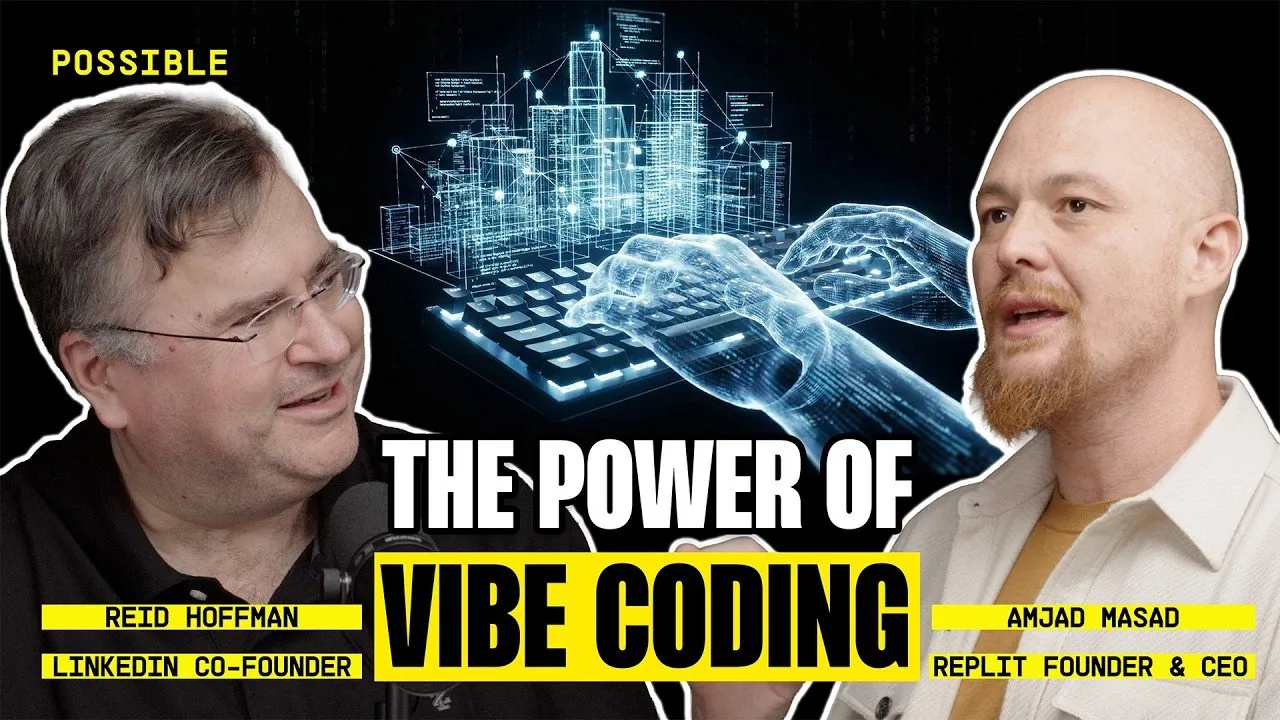
In a recent conversation on the Possible podcast, Amjad Masad, CEO of Replit, discussed this paradigm shift. Masad argues that we are moving toward a world where natural language is the primary programming interface—a concept popularly dubbed "vibe coding." This evolution promises to unlock the latent domain expertise of millions of non-technical entrepreneurs, transforming how humanity works, learns, and creates.
Key Takeaways
- Vibe coding is the new literacy: Programming is shifting from memorizing syntax to managing "vibes" and outcomes using natural language, fulfilling Grace Hopper’s 1950s vision of coding in English.
- Gaming mechanics improve developer tools: Treating software creation like a video game—with "save points" and immediate dopamine hits—drastically lowers the barrier to entry and encourages experimentation.
- Agents require habitats, not just prompts: The real value in AI development lies not just in the models, but in the "scaffolding" and environments that allow agents to verify, test, and correct their own work.
- Domain expertise beats technical minutia: As coding becomes accessible, the competitive advantage shifts to individuals with deep niche knowledge (e.g., a yoga teacher or small business owner) rather than just engineering skills.
- Innovation is the only moat: in a rapidly evolving AI landscape, traditional business moats are eroding; the only sustainable advantage is the velocity of continued innovation.
The Era of Vibe Coding and the End of Boilerplate
The term "vibe coding," coined by Andrej Karpathy, describes a workflow where developers rely less on writing individual lines of code and more on guiding an AI to achieve a desired outcome—checking if the "vibe" or behavior of the software matches their intent. While some purists may scoff at the abstraction, Masad views this as the natural evolution of computer science.
Historically, programming has always trended toward higher levels of abstraction. In the 1950s, Grace Hopper invented the compiler with the explicit goal of allowing people to program in English, moving away from machine code. Vibe coding is simply the next step in this trajectory, allowing creators to bypass the "accidental complexity" of software—such as configuring environments or memorizing object types—to focus on the creative solution.
We want to get to a point where you don't have to code at all. You should be in a creative space. A lot of coding is minutia. A lot of coding is accidental complexity.
This shift suggests that the future definition of a "coder" will expand to include anyone with an idea and the ability to articulate it, effectively democratizing the power of software creation.
Gamifying the Development Experience
One of Replit’s core philosophies is derived from the gaming industry. Masad, a lifelong gamer, noted that video games never start with a manual; they engage users immediately through interaction and feedback loops. Traditional programming environments, conversely, often require hours of setup before a user sees a result.
The Importance of "Save States" in Coding
In video games, the ability to save and load gives players the confidence to take risks. If a player dies, they simply reload from a checkpoint. Replit applied this logic to software development by building a proprietary, transactional file system. Every action in the Integrated Development Environment (IDE) is recorded in a ledger, allowing users—and AI agents—to "time travel" backward and forward through the codebase.
This reversibility is crucial for AI integration. Because Large Language Models (LLMs) are stochastic (random) by nature, they occasionally produce errors. A system that allows for instant rollbacks creates a safe environment for AI to experiment, fail, and retry without corrupting the entire project.
Building the Habitat for AI Agents
A critical insight from Masad is that LLMs are not standalone employees; they are organisms that require a specific habitat to thrive. While a chat interface is useful for basic queries, building complex software requires "scaffolding"—a robust environment wrapped around the model.
To make AI agents effective over long periods, Replit implemented a multi-agent system with distinct roles:
- The Builder: Generates the code and implements features.
- The Reviewer: An adversarial agent that critiques the code.
- The Tester: Boots up a browser to actually use the application and verify it works.
If the agent is going on a path and doesn't have feedback from the environment... it will very likely stray off the path... So, Replit agent 3 came out in September. We now boot up a browser for the agent, have the agent use it to test the application for you.
This verification loop allows agents to run unsupervised for significantly longer durations—moving from minutes to hours—transforming them from simple chatbots into autonomous workers capable of completing complex tasks.
Unlocking the Global "Long Tail" of Entrepreneurship
The democratization of coding is not just about making it easier for engineers; it is about economic enablement for the non-technical majority. Masad draws a parallel to Airbnb, which monetized the "long tail" of spare bedrooms. Similarly, Replit aims to monetize the long tail of human domain knowledge.
Everywhere in the world, there are individuals who are experts in niche fields—a yoga teacher in rural England, a scheduler for a construction firm, or a small bakery owner. These individuals understand their specific problems better than any Silicon Valley product manager ever could. Previously, they lacked the capital to hire developers to solve these problems. With AI-enabled coding tools, these domain experts can build bespoke software solutions, creating a explosion of micro-SaaS businesses and specialized tools.
The New Definition of Technical Talent
This shift raises a controversial question: Should we still teach children to code? Masad suggests that for the 99%, traditional syntax coding may become unnecessary. Instead, education should pivot toward computational thinking—the ability to break complex problems down into constituent parts and describe them logically to a machine.
While specialists will always be needed for low-level systems (we likely won't "vibe code" a mission-critical rocket landing sequence anytime soon), the barrier between having an idea and building a product is collapsing.
Business Strategy: Cathedrals Built from Bazaars
In the open-source world, development is often compared to a "bazaar"—messy, chaotic, but highly innovative. Corporate software development is often viewed as a "cathedral"—structured, top-down, and polished. Masad describes Replit’s strategy as building "cathedrals from bazaars."
By building a cohesive, user-friendly facade over the chaotic innovation of the open-source ecosystem, companies can offer the best of both worlds. However, in the age of AI, where technology moves at breakneck speeds, defensive moats are difficult to maintain.
Masad references Elon Musk’s philosophy that the only true moat is the pace of innovation. Relying on network effects or data moats is no longer sufficient when competitors can leverage AI to replicate features instantly. The only viable strategy is to build a culture of high-velocity engineering and to solve hard technical problems—like the transactional file system—that improve the performance of the underlying AI models.
Conclusion: A Human-Centric Future
Despite the rapid automation of technical tasks, the future of work appears increasingly human-centric. As machines take over the rote aspects of coding and administration, humans are freed to focus on creativity, empathy, and high-level strategy. The "cog in the machine" era of industrial labor is giving way to an era of mass entrepreneurship, where the ability to imagine a solution is the only prerequisite to building it.
Ultimately, the goal of tools like Replit is not just to generate code, but to generate wealth and agency for individuals who were previously locked out of the digital economy. By lowering the floor for entry and raising the ceiling for output, AI is poised to unleash a new wave of global innovation.