
Table of Contents
The barrier to software creation is collapsing. For decades, building an application required mastering complex syntax, managing development environments, and understanding the minutia of computer science. Today, we are witnessing a shift toward "Vibe Coding"—a movement where natural language controls the machine, and the primary skill required is not typing code, but curating ideas.
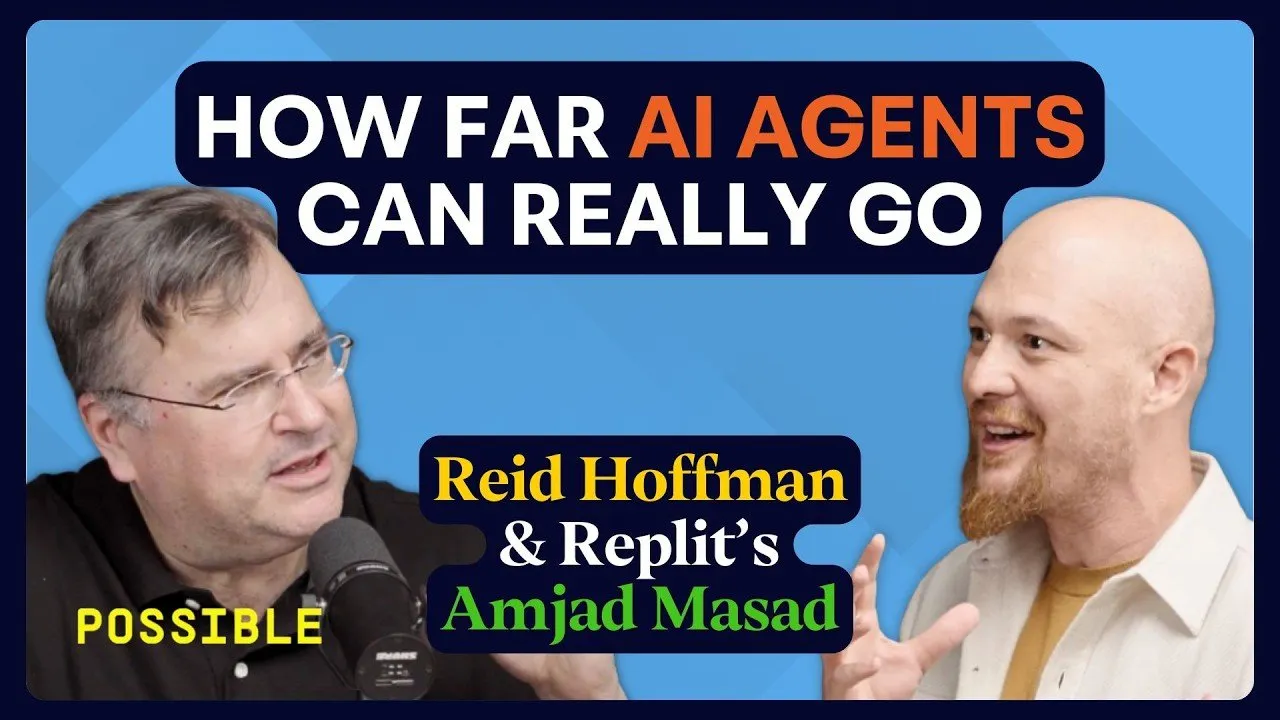
Amjad Masad, CEO of Replit, recently sat down with Reid Hoffman and Aria Finger to discuss how this shift is already happening. Masad, whose platform Replit has democratized coding for millions, argues that we are moving toward a world where the ability to imagine a solution is far more valuable than the ability to implement the syntax. From the influence of video game logic on software design to the philosophical implications of AI agents in the workforce, the conversation reveals a future where anyone with an idea can become a builder.
Key Takeaways
- Vibe Coding is the new literacy: The term describes a flow state where creators use natural language (prompts) to build software, managing the high-level logic while AI handles the syntax and implementation.
- Gaming psychology drives adoption: Replit’s interface is designed like a video game—no manuals, immediate dopamine hits, and "save points" (version control) that encourage risk-taking and exploration.
- The shift from "Copilot" to "Agent": We are transitioning from AI that assists with autocomplete to autonomous agents that can plan, execute, and verify complex tasks unsupervised.
- Technical moats still exist: While AI models are becoming commodities, the infrastructure around them—specifically transactional file systems that allow for "time travel" and error reversibility—remains a critical competitive advantage.
- Democratization of entrepreneurship: The cost of testing a business idea is dropping to zero, allowing non-technical domain experts (like teachers or small business owners) to build bespoke software solutions.
Defining "Vibe Coding" and the End of Syntax
The term "Vibe Coding" was popularized by Andrej Karpathy, former Director of AI at Tesla. It describes a style of programming where the human writes the prompt (the vibe), the AI writes the code, and the human reviews the output. If the app runs and feels right, the code is accepted. Masad embraces this shift, viewing it not as a degradation of skill, but as the fulfillment of a long-held computer science dream.
Historically, programming has been burdened by "accidental complexity"—the need to understand memory management, environment configuration, and syntax nuances that have nothing to do with the actual problem being solved. Masad points out that Grace Hopper, the inventor of the compiler in the 1950s, originally envisioned a future where people would program in English.
The history of humanity has been 'let's abstract away the details so we can focus on the more creative things.' Now, there's always specialists... but I think there are people that are going to be entirely programming in natural language.
This shift does not eliminate the need for logic. Instead, it elevates computational thinking over rote memorization. The new literacy involves breaking a problem down into its constituent parts and communicating those requirements clearly to an AI agent.
Gamification as a Design Philosophy
One of Replit's distinct advantages is its cultural DNA, which is rooted deeply in gaming. Masad grew up in Jordan playing Atari and building games for his younger brother. He realized early on that the most engaging software treats the user like a player, not a technician.
The "No Manual" Approach
Video games rarely start with a textbook; they start with a level one. Similarly, modern creative tools must offer immediate feedback. Masad argues that if a user has to read a manual to start, the product has already failed. The goal is to get the user to a "win state"—a running application—within minutes.
Safety Through "Save States"
In gaming, the ability to save and reload allows players to take risks without fear of permanent failure. Replit applied this logic to their infrastructure. They built a proprietary transactional file system where every action is recorded in a ledger. This allows users—and AI agents—to "undo" mistakes instantly.
In video games, if you think about save and load, it's a very important part of exploring a game... Replit we spend a lot of time working on checkpoint and restore. So every action you make... is actually stored in a sort of ledger.
This technical architecture is crucial for AI agents. Because Large Language Models (LLMs) are probabilistic (meaning they sometimes make mistakes or hallucinate), the environment they work in must be forgiving. If an agent breaks the code, the system must be able to roll back to the last working state automatically.
From Human Coders to AI Agents
The conversation highlighted a pivotal transition in the industry: the move from AI as a tool for humans to AI as an autonomous worker. Replit is re-architecting its platform to treat AI agents as "first-class citizens." This means building tools specifically for the AI to use, rather than just for the human.
The Challenge of Long-Context Agency
Current AI agents struggle with long, unsupervised tasks. If an agent makes a small error early in a process, that error compounds over time, leading to a broken final product. To solve this, Masad suggests a multi-agent architecture involving verification.
In this model, one agent writes the code, while a separate "adversarial" agent reviews it, and a third agent opens a browser to test the application effectively. By breaking the workflow into generation, verification, and testing, agents can run for hundreds of minutes rather than just a few, achieving genuine autonomy.
The Future of Work and the "Cognitive Industrial Revolution"
There is anxiety regarding AI's impact on employment. Masad frames this shift through the lens of Marx’s theory of alienation—the idea that industrial capitalism divorced workers from the fruits of their labor, turning them into cogs in a machine. He argues that much of modern corporate work, specifically data entry and form-filling, is dehumanizing.
AI offers a potential exit from this alienation. By automating the robotic aspects of knowledge work, humans are freed to operate at a higher level of abstraction—focusing on strategy, creativity, and entrepreneurship.
I don't think humans are fundamentally creative. I think anytime we assume the shape of a machine, I think people are actually not happy in their lives.
The Rise of the Non-Technical Founder
The immediate impact of this technology is the democratization of software creation. Masad shares stories of a mother building an app for her child’s rare eye condition and a yoga instructor in rural England creating a booking platform for pop-up events. These are domain experts who previously lacked the capital to hire engineering teams. With "vibe coding," the barrier to entry for entrepreneurship is effectively removed.
Strategic Moats in the Age of AI
With Replit recently surpassing $100 million in Annual Recurring Revenue (ARR), the conversation touched on business strategy. In a world where foundational models (like GPT-4 or Claude) are available to everyone, where is the competitive advantage?
Masad identifies three key areas for building a moat:
- User Obsession: Building specifically for a target persona (the creator) rather than trying to serve everyone.
- Hard Engineering on the Application Layer: Replit’s investment in their file system allows them to do things others can’t, such as "forking" environments cheaply to let AI run multiple experiments simultaneously to find the best code solution.
- Economies of Scale: As the platform grows, they can negotiate better compute rates and aggregate data to refine the experience, creating a flywheel effect.
Conclusion: A World of Infinite Ideas
The optimistic vision presented by Masad and Hoffman is one of abundance. We are moving toward a future where the bottleneck to innovation is no longer technical skill, but imagination. While the transition will require societal adaptation—and potentially new educational structures to teach "soft skills" and computational thinking—the end state is promising.
By lowering the floor for entry and raising the ceiling for what a single individual can accomplish, AI is reshaping the economy. It promises a future where wealth generation is accessible to anyone with an idea, the grit to pursue it, and the vibe to describe it.




%20%7C%20Possible)