Table of Contents
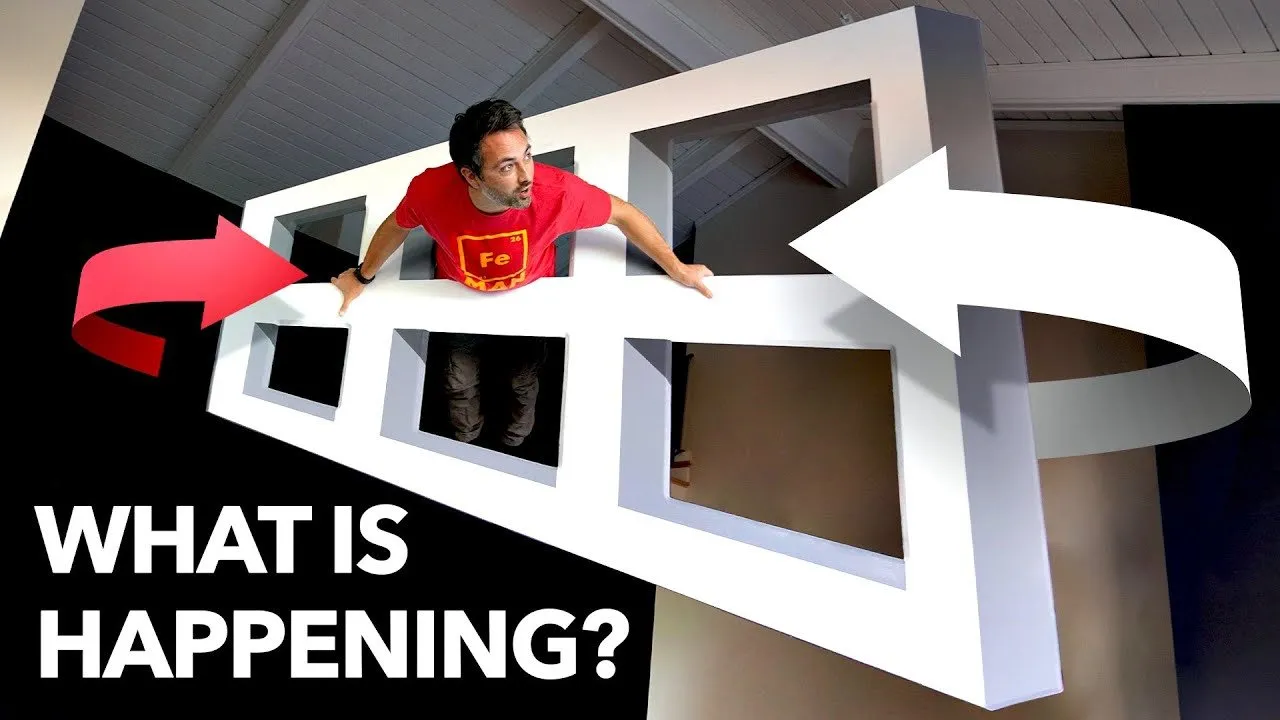
Imagine watching a window frame spinning on a turntable. As it rotates, your eyes tell you a straightforward story: the window spins 180 degrees, stops, reverses direction, and spins back. It appears to be oscillating. However, if you were to walk up and touch it, you would discover a baffling truth. The window never changes direction. It is rotating continuously in a full circle. Even when you attach a ruler to the frame—creating a scenario where the ruler physically passes through the solid frame—your brain still insists on the oscillation. This is the Ames Window illusion, a phenomenon that reveals less about the object itself and more about the fundamental shortcuts our brains take to construct reality.
Key Takeaways
- The Ames Window is a trapezoid painted to look like a rectangular window; its shape tricks the brain into perceiving oscillation rather than rotation.
- The "Carpentered World" hypothesis suggests that growing up in environments full of right angles conditions us to misinterpret trapezoidal shapes.
- Anamorphosis is a technique used in art and illusions where a distorted image only resolves into a coherent shape from a specific vantage point.
- Scientific implications extend beyond optics; the illusion demonstrates that identical observational data can support vastly different theories of reality.
The Mechanics of the Ames Window
The illusion, first created by Adelbert Ames Jr. in 1947, relies on specific physical properties to deceive the viewer. The object is not a rectangle, but a trapezoid. One vertical side is significantly longer than the other. Additionally, the surface is shaded to simulate depth and shadows, mimicking a three-dimensional window frame, though it is often a flat, two-dimensional cutout.
When this trapezoid rotates, the visual cues conflict with our brain's expectations. In a typical environment, when a rectangular window turns, the side moving away from us appears smaller due to perspective. However, the Ames Window is already physically smaller on one side. When the shorter side rotates toward the viewer, it still occupies a smaller visual angle than the longer side which is further away.
The Triumph of Illusion Over Physics
The brain prioritizes its internal model of the world over raw visual data. This preference is so strong that it can override physical impossibilities. In demonstrations where a rigid object, such as a ruler or a cube, is attached to the rotating window, the brain is forced to reconcile two conflicting realities.
Observers will often see the ruler rotating in a circle (the reality) while simultaneously seeing the window oscillating back and forth (the illusion). At the point where their paths intersect, the brain constructs a bizarre solution: the solid ruler appears to pass through the solid window frame like a ghost. This phenomenon highlights that our visual system is not a transparent window to the world, but an active interpreter of ambiguous data.
The Carpentered World Hypothesis
Why does the brain insist that a trapezoid is actually a rectangle? Adelbert Ames proposed that our perception is shaped by our environment. We live in what psychologists call a "carpentered world"—a modern environment dominated by rectangular boxes, 90-degree corners, and straight lines. Houses, doors, tables, and screens frame our existence.
Because we rarely look at these objects head-on, the images cast on our retinas are almost always trapezoidal. Through years of experience, our brains learn to decode these trapezoidal shapes as rectangles viewed from an angle. When presented with the Ames Window, the brain applies this hard-wired logic incorrectly, assuming the trapezoidal shape implies depth rather than the object's true form.
Evidence from Cross-Cultural Studies
If the environment dictates perception, then people raised in environments with fewer right angles should be less susceptible to the illusion. In 1957, Harvard psychologists tested this theory in South Africa. They compared two groups of children aged 10 to 14: one group from the city of Durban, surrounded by rectangular architecture, and another from rural communities living in traditional round huts.
The results were striking.
"When subjects were seated 10 feet away from the rotating Ames window with both eyes open, 60% of the urban group reported seeing the window oscillating. But in the rural group, only 17.5% saw the same thing."
This data supported the Carpentered World hypothesis. However, the study also revealed a limit to this environmental influence. When the children were moved 20 feet away and asked to view the illusion with one eye closed, 90% of participants in both groups saw the oscillation. This suggests that while environmental conditioning plays a role, other innate mechanisms of depth perception are also at work.
Anamorphosis and the Geometry of Deception
The principles powering the Ames Window are closely related to anamorphosis, a technique utilized by artists for centuries. Anamorphosis involves creating a distorted projection that only appears proportional when viewed from a specific "privileged" perspective.
A famous example is Hans Holbein the Younger’s 1533 painting, The Ambassadors. The painting features a smeared, unrecognizable shape across the floor. However, when viewed from a sharp angle at the side, the shape resolves clearly into a human skull—a memento mori hidden in plain sight. Similarly, the Ames Room, another invention by Adelbert Ames, uses forced perspective to make people appear to grow or shrink as they walk across a room. The room is trapezoidal, but from the viewing peephole, the geometry aligns perfectly to look like a standard cubic room.
These illusions work because perception is fundamentally ambiguous. A single two-dimensional image on the retina could mathematically represent an infinite number of three-dimensional realities. The brain must solve this inverse problem by relying on probability and past experience.
The Philosophy of Scientific Observation
The Ames Window is more than a parlor trick; it serves as a powerful metaphor for the philosophy of science and the limits of observation. It challenges the misconception that science is merely the process of collecting data to determine which theory is correct. In reality, identical data sets can often support contradictory theories.
Consider the history of astronomy. The observation of the sun moving across the sky is consistent with two different realities: a geocentric universe where the sun revolves around the earth, and a heliocentric universe where the earth rotates on its axis. The visual data alone does not distinguish between them.
"The truth is there are many circumstances in which the same data could come from very different external realities."
This problem, known as the underdetermination of theory by data, persists in modern physics. In quantum mechanics, mathematical formulas predict outcomes perfectly, yet physicists debate whether the wave function collapses or branches into multiple universes. The observable results are identical, but the implications for the nature of reality are vastly different.
Conclusion
The Ames Window serves as a humbling reminder of our cognitive limits. We feel as though we perceive the world directly and transparently, but we are actually navigating a simulation constructed by our brains. This simulation prioritizes consistency and familiarity over raw accuracy.
Just as the brain resolves a rotating trapezoid into an oscillating rectangle to make sense of the visual field, we often interpret complex information through the lens of our prior experiences and biases. Recognizing that our perceptions—and the conclusions we draw from them—are fallible is a crucial step toward a more rigorous and humble approach to understanding the world.