Table of Contents
AMD has unveiled its latest lineup of consumer processors and software enhancements, a launch characterized more by incremental refreshes and aggressive branding strategies than significant architectural breakthroughs. While the announcement included powerful new configurations for its high-end Strix Halo mobile chips, industry analysts are flagging concerns regarding a heavy reliance on rebranding previous-generation hardware and a conspicuous lack of pricing details for upcoming products.
Key Points
- Incremental Mobile Updates: The new Ryzen AI 400 series offers negligible performance gains over the 300 series, with top models seeing only a 0.1 GHz boost in clock speed.
- Strix Halo Expansion: AMD is bringing its high-performance mobile graphics architecture to 8-core and 12-core variants, offering "console-level" graphics without the requirement of a 16-core CPU.
- Desktop Refreshes: The announced 9850X3D desktop processor features an 8-core layout with a 5.6 GHz clock speed, stopping short of the rumored 16-core dual V-Cache flagship.
- AI Strategy Concerns: New software initiatives encourage users to rely on local "AI Agents" for sensitive financial planning, raising significant privacy and liability questions.
- Pricing Opacity: The complete absence of pricing information for the new chips has fueled speculation regarding potential cost increases for consumer GPUs.
Mobile Processors: Rebranding and Minor Gains
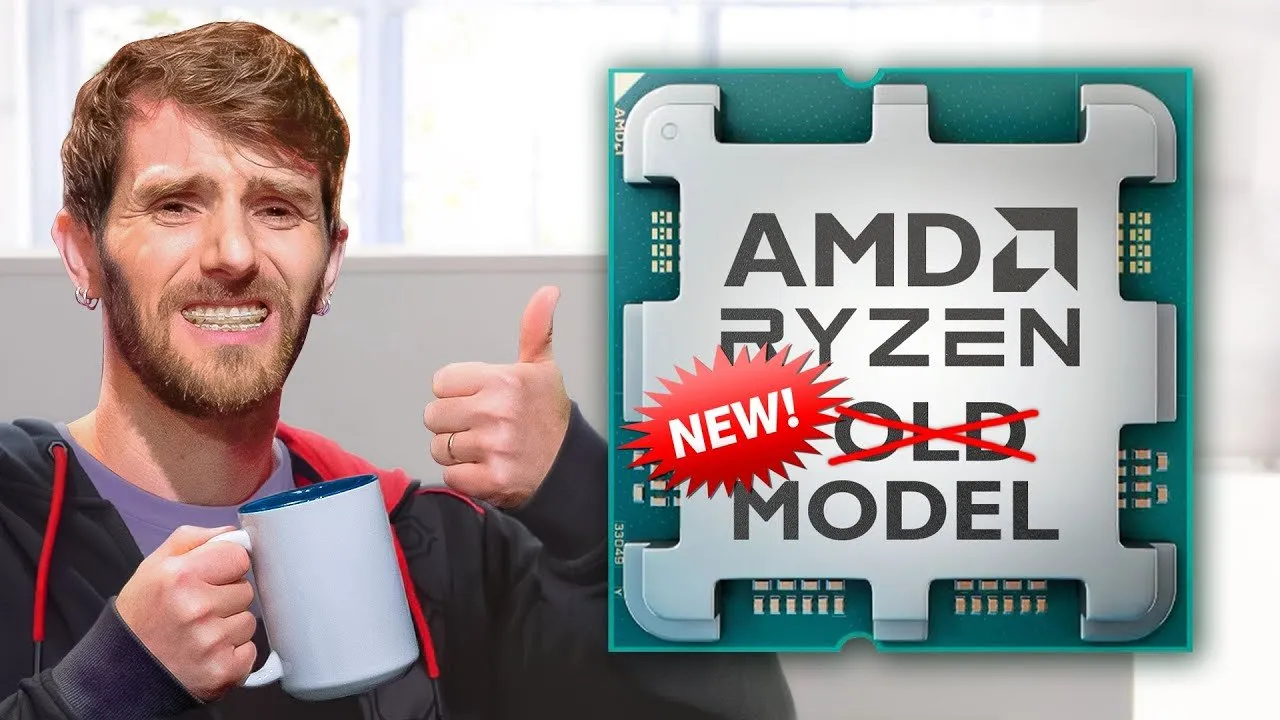
The centerpiece of AMD’s mobile announcement, the Ryzen AI 400 series, appears to be a near-direct rebrand of the existing Ryzen AI 300 chips. Technical specifications reveal that the primary difference in the flagship models is a 0.1 GHz increase in maximum boost clock, bringing the speed to 5.2 GHz. The lineup retains the same mixture of Zen 5 and Zen 5C cores.
While the architecture remains largely static, there are tangible improvements in memory support. The 400 series introduces support for faster LPDDR5 memory, which directly benefits the integrated graphics performance. AMD claims a 7% increase in GPU speeds, a modest improvement likely attributable to the increased memory bandwidth rather than architectural changes.
Specification Downgrades in Lower Tiers
Detailed analysis of the product stack reveals potential performance regressions in entry-level models. Comparisons between the new Ryzen AI 7 445 and the previous generation’s Ryzen AI 5 340 suggest that the newer model features lower clock speeds and reduced cache, despite similar RAM specifications. This complicates the value proposition for budget-conscious consumers, particularly as competitor Intel is rumored to be targeting substantial GPU performance gains—potentially up to 50%—with its upcoming Panther Lake architecture.
Desktop Gaming and Strix Halo
On the desktop front, AMD announced the 9850X3D, a refreshed iteration of its popular 3D V-Cache technology. The chip features eight cores and achieves clock speeds of up to 5.6 GHz—approximately 400 MHz faster than its predecessor. However, the announcement disappointed enthusiasts expecting a high-core-count flagship. Rumors of a "9950X3D" featuring 16 cores and dual 3D V-Cache layers (totaling an alleged 192MB of L3 cache) did not materialize.
Performance benchmarks provided by AMD compared the 9850X3D against Intel’s Core Ultra 9 285K rather than AMD’s own previous generation, a marketing move that obscures the direct generational performance uplift.
Conversely, the expansion of the Strix Halo line received positive reception. Previously limited to expensive 16-core configurations, AMD is bringing its high-performance integrated graphics to 8-core and 12-core mobile chips. This move allows users to access massive graphics throughput—comparable to a PlayStation 5—without the thermal and financial premium of a top-tier CPU.
"We heard that you love astonishingly fast graphics in a mobile chip, but don't want to pay an extra $500 for the 16 core model. So, we put the best graphics on an 8 core and a 12 core."
Software Ecosystem and AI Integration
AMD continues to pivot heavily toward artificial intelligence, reporting 2.5x year-over-year growth for its Ryzen AI family. The company showcased updates to its ROCm software stack, citing improved Windows compatibility and simplified installation processes for tools like ComfyUI.
However, the introduction of "AI Agents" for personal finance drew skepticism. AMD pitched a use case where local AI models ingest a user's bank information, pay stubs, and tax returns to generate financial advice. While running these workloads locally offers privacy benefits over cloud-based solutions, experts warn against trusting unvetted AI with critical financial planning.
"Do not trust an AI to give you financial advice without also having it thoroughly vetted. At least not for now."
The relentless branding of standard features as "AI" capabilities suggests AMD is under pressure to demonstrate leadership in the sector, even as consumers remain largely driven by traditional metrics such as battery life and raw performance.
Market Outlook
The lack of innovation in this cycle has drawn comparisons to Intel's period of stagnation in the mid-2010s. By relying on minor clock speed bumps and confusing nomenclature, AMD risks eroding the consumer goodwill it built over the last decade of Ryzen innovation.
Furthermore, the omission of pricing details is notable. With rumors circulating regarding price hikes for consumer GPUs, the industry is bracing for a potentially expensive hardware cycle. Stakeholders and consumers alike will be awaiting third-party benchmarks and official pricing releases to determine if the modest performance gains justify the investment.