Table of Contents
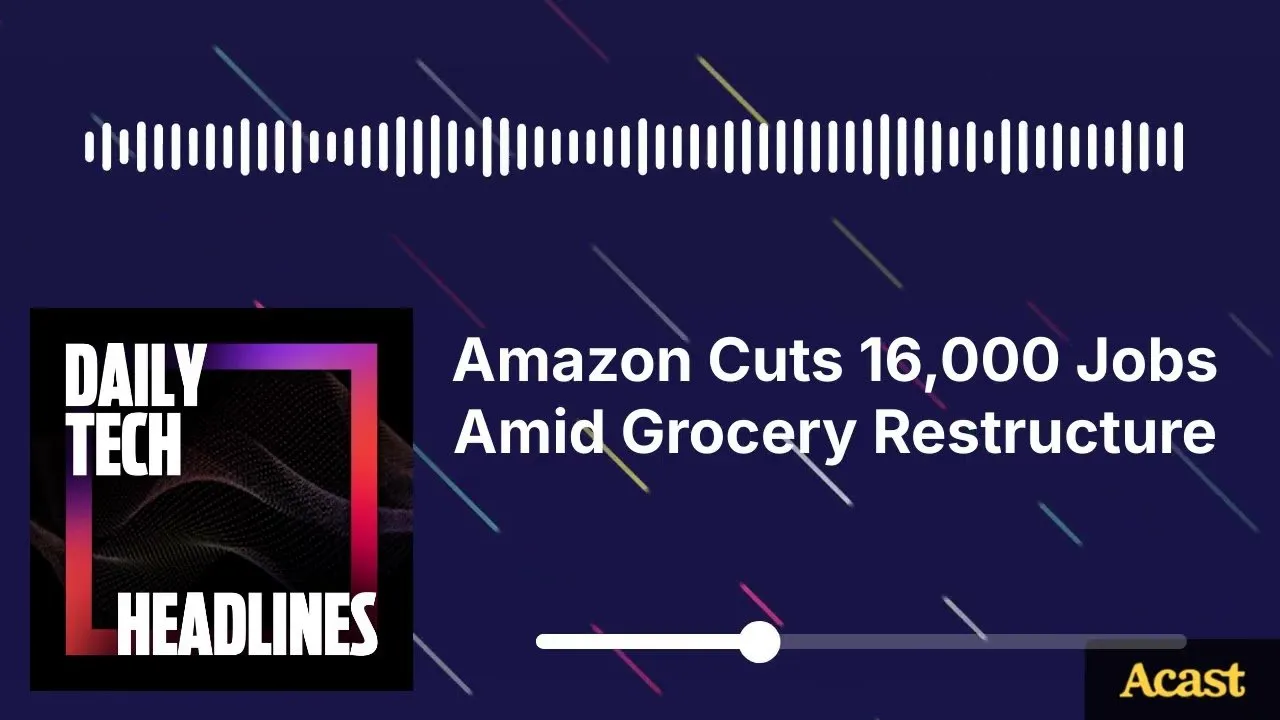
Amazon has announced the elimination of 16,000 positions in a major strategic restructuring, marking its second significant workforce reduction in three months. The move coincides with a broader pivot in the company's grocery division and the discontinuation of its biometric payment technology, signaling a shift toward operational efficiency and artificial intelligence integration across its retail footprint.
Key Points
- Workforce Reduction: Amazon is cutting 16,000 jobs following a previous reduction of 14,000 in October, citing ongoing consolidation.
- Retail Strategy Shift: The tech giant is shuttering Amazon Go and Amazon Fresh stores to focus on Whole Foods same-day delivery and is discontinuing the Amazon One palm-scanning system.
- Autonomous Transport: Uber has signed a deal to deploy 25,000 robotaxis with Waabi, investing $1 billion into the autonomous trucking startup.
- Hardware Spinoff: Snap is spinning off its augmented reality glasses division into a standalone subsidiary, Specs, Inc., to attract external investment.
Amazon Aggressively Restructures Retail Operations
In a decisive move to streamline operations, Amazon confirmed on Wednesday that it is cutting 16,000 roles. This reduction comes shortly after the company eliminated 14,000 positions in October, bringing the total job losses to 30,000 in under two quarters. Management attributes these cuts to an ongoing restructuring effort, warning that further consolidations may occur as teams merge.
The restructuring extends beyond headcount. Amazon is dismantling two of its high-profile retail experiments: the cashier-less Amazon Go and Amazon Fresh store formats. The company plans to redirect resources toward its established Whole Foods chain, specifically prioritizing same-day delivery capabilities.
Additionally, the company is ending its biometric identification program. The Amazon One palm-scanning system, launched in 2020 for entry and payments at third-party venues and Whole Foods, will be discontinued on June 3, 2026. Addressing long-standing privacy concerns, Amazon stated it will permanently delete all stored biometric data associated with the retail service, though healthcare check-in features will remain operational for the time being.
"AI will reduce demand for certain jobs, but create others," stated Amazon CEO Andy Jassy regarding the company's evolving labor strategy.
Major Market Moves: Uber, Snap, and Apple
Beyond Amazon, the broader technology sector saw significant capital movements and strategic realignments this week.
Uber Bets Big on Waabi
Autonomous trucking company Waabi has secured a massive partnership with Uber. The deal involves the deployment of over 25,000 robotaxis utilizing the "Waabi Driver" system. As part of the agreement, Waabi is receiving a $1 billion investment. Waabi claims its simulator-driven AI stack allows it to scale across both trucking and passenger vehicles more efficiently than competitors. Concurrently, Uber is launching a new "Uber AV Labs" unit to support data collection for its growing roster of autonomous vehicle partners.
Snap Restructures AR Division
Snap is reorganizing its hardware ambitions by spinning its augmented reality glasses unit into a standalone subsidiary named Specs, Inc. While Snap will retain full ownership, this corporate structure is designed to attract outside investors and facilitate partnerships. The company is currently hiring for over 100 roles globally and aims to release new standalone AR glasses later this year, positioning them as AI-integrated tools that assist users without removing them from real-world interactions.
Apple Supply Chain Resilience
Despite a global RAM shortage and rising memory costs, Apple reportedly plans to maintain steady pricing for the upcoming iPhone 18 line. According to analyst Ming-Chi Kuo, Apple is renegotiating memory prices quarterly and choosing to absorb the increased manufacturing costs. The company intends to offset these hardware margin pressures through continued growth in its high-margin Services business. Kuo notes that supply chains remain tight, particularly for glass cloth used in AI hardware circuit boards.
Software and Robotics Developments
In software news, a bug report in Chromium has inadvertently exposed Google's potential "desktop mode" for Android 16, identified as "ALOS." Leaked visuals running on an HP Chromebook show a comprehensive desktop interface featuring a taskbar, window controls similar to ChromeOS, and split-screen multitasking, suggesting a blurring of lines between Google's mobile and desktop operating systems.
On the professional networking front, LinkedIn is integrating "verified vibe coding" and AI proficiencies into user profiles. Moving away from self-reported skills, the platform is partnering with tools like Replit, Lovable, and Descript to assess users and automatically update their skill ratings—such as "Bronze" or "Intermediate"—offering recruiters validated data on a candidate's technical abilities.
Finally, Fauna Robotics introduced "Sprout," a $50,000 soft-bodied humanoid robot designed for safety around humans. With early buyers including Disney and Boston Dynamics, Sprout ships with pre-built navigation and perception features, allowing researchers to focus on application development rather than building hardware from scratch.
As 2026 progresses, the industry is witnessing a clear trend toward consolidation in retail tech, while capital continues to flow heavily into autonomous systems and verified AI competencies.