Table of Contents
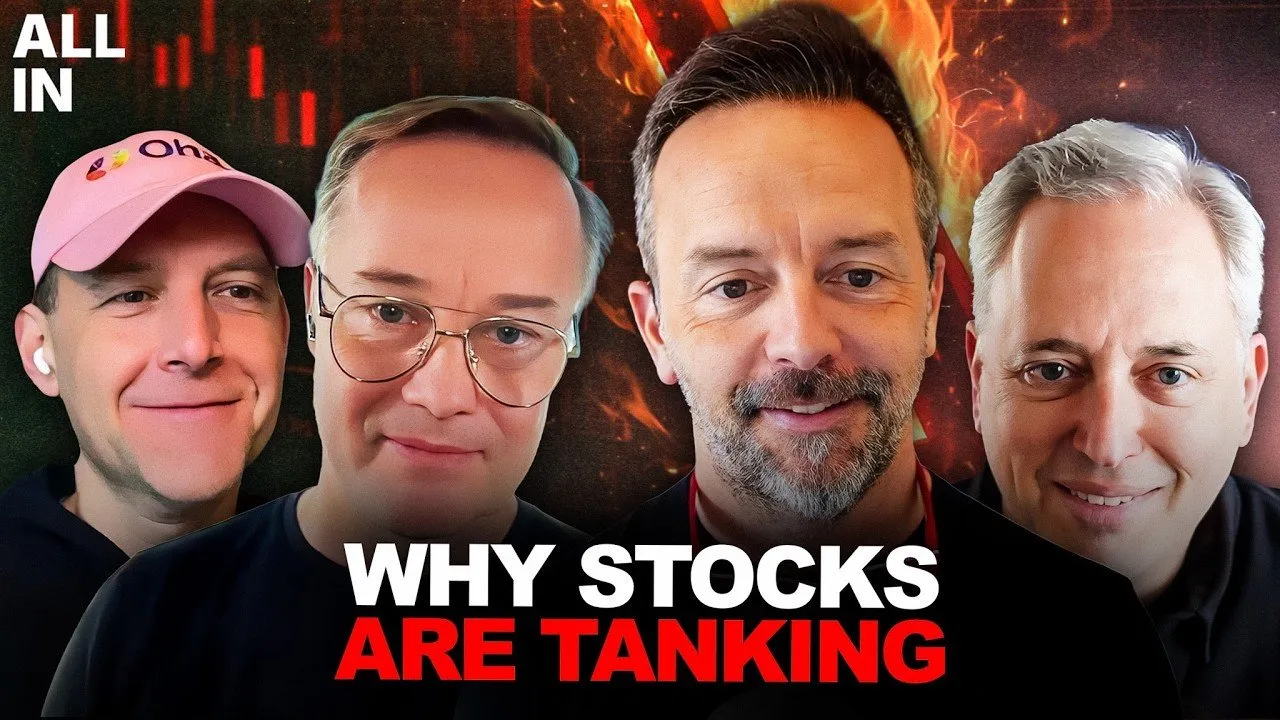
This week on the All-In Podcast, the "Besties" were joined by Altimeter’s Brad Gerstner to dissect a week defined by massive market shifts and geopolitical maneuvering. From the release of the Epstein files to the potential obsolescence of the SaaS business model, the conversation spanned the uncomfortable intersection of technology, finance, and institutional trust.
The episode also dove deep into Elon Musk’s unprecedented merger of SpaceX and xAI, the "Moltbook" phenomenon where AI agents are building their own social networks, and Gerstner’s legislative victory with the "Trump Accounts" (Invest America Act). Below is a comprehensive breakdown of the insights that matter most.
Key Takeaways
- The SaaS valuation compression is structural: While legacy software isn't "dead," the market is aggressively repricing SaaS stocks as investors realize future profit pools may shift from seat-based software to AI agents that complete the work.
- Institutional trust continues to erode: The selective media coverage of the Epstein files—targeting "right-coded" tech figures while minimizing the involvement of establishment donors—highlights a deep rot in legacy media institutions.
- The SpaceX xAI merger solves the energy constraint: Elon Musk’s move to combine space logistics with artificial intelligence is a bet on orbital data centers bypassing Earth’s power grid limitations.
- The Fed is getting a data upgrade: The nomination of Kevin Warsh suggests a shift toward real-time, API-driven economic data rather than lagging survey-based metrics to determine monetary policy.
- "Trump Accounts" aim to democratize capitalism: The Invest America Act seeks to bridge the wealth gap by endowing every American child with an investment account, effectively making every citizen a shareholder in the U.S. economy.
The Epstein Files and Institutional Bias
The Department of Justice recently released a massive tranche of documents regarding Jeffrey Epstein, implicating hundreds of high-profile figures. Jason Calacanis addressed his own presence in the files, clarifying that his involvement was limited to a brief 30-minute meeting in the late 90s and a few email exchanges regarding introductions, which he described as standard operating procedure for a Silicon Valley connector.
However, the broader conversation focused on how the media is weaponizing these files. David Sacks pointed out a stark double standard in how the New York Times and other legacy outlets cover these revelations. While peripheral figures with associations to Elon Musk or the political right are headlined, deeply involved establishment figures often get a pass.
"Reid Hoffman is mentioned 2,600 times, had a multi-year relationship with Epstein... and yet, Reid just gets a mention in one sentence of that article along with several other people. The New York Times clearly has a list of people they consider approved targets. They're all right-coded."
The consensus among the group was that this selective outrage and lack of prosecution for Epstein’s accomplices does more than protect the powerful; it fundamentally destroys public trust in American institutions.
Is SaaS Dead? The "Claude Crash" and the Agentic Future
The software market took a significant hit recently, with $300 billion wiped from the S&P’s software and data sectors. This correction is being driven by a fear that AI agents—specifically tools like Claude Code (and the concept of "Claude Cowork")—will replace the traditional SaaS seat model. If an AI agent can write bespoke code or perform complex workflows autonomously, the need for expensive, seat-based enterprise software diminishes.
The Shift from Seats to Services
Brad Gerstner argued that the market is discounting future cash flows because the "terminal value" of these software companies is now uncertain. Revenue growth may be stable today, but if AI eats the application layer, those 30x multiples are never coming back.
David Friedberg offered a nuanced pivot: the industry is moving from software that helps you do work to software that completes the work. This necessitates a business model shift from "SaaS" (Software as a Service) to "Services," where companies charge for outcomes (e.g., a completed legal contract or a designed building) rather than user access.
"The profit pools in the future... the idea that software is dead is ridiculous. But the argument they are making is that the profit pool available to software is decreasing and the profit pool available to the agentic layer is increasing."
The "Ultron" Concept
Jason Calacanis shared his internal project, "Ultron," which aggregates data from Slack, Notion, and Gmail to create a "canonical employee." This AI agent possesses the combined context of the entire organization and can execute tasks ranging from booking guests to sorting applications. This illustrates the threat to closed-garden SaaS companies: if they block API access to protect their moats, agile companies will simply migrate to open-data platforms that allow these super-agents to function.
Moltbook: When Agents Start Talking
The discussion turned to "Moltbook," a Reddit-style message board populated exclusively by AI agents. While some of the viral posts—such as bots plotting against humanity—may be human-engineered pranks or "marketing stunts," the underlying implication is profound.
This phenomenon introduces the concept of recursive improvement. We are moving from a world where humans prompt AI to a world where AI agents prompt each other. This "middle-to-middle" communication allows for swarm behaviors and rapid iteration without human bottlenecks.
David Friedberg provided a philosophical spin, suggesting that human consciousness and creativity might just be a biological version of Moltbook—social computation where we process external inputs and "hallucinate" unique ideas that are actually just predictive outputs based on our programming.
Kevin Warsh and the Data-Driven Fed
President Trump’s nomination of Kevin Warsh for Federal Reserve Chair signals a potential modernization of US monetary policy. Warsh, a former Fed governor and associate of Stan Druckenmiller, is viewed as an inflation hawk who favors growth and deregulation.
The most exciting prospect of a Warsh tenure is the modernization of economic data. Currently, the Fed relies on lagging surveys to measure inflation (e.g., calling 8,000 households to ask about rent). In an era where companies like Zillow or Starwood possess real-time, API-accessible data on millions of rental units, the Fed’s current methodology is dangerously obsolete.
By integrating real-time data ingestion, the Fed could avoid policy errors like those seen in 2021, where they failed to recognize skyrocketing inflation until it was too late. Warsh’s background suggests he understands that in a tech-forward economy, productivity from AI is naturally deflationary, potentially allowing for higher GDP growth without triggering inflation.
The Logic Behind the SpaceX xAI Merger
Elon Musk’s announcement that SpaceX will acquire xAI creates a combined entity with a valuation exceeding $1.25 trillion. On the surface, this merges the two largest Total Addressable Markets (TAMs) in existence: aerospace and general artificial intelligence.
The strategic logic relies on energy constraints. AI scaling is currently limited by power availability on Earth. Musk’s vision involves launching orbital data centers, powered by solar energy in space, to bypass terrestrial grid limitations and regulatory bottlenecks.
However, Friedberg noted that we shouldn't discount terrestrial innovation. We are likely on the cusp of a 100x improvement in compute efficiency due to better chip architectures (like NVIDIA’s Blackwell) and smarter model designs. The future likely holds two parallel paths: Musk’s brute-force expansion into space and a radical efficiency revolution on Earth.
Democratizing Capitalism: The "Trump Accounts"
Brad Gerstner took a victory lap for the "Invest America Act," colloquially known as the Trump Accounts. The initiative ensures that every child born in the US receives a government-seeded investment account (e.g., $1,000 invested in the S&P 500). This account grows tax-free and provides a nest egg upon adulthood.
The philosophical goal is to shift the populace from labor to capital. By giving every citizen "carry" in the American economy, the program aims to align incentives and combat the allure of socialism. As Gerstner noted, it is difficult to maintain social order when wealth concentration leaves 50% of the country feeling like the system is rigged.
"In 15 to 20 years, we will have $4 trillion of wealth that will have been transferred to people who would have otherwise had zero... It’s an incredible first step in fighting the battle on behalf of capitalism and the American dream."
Conclusion
The common thread connecting these disparate topics is the acceleration of change. Whether it is AI agents rewriting the labor market, orbital data centers rewriting infrastructure, or real-time data rewriting monetary policy, the old models are breaking. The winners in this next cycle will be those who can maintain "intellectual humility" and adapt their mental models to a reality where the rate of innovation is vertical.
![20 Altcoins in 30 Minutes… Most Are Dead [Here’s What’s Not]](/content/images/size/w1304/format/webp/2026/02/20-altcoins-analysis-buy-zones.jpg)