Table of Contents
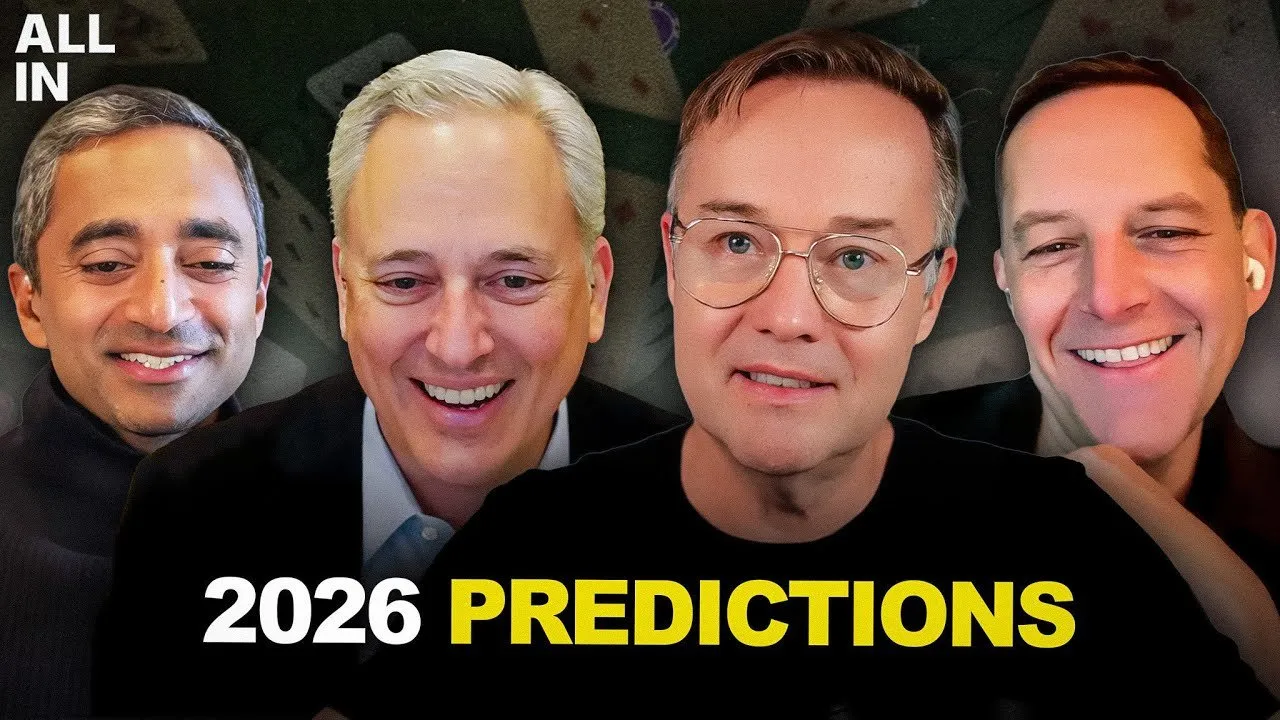
The latest episode of the All-In Podcast brings the "Besties"—Chamath Palihapitiya, Jason Calacanis, David Sacks, and David Friedberg—together to forecast the political, economic, and technological landscape of 2026. Against the backdrop of a significant migration of wealth from California to Texas, the group dives deep into the implications of proposed wealth taxes, the potential for a historic economic boom, and the shifting dynamics of Silicon Valley dealmaking. From the decline of the "software industrial complex" to the rise of citizen journalism, the predictions for the coming year suggest a radical restructuring of American business and politics.
Key Takeaways
- The California Exodus: The proposed "wealth tax" (or asset seizure tax) in California is predicted to drive a massive flight of capital and billionaires to states like Texas and Florida.
- The "Trump Boom": The group predicts aggressive GDP growth (potentially 5-6%), driven by deregulation, tax cuts, and a surge in productivity.
- Shift in M&A Strategy: Due to regulatory hurdles, traditional mergers may be replaced by massive IP licensing deals and "acqui-hires," particularly in the AI sector.
- Decline of Legacy SaaS: Chamath Palihapitiya predicts the "software industrial complex"—specifically maintenance and migration revenue—will shrink significantly due to AI efficiency.
- Geopolitical Resets: Contrarian predictions include a potential regime change in Iran toward democracy and a settlement of the Russia-Ukraine conflict.
The California Wealth Tax and the Flight of Capital
A significant portion of the conversation centered on the controversial California wealth tax proposal. The hosts argue that this initiative, which targets unrealized capital gains, acts as a "seizure tax" that fundamentally alters the relationship between citizens and private property. The consensus among the group is that regardless of whether the measure passes, its mere existence on the ballot will accelerate the exodus of high-net-worth individuals.
The Super-Voting Share Dilemma
David Sacks highlighted a specific, often overlooked nuance regarding tech founders. The proposed tax valuation does not rely solely on liquid market value. Instead, for founders with super-voting shares (like Larry Page and Sergey Brin of Google), the state could multiply their voting power by the company's market cap to determine their taxable net worth.
This mechanism could theoretically result in tax bills that exceed the liquid assets of the founders, forcing them to sell controlling stakes in their companies to pay the state. The group suggests this is a primary driver for the recent relocations of major tech figures to Florida and Texas.
"If we're forced to look down the barrel of an asset tax system that has God knows what methodology... It's probably half the total wealth that the budget estimated would be available to be taxed will be gone."
Political Predictions: The "Trump Boom" vs. The Rise of Socialism
The predictions for the biggest political winners of 2026 revealed a sharp divide in how the hosts view the current political trajectory. While there is agreement on the economic data, the political ramifications differ.
The Economic Boom
David Sacks forecasts that the "Trump Boom" will be the defining political narrative of 2026. Citing core CPI dropping to 2.6%, robust GDP growth, and increasing real wages, Sacks argues that the U.S. is entering a period of economic expansion that rivals historical highs.
The group generally agreed on the economic outlook, with estimates for 2026 GDP growth ranging between 4% and 6%. This growth is attributed to a combination of deregulatory policies, AI-driven productivity gains, and a stable energy sector.
The Polarization of Parties
Conversely, David Friedberg predicts that the Democratic Socialists of America (DSA) will be the significant winners on the left, effectively taking over the Democratic Party much like the MAGA movement reshaped the GOP. Jason Calacanis agrees, noting the "Mamdani Moment" and a shift toward collectivist rhetoric among younger progressive candidates.
This polarization leaves "Democratic Centrism" as the predicted biggest loser of 2026. The hosts argue that gerrymandering has eliminated competitive districts, forcing incumbents to guard their left flank against radical challengers rather than appealing to the middle.
Business Winners: Commodities, Robotics, and Prediction Markets
Moving beyond politics, the Besties identified key sectors poised for explosive growth in 2026.
The Resurgence of Hardware and Commodities
Chamath Palihapitiya selected copper as the biggest business winner. As the world moves toward unilateral national security and localized supply chains ("The Trump Doctrine"), the demand for copper—essential for data centers, chips, and weapons systems—is expected to outstrip supply significantly. He notes that by 2040, the world could be short 70% of the required global supply.
Jason Calacanis pointed to Amazon and the rise of corporate robotics. He predicts Amazon will become the first "corporate singularity," where robots eventually drive more of the bottom line than human employees. The deployment of humanoid robots in warehouses is expected to surge, decoupling revenue growth from headcount growth.
Polymarket and the Information Economy
David Friedberg highlighted Polymarket as a breakout business. The platform is evolving from a niche betting site into a primary source of news and market sentiment. By aggregating real-time probabilities on global events, prediction markets are beginning to replace traditional polling and media analysis.
The Decline of the "Software Industrial Complex"
In a notable bearish call, Chamath Palihapitiya predicts that the enterprise SaaS (Software as a Service) model faces an existential threat. He categorizes the industry into three buckets: initial licensing, maintenance, and migration. The latter two represent the vast majority of revenue.
With the advent of AI agents and advanced coding assistants, the cost and complexity of maintaining and migrating software are plummeting. This efficiency threatens the lucrative "maintenance" revenue streams that legacy software giants rely on.
"I think you're going to see that total economic opportunity shrink and contract aggressively. The companies will still be able to do their business, it'll just be at a much, much lower incremental revenue."
The Impact on Knowledge Workers
This shift leads to conflicting views on the labor market. Jason Calacanis argues that young, entry-level white-collar workers will be the biggest losers, as AI automates the bottom rung of the corporate ladder. However, David Sacks counters with "Jevons Paradox," suggesting that as the cost of code and analysis drops, demand will skyrocket, potentially increasing the need for skilled knowledge workers to manage these new capabilities.
The New Era of Dealmaking: IP Licensing vs. M&A
The regulatory environment regarding antitrust has forced a structural change in Silicon Valley dealmaking. The group predicts that 2026 will see the death of traditional M&A for large tech companies, replaced by massive IP licensing agreements.
Chamath Palihapitiya explains that companies like Google, Microsoft, and NVIDIA are bypassing antitrust blockers by "licensing" technology and hiring the talent (acqui-hires) rather than buying companies outright. This allows for the transfer of intellectual property and human capital without triggering the multi-year regulatory reviews associated with formal mergers.
Simultaneously, Jason Calacanis predicts a resurgence of the IPO market. He anticipates that major private players—specifically citing SpaceX, Stripe, Databricks, and OpenAI—will finally enter the public markets in 2026, driven by a friendlier SEC and pent-up demand from the public.
Contrarian Beliefs and Geopolitics
The hosts offered several predictions that run counter to the current consensus.
- Iran's Democratic Turn: David Friedberg predicts a revolution in Iran, leading to the ousting of the Ayatollahs and the establishment of a democratic state. He views Iran not as the destabilizer, but as a potential future stabilizing force in the region once the regime changes.
- SpaceX Consolidation: In a bold financial prediction, Chamath Palihapitiya argues that SpaceX will not IPO. Instead, he foresees a reverse merger where Tesla acquires SpaceX, allowing Elon Musk to consolidate his major assets (potentially including xAI and The Boring Company) into a single, massive holding company.
- Russia-Ukraine Settlement: Friedberg also predicts the Russia-Ukraine war will settle in 2026, driven by economic exhaustion and shifting political motivations.
Conclusion: The Rise of Citizen Journalism
The episode concluded with a shared anticipation for the explosion of "citizen journalism" and independent auditing. The hosts believe the decentralization of media is entering a new, more aggressive phase. Rather than passive commentary, creators are now engaging in active investigations—auditing government spending, testing First Amendment rights, and exposing waste on the streets.
This trend parallels the broader theme of the episode: a move away from centralized legacy institutions (legacy media, legacy SaaS, centralized political parties) toward a more decentralized, efficient, and transparent future.
"The work of journalism has been decentralized... There's going to be so much more that's going to be shared and covered this year."