Table of Contents
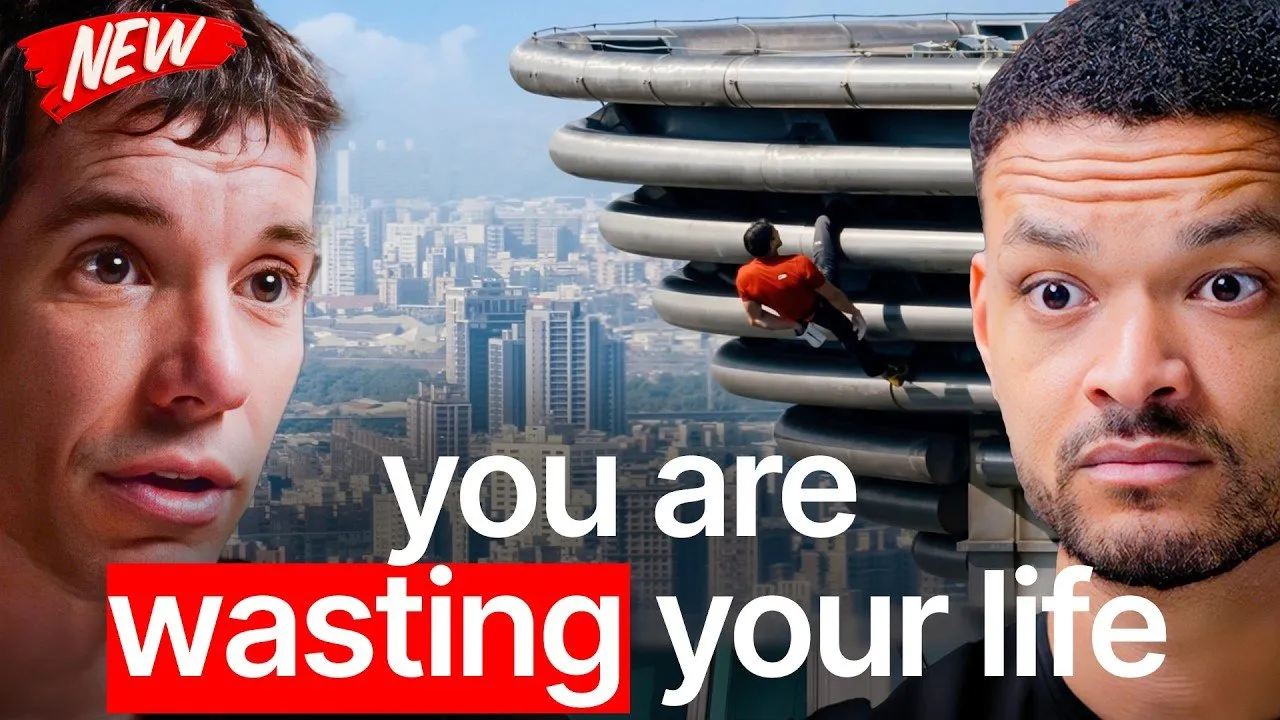
Alex Honnold is best known to the world as the man who free soloed El Capitan—a feat documented in the Oscar-winning film Free Solo. To the casual observer, Honnold appears to be a biological anomaly, a man missing the part of the brain that processes fear. However, a deeper look into his psychology, career trajectory, and recent ascent of Taipei 101 reveals a much more relatable, albeit disciplined, reality. Honnold is not fearless; he is a master of preparation who views risk through a lens of extreme rationality. In a wide-ranging conversation with Steven Bartlett, Honnold deconstructs the myths surrounding his physiology, explains the economics of passion, and offers a blueprint for how anyone can restructure their relationship with fear and mortality.
Key Takeaways
- Risk is Inevitable: Honnold argues that avoiding physical danger does not equate to safety; sedentary lifestyles and unconscious choices (like drunk driving) carry risks that people accept passively, whereas he chooses his risks intentionally.
- Fear is conditioned, not absent: Despite viral claims about his amygdala, Honnold experiences fear. His calmness is the result of decades of exposure therapy and gradual desensitization, not a physiological defect.
- Success is a lagging indicator: Honnold spent over a decade living in a van on a few hundred dollars a month before achieving mainstream financial success, proving that value creation often precedes monetization.
- Preparation demystifies the impossible: Whether climbing El Capitan or a skyscraper, Honnold breaks insurmountable tasks into small, manageable segments to strip them of their terror.
- Action overrides words: In both his relationships and his philanthropy, Honnold prioritizes tangible acts of service and material impact over performative gestures or verbal affirmations.
Redefining Risk: Intentionality vs. Passive Danger
One of the most profound aspects of Honnold’s philosophy is his rejection of the standard societal view on safety. While the public views free soloing (climbing without ropes) as a death wish, Honnold views it as a celebration of life through extreme intentionality. He challenges the notion that the "safe" path is actually safe, pointing out that mortality is the only guarantee in life.
- The fallacy of the "safe" life: Honnold notes that people who avoid outdoor adventure to stay home and play video games are simply trading the risk of falling for the risk of heart disease. Everyone is taking risks; most just aren't choosing them consciously.
- The illusion of immortality: Most people live as if they will never die, leading to a fear of taking chances. Honnold suggests that acknowledging mortality liberates you to live fully. He argues it is better to die at 55 having lived a life of passion than to die at 78 having done nothing but exist safely.
- Calculated vs. reckless risk: There is a distinct difference between "rolling the dice" (like drunk driving or gambling) and the calculated risk of climbing. Honnold’s risks are mitigated by years of training, whereas reckless risks rely on luck.
- Binary outcomes heighten focus: Climbing is often binary—you are either perfectly safe or you are dead. This clarity forces a level of alertness and presence that modern life rarely demands, creating a state of hyper-focus that Honnold finds deeply satisfying.
- Ownership of consequences: The frustration Honnold feels toward critics is rooted in autonomy. He believes that if one is to die, it should be on their own terms, pursuing what they love, rather than as a passive victim of lifestyle choices.
- The "One Last Climb" hypothetical: When asked what he would do if he had one week left to live, Honnold didn't choose a beach vacation. He chose the "Free Triple" in Yosemite—climbing El Capitan, Half Dome, and Mount Watkins in a single day—demonstrating that his climbing is intrinsic to his happiness, not just a career.
It drives me crazy that nobody else thinks about risk in this way... You can take no risk in your life and you're still going to freaking die. So, you might as well take smart, calculated risks and do all the things that you want to do and at least die happy when you go.
The Myth of Fearlessness: Conditioning the Amygdala
Following the release of Free Solo, a narrative emerged that Honnold has a defective amygdala (the brain's fear center) because it didn't light up during an fMRI scan while viewing scary images. Honnold vehemently rejects this "superhuman" label, viewing it as a dismissal of his hard work. He posits that his brain is the result of software updates, not hardware differences.
- Contextualizing the science: Honnold points out the flaws in the famous fMRI study. He was shown black-and-white photos while lying safely in a metal tube. For someone who has hung off cliffs for 20 years, a picture of a scary face is simply not a threatening stimulus.
- Neuroplasticity in action: He attributes his calmness to exposure therapy. Just as a monk’s brain changes through meditation, Honnold’s brain has adapted through decades of high-consequence climbing. He isn't fearless; he is desensitized.
- Public speaking vs. climbing: To prove his brain works normally, Honnold cites his past fear of public speaking. Ten years ago, he was too terrified to speak on camera; today, after "exposure therapy" via media tours, he is comfortable. The fear mechanism exists; he just learns to master it in different domains.
- The slow creep of fear: Unlike "gravity-assisted" sports like skiing, where you commit once and momentum takes over, climbing allows fear to creep in during slow, static moments. You make a move, then hang there, debating whether you are safe. Mastering this internal monologue is the sport's core mental challenge.
- The reality of panic: Honnold admits to experiencing trauma and panic, specifically citing a moment on Half Dome where he mentally crumbled on a ledge. He isn't immune to the "Elvis leg" (shaking from fear); he has just developed protocols to breathe through it and rationalize his safety.
- The Anterior Mid-Cingulate Cortex: Honnold resonates with recent neuroscience regarding this brain region, which is thought to grow when people do things they don't want to do. He views his capacity to suffer—enduring cold, pain, and exhaustion—as a trainable muscle that is more important than raw talent.
Deconstructing the Impossible: The Art of Preparation
Honnold recently made headlines for scaling one of the world's tallest buildings, Taipei 101. His approach to this feat—and to El Capitan before it—provides a masterclass in how to tackle overwhelming goals. It is not about a leap of faith; it is about granular deconstruction.
- Breaking down the monolith: When looking at El Capitan or Taipei 101 as a whole, they appear impossible. Honnold’s strategy is to break the structure into "pitches" or segments (e.g., "the dragons," "the coins," "the overhangs"). By mastering one small piece at a time, the impossible becomes a series of executable tasks.
- Visualization as a safety tool: Honnold doesn't just visualize success; he visualizes failure. He calculates exactly what happens if he falls at specific points. If a fall means hitting a ledge, he treats it with extreme caution. If a fall means swinging into empty air (safe), he pushes harder.
- The illusion of "magic": He acknowledges that to the public, his climbs look like magic tricks. However, the "magic" is simply 30 years of climbing five days a week. The ease he displays on camera is the result of thousands of hours of unseen struggle.
- Physical study: For Taipei 101, Honnold utilized a 3D printed model to study the architecture before arriving. He noted specific holds, like security cameras bolted to the wall, which provided solid grips. Preparation involves intellectual study as much as physical training.
- Endurance confidence: When asked how he knew he had the stamina for Taipei 101, he referenced past experiences, such as a 54-hour continuous push in Patagonia. Knowing he had survived much worse gave him the confidence that a two-hour building climb was well within his reserves.
- The difference between hard and dangerous: Honnold clarifies that while Taipei 101 was physically demanding (stamina-based), it was "easier" than El Capitan because it was less technical. However, he optimizes for "fun" and "challenge," finding a sweet spot where the activity is difficult enough to be engaging but not so lethal that it requires years of secret preparation.
People watch some of those programs and they're like, "He just walked up and did it." And you're like, "Well, yeah, after 30 years of practice... I've literally been climbing 5 days a week for 30 years."
The Long Game: Persistence, Passion, and the "Hockey Stick" Career
In a world obsessed with instant gratification, Honnold’s career graph is a testament to the power of the "long tail." For the first decade of his adult life, he lived in obscurity and near-poverty, driven entirely by an intrinsic love for the sport.
- The vanity of the "overnight success": Honnold drew a graph of his career earnings/success. It showed a flat line for a decade (ages 18-29), followed by a massive spike with Free Solo. He emphasizes that he was happiest during the flat line, learning and growing in anonymity.
- Living on nothing: Following his father's death and his parents' divorce, Honnold lived in a minivan on roughly $300 a month for years. He viewed this not as enduring hardship, but as ultimate freedom to pursue climbing without the distraction of a "real job."
- Value precedes money: Honnold did countless film projects and climbs for free early in his career simply because he loved them. He believes that if you focus on mastery and creating value, the economics eventually sort themselves out. Monetization is a byproduct of excellence, not the primary goal.
- "Greatness is just good repeated": Honnold resonates with the idea that consistency breeds greatness. He keeps lists of goals on his phone—some small, some massive. By constantly ticking off small goals ("Type A 4" before "Type A 101"), the massive achievements eventually manifest as a matter of course.
- Rejecting the "finance bro" life: Honnold admits he would be miserable in a standard corporate structure. His "urgency" and high energy levels are unsuited for a cubicle. He views the standard path—commuting, following rules, repetitive tasks—as a form of living death compared to the freedom of the van.
- Strategic patience: He notes that elite performance requires patience. Just as Warren Buffett’s wealth compounded late in life, Honnold’s technical skills compounded over decades. Attempting to rush the process leads to injury or death in his field.
Emotional Intelligence and the Language of Action
A recurring theme in Honnold’s public life is his perceived lack of emotion. However, a letter from his wife, Sani, read during the interview, paints a picture of a man who feels deeply but expresses love through observation and action rather than words.
- Acts of service over words: Honnold admits he struggles with verbal affirmation. To him, love is practical—it is rushing home to be with his kids, taking red-eye flights to save time, or handling chores. He operates on the logic that "actions speak louder than words."
- Seeing what others miss: Sani’s letter highlights that Honnold’s hyper-focus in climbing applies to his relationships. He notices the "quiet intrinsic desires" of his daughters and the potential in his friends. His "dead inside" demeanor masks a hawk-like observation of the people he loves.
- The influence of childhood: Honnold’s upbringing was undemonstrative. He describes his family as "non-huggers" and notes that he never saw his father truly happy until after his parents divorced. This context shaped his discomfort with overt emotional displays.
- Marriage as a project: Honnold approaches his emotional growth with the same incremental mindset he applies to climbing. He acknowledges he is starting from a "low point" regarding verbal affection but views his marriage as a lifelong project where slow progress is still progress.
- Strong opinions, loosely held: In both life and relationships, Honnold tries to remain adaptable. He is willing to change his mind immediately when presented with new data, a trait that serves him well in high-stakes environments where rigidity can be fatal.
- The disconnect with "normalcy": Honnold admits that he sometimes struggles to relate to standard emotional needs, but he has learned to intellectualize them. He understands that his wife "needs the words," so he tries to provide them, even if it feels unnatural to him.
Actions speak louder than words. I'm kind of like, if you're doing all the things, you're doing the correct things. You don't need to talk about them because you're doing the things.
Beyond Climbing: Tangible Impact and Solar Energy
While climbing is his passion, Honnold is acutely aware that it is, in the grand scheme, a selfish pursuit. This realization led to the creation of the Honnold Foundation, which focuses on solar energy access.
- Tangible vs. Inspirational Impact: While Honnold appreciates that his climbs inspire people to overcome obstacles, he prefers the measurable impact of philanthropy. Inspiration is abstract; giving a community access to electricity is concrete.
- The Solar Thesis: The foundation focuses on solar because it addresses two problems simultaneously: environmental degradation and human poverty. Energy access improves education (reading at night), health (refrigeration), and economic autonomy.
- Giving away wealth: Honnold gives away roughly one-third of his income to his foundation. This covers the overhead, ensuring that public donations go directly to the projects on the ground. He views this as a necessary counterbalance to the self-focus of being a professional athlete.
- Indigenous sovereignty: A key aspect of his work involves empowering indigenous communities in places like the Amazon. By providing them with energy independence, they are better equipped to protect their land from illegal mining and logging, creating a secondary environmental benefit.
- Legacy beyond records: Speed records are broken; climbing feats are eventually surpassed. Honnold views the foundation as a legacy that endures longer than his name in a record book. It is the answer to the question, "So what?" that follows every great athletic achievement.
- Optimism through action: Honnold hosts a podcast, Planet Visionaries, where he interviews scientists and conservationists. He notes that engaging with people who are actively solving problems makes him feel energized and optimistic, contrasting with the drain of corporate obligations.
Conclusion
Alex Honnold’s life is a testament to the power of extreme focus. Whether he is clinging to a granite face without a rope, analyzing the architecture of a skyscraper, or navigating the complexities of marriage and fatherhood, his approach remains consistent: break the problem down, remove the emotion, and execute with precision. His journey challenges us not to be fearless, but to be prepared. It asks us to stop drifting through life avoiding risks we haven't chosen, and instead to intentionally pursue the "hard things" that expand our capacity for life. As Honnold bluntly puts it, we are all going to die anyway—we might as well get good at living first.