Table of Contents
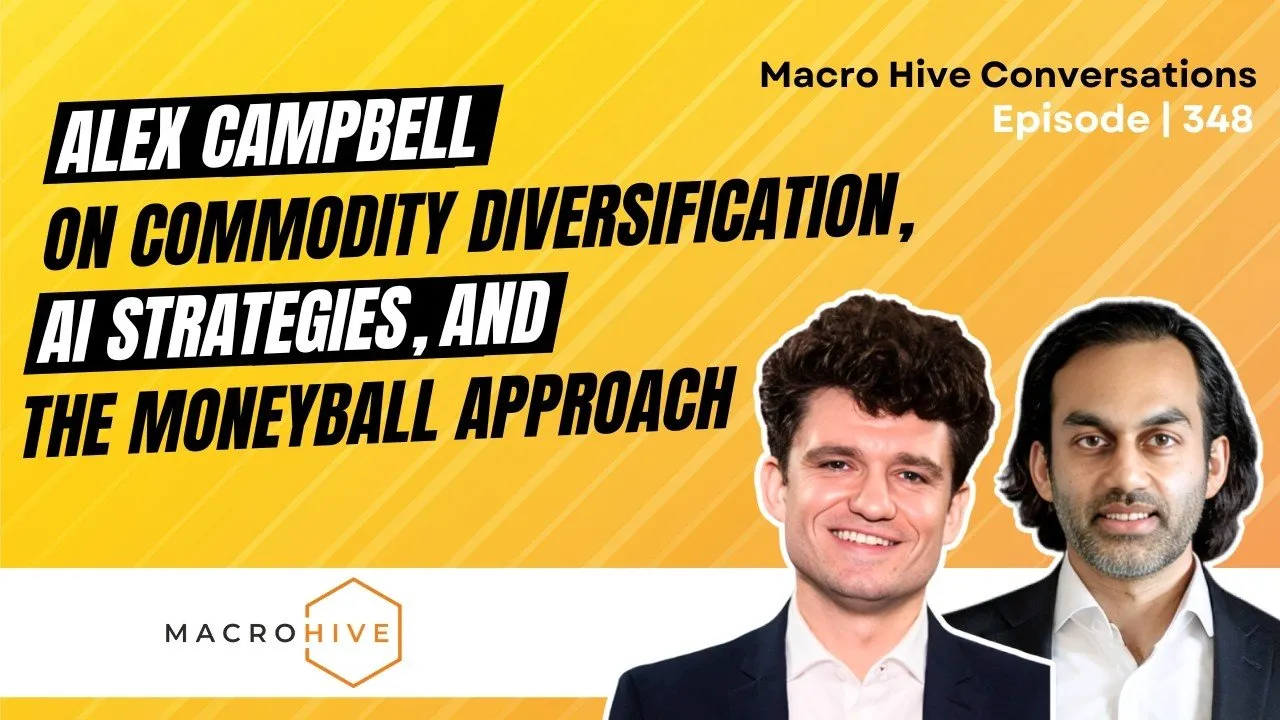
In the evolving landscape of global markets, the ability to synthesize vast datasets into actionable intelligence is the new frontier of asset management. Alex Campbell, a seasoned investor with a background at Bridgewater Associates and Lehman Brothers, joins this episode to discuss how the integration of artificial intelligence, a rigorous Moneyball-inspired analytical framework, and commodity diversification are reshaping modern portfolios.
Key Takeaways
- The Power of Diversification: True diversification goes beyond traditional assets; investors should seek lowly correlated—or even negatively correlated—streams to build resilience against market shocks.
- Commodities as a Strategic Tool: Commodities offer unique opportunities for supply-demand analysis that paper assets often lack, providing a necessary hedge against inflationary pressures.
- The AI Paradigm Shift: AI is revolutionizing how we handle data, but its true value lies in automating the "back-breaking" work of data infrastructure rather than just predicting price movements.
- Depth Over Surface: In an era of AI-generated content, competitive advantage belongs to those who possess deep domain expertise and the ability to think critically about system mechanics.
The Evolution of a Systematic Investor
Alex Campbell’s journey into finance was unconventional, stemming from an early interest in the analytical rigors of fantasy sports. This foundation in data-driven decision-making led him from game theory studies at Oxford to the high-pressure trading floors of Lehman Brothers during the 2007 financial crisis. His time at Bridgewater Associates further refined his approach, emphasizing the importance of institutionalizing a culture of radical transparency and meritocratic idea exchange.
The goal is to understand what you were like and what I am like, and empower people so that if you're not good at a certain thing, people don't keep asking you to do that thing.
Campbell emphasizes that this scientific approach to culture isn't just about corporate harmony; it is about efficiency. By accurately identifying an individual's strengths—whether they are creative, analytical, or reliable—firms can optimize their human capital, ensuring that the best ideas rise to the top regardless of office politics.
Commodities and the Quest for Uncorrelated Returns
For many institutional investors, commodities are an afterthought. Campbell argues that this is a mistake born from an over-reliance on US equities. To truly protect a portfolio, one must look toward assets that provide true diversification. This involves moving beyond passive index exposure and understanding the physical mechanics of supply and demand.
The Role of Gold and Silver
Gold and silver serve as more than just inflation hedges; they function as fundamental components of a global monetary reset. With central banks increasingly wary of dollar-denominated assets following geopolitical shifts, precious metals are reclaiming their role as a neutral reserve. Campbell suggests that silver, in particular, offers a dual appeal: its status as a precious metal combined with its critical role in the energy transition through solar panel manufacturing.
Data Infrastructure in the Age of AI
As the creator of Rose AI, Campbell is at the center of the push to modernize data accessibility. He posits that the current hurdle for most quants is not the lack of models, but the time-consuming process of cleaning and aligning disparate data sources.
The goal of Rose is to facilitate the AI transformation of investing... to build the APIs and the pipes that allow both quants and AI agents to quickly access and buy and warehouse data.
By automating the data stack, firms can reduce the friction between idea generation and execution. This allows researchers to spend less time formatting spreadsheets and more time stress-testing hypotheses against historical data, such as looking back at commodity volatility during the Great Depression to better understand modern market reactions.
Navigating the China Complexity
Investment in China presents a unique paradox. While the manufacturing sector showcases world-leading technological innovation, the banking system remains a complex web of government-guaranteed wealth management products (WMPs) and obscure local government financing vehicles (LGFVs). Campbell warns investors to remain skeptical of national statistics that often mask deeper systemic risks. Success in such an environment requires a "both-and" mentality—recognizing that China can be simultaneously an innovative powerhouse and a repository of significant structural credit risk.
Strategic Advice for the Next Generation
For aspiring financial professionals entering a market dominated by generative AI, the path forward requires a shift in focus. Simply knowing how to use tools is no longer enough; the bar for entry has risen. True value today comes from the ability to synthesize complex systems and demonstrate deep, nuanced understanding rather than relying on automated surface-level insights.
Ultimately, the future of investing belongs to those who view the market as a massive, interconnected machine. By mastering the fundamentals of data, maintaining an openness to diverse asset classes, and leveraging AI to handle the mechanical heavy lifting, investors can navigate the complexities of a changing world with confidence.