Table of Contents
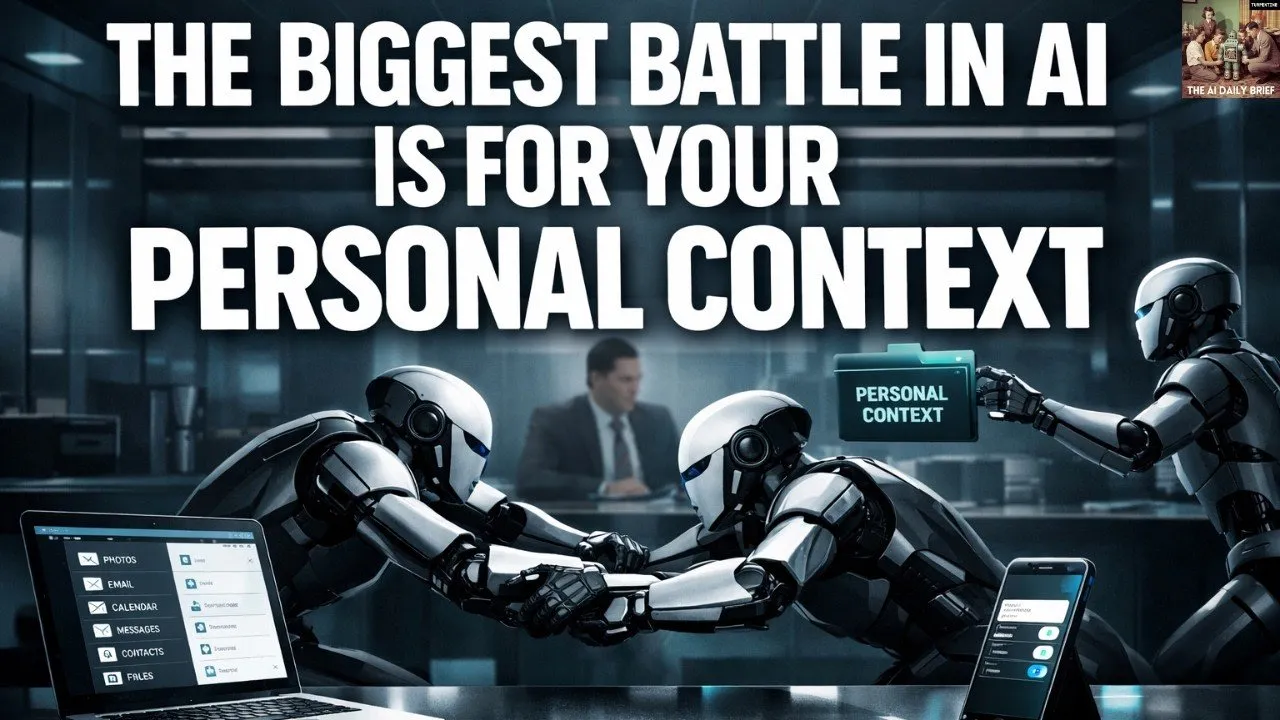
The artificial intelligence sector has entered a pivotal new phase of competition, moving beyond model reasoning capabilities to a race for "personal context." Following Google’s recent unveiling of "Personal Intelligence" for Gemini—an upgrade integrating the AI with proprietary data from Gmail, Google Photos, and Drive—major industry players are scrambling to secure deep access to user data. This shift signals a strategic pivot where utility is derived not just from general intelligence, but from an AI’s ability to recall and synthesize a user’s specific digital history, creating high switching costs for consumers and new moats for tech giants.
Key Points
- Google’s Strategic Pivot: The new "Personal Intelligence" update allows Gemini to reason across Google Workspace apps, utilizing a decade of user data to provide highly specific, personalized answers.
- The Context War: Competitors like Anthropic and OpenAI are aggressively launching features—such as Claude Co-Work and ChatGPT Health—designed to capture desktop and biological context, respectively.
- Switching Costs: As AI models gain "memory" and access to fragmented personal data, the friction of moving to a competitor increases significantly.
- Hardware’s Role: Apple and potential OpenAI hardware ventures aim to capture "physical world" context, a domain where software-first companies like Google currently have less traction.
Google Leverages its Ecosystem Advantage
In a move that industry analysts have long anticipated, Google has officially unlocked its massive repository of user data for its AI model, Gemini. Dubbed "Personal Intelligence," the feature enables the AI to retrieve and reason across distinct data silos within the Google ecosystem.
According to Google CEO Sundar Pichai, this update addresses one of the top requests from users: the ability to make the AI practically useful in day-to-day life.
"Answering a top request from our users, we're introducing personal intelligence in the Gemini app. You can now securely connect to Google apps for an even more helpful experience. Personal Intelligence combines two core strengths: Reasoning across complex sources and retrieving specific details, e.g., from an email or photo, to provide uniquely tailored answers."
The utility of this integration lies in complex retrieval tasks. Google provided examples such as asking Gemini to "recommend tires for my car." Rather than offering a generic list, the AI references Gmail to identify the user's specific vehicle make and model, checks Google Photos to see the terrain the user typically drives on, and retrieves license plate information to assist with the purchase. While the feature is "off by default" to address privacy concerns, the potential for hyper-personalized assistance places significant pressure on competitors who lack a similar ecosystem of historical data.
The Industry-Wide Battle for Context
While Google leverages its cloud applications, competitors are adopting different strategies to capture personal context. Anthropic recently launched Claude Co-Work, a desktop-focused application designed to integrate with a user’s local computing environment. Unlike web-based chatbots that require users to upload files manually, Claude Co-Work can "see" the desktop, interacting directly with the file system and local applications.
Simultaneously, OpenAI continues to focus on "memory" as its primary differentiator. The company’s recent shipping velocity—including the introduction of ChatGPT Health—suggests a strategy aimed at consolidating fragmented personal data. By allowing users to import medical notes, wearables data, and PDFs into a single interface, OpenAI is attempting to become the central repository for personal health context.
These moves underscore a broader industry realization: raw intelligence is becoming a commodity, while personal data access creates a defensible competitive advantage. If an AI understands a user's health history, coding style, or communication patterns, the user is less likely to switch to a rival platform that starts from a "blank slate."
Market Implications and the "Moat" of Memory
Market observers argue that Google’s decades-long collection of consumer data gives it an inherent advantage that is nearly impossible for startups to replicate. Akos Gupta, a prominent voice in the tech sector, noted that while every AI company is racing to build memory, Google effectively begins with a massive head start.
"Google connects to a decade of your Gmail threads, every photo you've ever taken, your complete YouTube watch history, and every search query you've made since 2005. The question for every other AI company: how do you compete on personalization when your competitor has the user's entire digital life and you're starting from a blank conversation?"
However, the value of this context depends heavily on the use case. For "power users" and enterprise professionals, the ability to analyze strategic decisions or write complex code often outweighs the convenience of retrieving a license plate number. For these users, the quality of reasoning and data analysis remains the primary driver of adoption, regardless of how well an AI knows their personal history.
The Hardware Frontier: Apple and Physical Context
The final frontier in this battle for context is the physical world. While Google dominates cloud data and Anthropic targets the desktop, Apple retains a unique advantage through its hardware ownership. Despite delays in rolling out its "Apple Intelligence" features, Apple holds distinct datasets that Google cannot easily access, specifically iMessage history and real-time physical context via wearables.
Devices like AirPods offer a potential entry point for "always-on" AI that understands physical interactions—conversations, location, and movement. This creates a different type of context that is arguably more valuable for lifestyle assistance than email archives. Reports suggesting that OpenAI, in collaboration with former Apple designer Jony Ive, is exploring hardware form factors indicate that the industry views physical context as the next major battleground.
As the "personal intelligence" race accelerates, the market will likely fragment based on the type of context users value most: Google for digital history, Anthropic for workflow, and potentially Apple or OpenAI for physical world interaction.