Table of Contents
Despite the ubiquitous buzz in boardrooms and the rush to establish AI strategies, true "AI-native" organizations remain a rarity outside of the hyperscalers and frontier labs. While executives form committees and approve proof-of-concept budgets, the actual integration of artificial intelligence into the daily fabric of enterprise workflows is often slower than the headlines suggest.
However, the path forward is becoming clearer. By moving beyond simple productivity hacks and treating AI as a fundamental layer for coordination, coding, and business intelligence, forward-thinking leaders are beginning to reshape what is possible within a corporate structure. The transition involves not just new tools, but a complete reimagining of the "analyst" role and the democratization of software creation through natural language.
Key Takeaways
- The "Dugout" Phase: Despite the hype, most enterprises are in the pre-game phase, setting up committees rather than deploying active agents in the field.
- Coordination over Creation: The immediate value of AI lies in the "communication layer"—automating the friction of meetings, notes, and action items to streamline team dynamics.
- BI is a Subset of AI: Data analysis is shifting from a syntax challenge (writing SQL) to a semantic challenge (asking the right questions), reducing weeks of work to minutes.
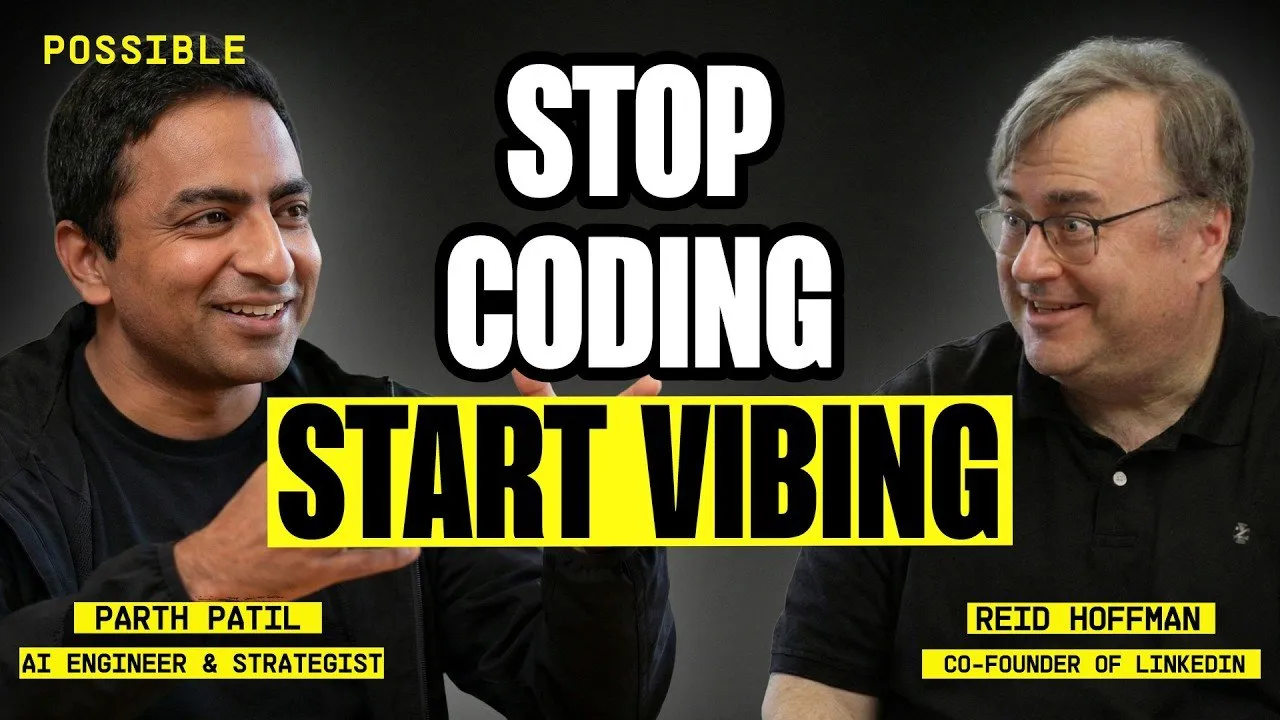
- The Rise of "Vibe Coding": Non-technical executives can now build custom internal software tools using natural language, effectively becoming system architects without writing code.
- Agentic Workflows: The future office involves managing "pods" of agents that work in parallel, turning static software into liquid, adaptable solutions.
The "First Inning" Reality of Enterprise AI
There is a distinct gap between the public narrative of AI adoption and the operational reality within large companies. While CEOs and boards push for AI strategies, the cumbersome nature of large enterprises—with their layers of approval and rigid structures—often stifles experimentation. The playbook for infusing AI into legacy systems remains opaque for many.
To use a baseball analogy, we aren't just in the first inning; the players haven't even taken the field yet.
"They're setting up a committee to study coming out of the dugout, but it's not, 'Get on the field.'"
This hesitation creates an opportunity for ambitious leaders. The barrier to entry isn't technical skill anymore; it is the willingness to experiment with workflows. The organizations that will win are those that move from "studying" the technology to integrating it into their actual workflow processes, rather than isolating innovation within a small, detached group.
Revolutionizing the Coordination Layer
For executives wondering where to start, the answer lies in language. Large language models (LLMs) inherently accelerate language-related tasks, and the largest set of these tasks in any company is the coordination layer: meetings, documentation, and project management.
By implementing AI in this layer, companies can reduce the friction of coordinating across large teams. This goes beyond simple transcription. An AI agent can ingest meeting audio, compare it against a list of active projects and collaborators, and autonomously suggest who needs to be notified, what action items were missed, and which stakeholders should be consulted.
Breaking the Meeting Culture
This capability fundamentally changes the necessity of the "big meeting." Historically, large groups attended meetings simply to stay informed. With intelligent agents capable of summarizing context and notifying relevant parties based on specific triggers (e.g., "If Reed's project is mentioned, notify Parth"), the need for real-time presence diminishes.
This allows the core working group to remain small and agile, while the "consulted and informed" layers are managed via agentic workflows. The result is a shift from manual note-taking and memory reliance to a system where the AI acts as a persistent, collective memory for the organization.
Business Intelligence as a Subset of General Intelligence
One of the most profound shifts occurring is the collapse of the barrier between business intelligence (BI) and general AI. Traditionally, analyzing a dataset required an analyst to write specific SQL queries, clean the data, and build visualizations—a process that could take weeks.
Today, coding agents allow us to bypass the syntax layer entirely. You can point an AI at a folder of raw CSV files—even messy, unstructured ones—and request a dashboard, a trend analysis, or a McKinsey-style presentation. The AI cleans the data, writes the Python code to analyze it, and renders the visualization in minutes.
"I really think that BI is a subset of AI. This is how I imagine the role has already evolved... point the AI at that data and have it make sense of it."
This does not eliminate the role of the analyst; it elevates it. The job is no longer defined by the ability to write code but by the ability to orchestrate the investigation. The constraint shifts from "how long will it take to run this query" to "how many different angles can we explore simultaneously?" We are moving from single-threaded human analysis to parallelized, multi-agent exploration.
The Era of "Vibe Coding" and Internal Tools
A significant psychological barrier for non-technical executives is the belief that building software is solely the domain of engineers. This is changing with the advent of "vibe coding"—the process of using natural language to instruct an AI to write and deploy code. This paradigm shift allows anyone with a clear vision to build software.
The best place to start is with internal tools. Building customer-facing products carries high risks regarding security and scalability. However, building a tool to automate a specific team workflow or analyze a personal dataset carries low risk and offers high feedback loops. Since the user is you (or your immediate team), the iteration speed is incredibly fast.
The New Executive Skill Set
If you are an ambitious executive, you no longer have the excuse of being "non-technical." You can describe the tool you need, and the AI can generate the code. Alternatively, executives can partner with a technical lead to set up the environment, allowing the executive to focus on the logic and the "vibe" of the application while the engineer handles the infrastructure.
This leads to a democratization of software creation where tools are disposable and abundant. If a custom piece of software saves a team five hours a week, it is worth building, even if it is never sold to a customer.
The Future Office: Liquid Software and Agent Pods
Looking forward, the corporate office will likely function as a hub for managing "pods" of agents. Just as we currently manage human teams, individuals will oversee multiple AI agents working in parallel on different time horizons.
- Ambient Intelligence: Agents will run in the background, listening to meetings and initiating workflows without explicit commands (e.g., "I see you agreed on a prototype; I’ve drafted three versions for you to review").
- Liquid Software: Applications will no longer be static. An agent might rebuild a dashboard or a knowledge graph in six different ways overnight, presenting you with options the next morning.
- Self-Amplification: Teams will build their own "Wikipedias"—interactive knowledge graphs that ingest all project history and code, allowing new team members (or agents) to query the collective intelligence of the firm instantly.
This shift makes software feel "liquid" and malleable. It allows for a "spellcasting" approach to work, where the right combination of words sets complex machinery in motion.
Conclusion
The integration of AI into the enterprise is not about automating jobs away; it is about "fanning out" human capability. It allows a single individual to attack a problem from ten different angles simultaneously or to build a tool that previously required a dedicated engineering team.
The learning curve has flattened. Whether through "vibe coding" or partnering with technical counterparts to deploy agents, the only wrong move is inaction. The technology is ready to leave the dugout; the question is whether leadership is ready to let it play.