Table of Contents
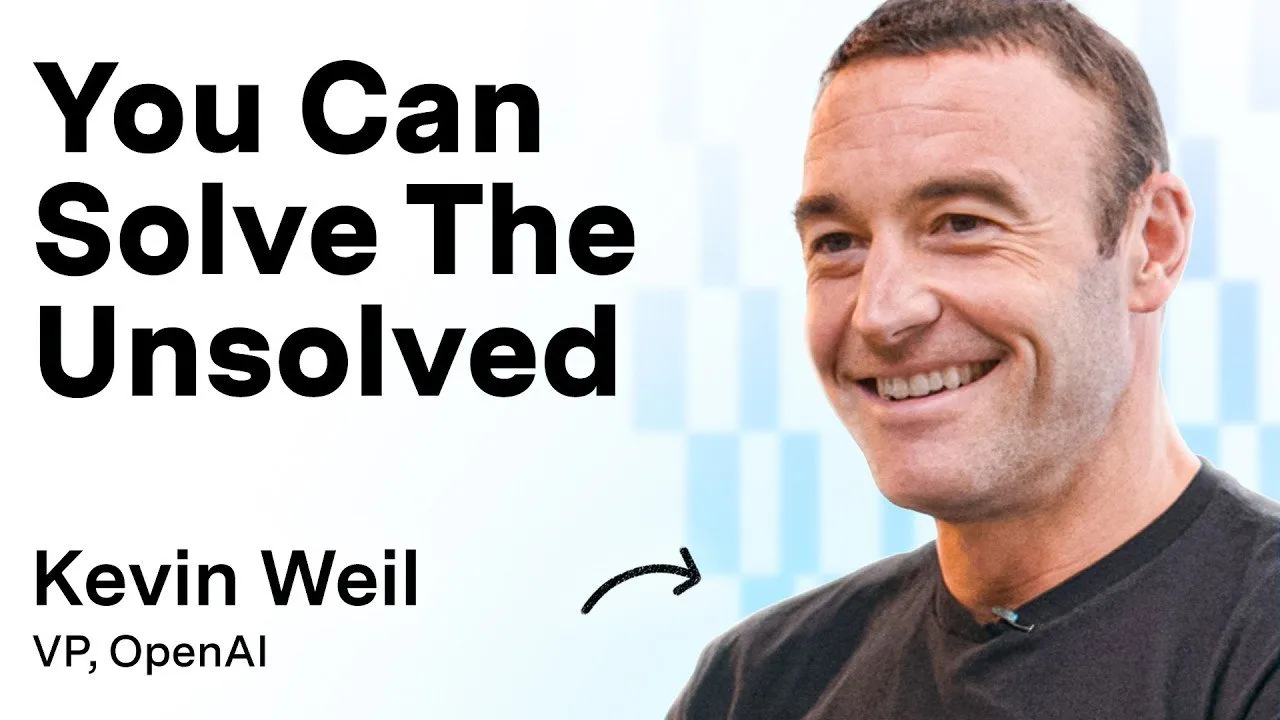
The pace of technological advancement has historically been measured in decades, but the advent of large-scale reasoning models is compressing that timeline into years. Kevin Weil, the Vice President of Science at OpenAI, suggests we are entering an era where artificial intelligence no longer simply summarizes existing human knowledge but actively expands it. By leveraging models that can solve previously unsolved mathematical problems and orchestrate complex scientific experiments, the goal is to realize the scientific breakthroughs typically expected by 2050 as early as 2030.
Key Takeaways
- Knowledge Expansion: AI models have moved beyond summarization and are now solving frontier mathematical problems that were previously unsolved by humans.
- The 2050 Goal: OpenAI is focused on accelerating the "science of 2050" to arrive by 2030 through long-horizon reasoning and specialized scientific tools.
- Robotic Labs: The future of discovery lies in closed-loop systems where AI models design, simulate, and execute experiments in horizontally scalable robotic laboratories.
- High Agency as a Core Skill: In an age where agents can execute code and solve bugs in parallel with human activity, "high agency" and curiosity become the most valuable traits for founders and researchers.
- Ensemble Strategies: Startups should move toward using ensembles of specialized models rather than relying on a single large prompt to handle complex workflows.
Crossing the Frontier of Human Knowledge
For years, critics of generative AI argued that these models were merely "stochastic parrots," capable only of rearranging and summarizing existing information. However, recent developments in reasoning models have challenged this narrative. In early 2024, several open mathematics problems were solved by frontier models, marking a shift from reflection to genuine discovery. While these problems might have eventually been solved by dedicated human mathematicians, the fact that a model arrived there first indicates that AI is now operating at the edge of human capability.
Weil notes that the transition from a model being "incapable" of a task to being "excellent" at it happens with startling speed. In the world of AI evaluation, a capability often jumps from a 5% success rate to an 80% success rate in as little as six to twelve months. We are currently in the midst of this "middle phase" for frontier science, where we see glimmers of superhuman capability that will soon become standardized tools for discovery.
The models can now solve problems that humans have never solved before. Going beyond the frontier of human knowledge.
Accelerating Science: From 2050 to 2030
OpenAI’s dedicated science group is tasked with a singular mission: accelerating the pace of discovery. While initial efforts focused on fields that could be explored entirely in silico—such as physics, math, and theoretical computer science—the implications extend to every tangible facet of human life. The ultimate goal is to apply AI to challenges like superconductivity, personalized medicine, and fusion power.
Long-Horizon Reasoning
A critical component of this acceleration is "long-horizon reasoning." Most current interactions with AI involve near-instantaneous responses. However, scientific breakthroughs often require deep, sustained thought. OpenAI is working on teaching models to stay on track for days, weeks, or even months at a time to solve high-level problems. Just as a human mathematician might solve in two days what they couldn't solve in twenty minutes, AI models gain significant power when granted the "compute time" to think through complex causal chains.
Closing the Simulation Gap
While simulation is becoming more powerful due to massive compute resources, experimental validation remains essential. Weil envisions a future where AI models operate in a continuous reinforcement learning loop with the real world. A model will run a simulation, refine an experiment, and then send instructions to a robotic lab. The results of that real-world test are then fed back into the model to inform the next round of simulations.
The Rise of Autonomous Research and Robotic Labs
The traditional model of scientific research is often bottlenecked by human labor—specifically the repetitive tasks performed by graduate students, such as pipetting or manual data entry. Robotic labs offer the ability to scale research horizontally, running experiments 24 hours a day without fatigue. This doesn't replace the human element but rather elevates it; researchers can focus on high-level strategy and creative hypothesis generation while the AI handles the execution and iterative testing.
This shift represents a fundamental change in the "craft" of science. Similar to how the Industrial Revolution transformed furniture making from a manual craft to a scalable industry, AI is transforming research from a series of manual steps into an automated, high-throughput pipeline. While "bespoke" human-led science will always have a place, the bulk of breakthroughs in materials science and drug discovery will likely emerge from these automated loops.
The science of the future will definitely involve robotic labs and reinforcement learning loops that go through the real world.
The High-Agency Workflow: Building in the Age of AI
For developers and founders, the availability of high-level coding agents like Codeex has changed the nature of productivity. Weil describes a workflow where "multitasking" is no longer a distraction but a necessity. By running agents in the background to fix bugs or implement features while the human lead focuses on strategy or meetings, the output of a single individual is multiplied.
Valuing Agency Over Expertise
As AI lowers the barrier to technical execution, the premium on specific technical skills may decrease, while the value of "high agency" increases. People who are curious, learn quickly, and have the initiative to deploy agents to solve their problems will outperform those who rely on traditional credentials. The ability to "marry" an interesting idea with the technical power of AI means that there is no longer an excuse for not building a prototype or exploring a new concept.
The Ensemble Approach to Product Development
A common mistake for startups is trying to force a single, massive prompt to solve a complex business problem. Internally, leaders at OpenAI advocate for an "ensemble" approach. This involves using an orchestration model to understand a user's intent and then delegating tasks to various smaller, specialized models. Some models might be cheaper and faster for simple tasks, while others are high-reasoning "experts" reserved for the most difficult steps. This modularity increases reliability and decreases costs.
Design and Ethics: The UX of Reasoning
The introduction of reasoning models like O1 has created new challenges in user experience (UX). Unlike previous models that babble an answer immediately, reasoning models require "thinking time." This creates a tension: how do you keep a user engaged while a model is performing a complex chain of thought?
Transparency and Model Distillation
OpenAI’s approach to the O1 reasoning model involves providing "cliff notes" or periodic updates on what the model is thinking without exposing the entire raw chain of thought. This decision is partly to prevent "model distillation"—where competitors might use the raw reasoning steps to train their own models—but also to mimic human social interaction. When humans think, they don't verbalize every internal monologue; they provide summaries of their progress. This balance between transparency and security is a central theme in the next generation of AI product design.
Data vs. Taste
While data is essential for scaling, Weil argues that "taste" and intuition remain vital. Blindly following data can lead to local optima or "confused" metrics where novelty is mistaken for utility. Product leaders must interpret why numbers change. If users are clicking a button because they are confused by the UI, the data might look "good" (high engagement), but the product is failing. Successful AI products require a blend of data-driven insights and a human-centric vision of the user experience.
The Fertile Ground for Startups
The current landscape is described by Weil as the "most fertile ground for startups" in history. Because AI is developing emergent capabilities that even the creators don't always predict, new opportunities for "economically valuable work" appear every month. While B2B applications currently lead the way due to their clear ROI and the high cost of running frontier models, the potential for consumer-facing "personal agents" is rapidly approaching.
As infrastructure catches up to mitigate security risks, we will likely see a move toward fully personalized agents that have access to a user's entire digital life. The transition from "tools" to "agents" will mark the final stage of the current AI revolution, turning the software we use into active partners in both our professional and creative lives.